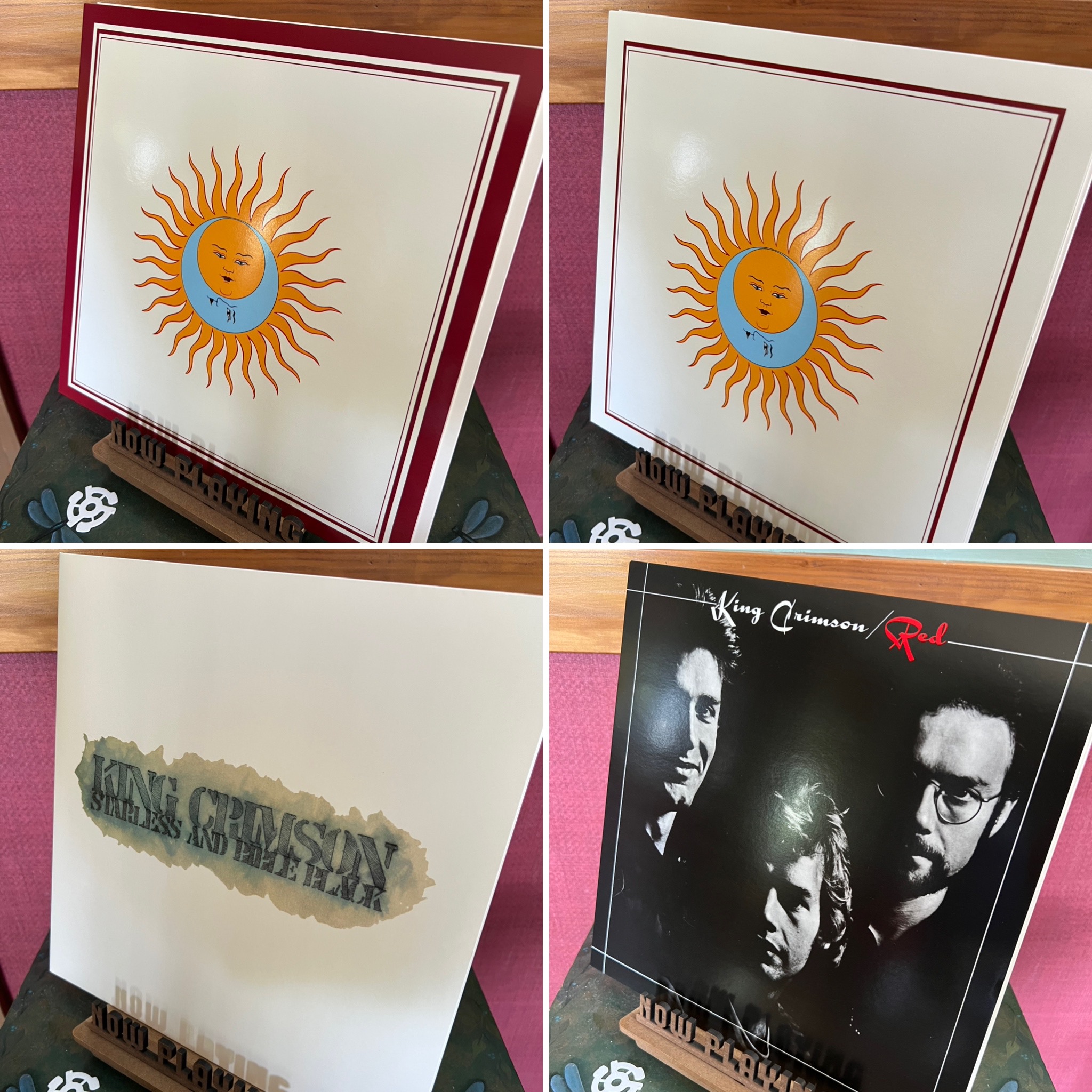
After making five albums with Yes,
Bill Bruford, drummer extraordinaire,
migrates in 1972 to King Crimson,
John Wetton joins on bass guitar
and vocals, and a new lyricist shows
up, one Richard Palmer-James, the
guy who would eventually co-found
the supergroup Supertramp.
On their first outing together, the strangely
titled Larks’ Tongues in Aspic,
it appears that Robert Fripp has found
his signature guitar thing, a thing
that is not easy to spot in the first
four studio albums, a thing that will
characterize in large part his unique
guitar gift moving forward into the
next decades. How to describe it?
On full display in Part One of the
title track, his parts are intricate,
precisely patterned, oddly shaped,
angular, lots of notes really fast
in a repetitive loop; you know it
if you’ve never heard King Crimson
but have been paying attention
recently to these costumed maniacs
from Quebec, Angine de Poitrine.
That’s kind of what Fripp’s
guitar playing sounds like, most of
the time–but not always. In the
ballad “Book of Saturday,” his playing
is the backdrop necessary for
Wetton’s singing. A nevertheless
densely structured set of chord
changes, it sounds almost like
conventional guitar playing, with
that signature seagull singing lead
sound that he often chooses for
solos and embellishments. I’m not
a guitar player, so that’s the best
I can do. Fripp’s guitar playing is
pretty crazy, but if there is a vocalist
on the tune, he knows what to do
to support the singing, which is
characteristically intricate,
but rarely crazy, at least here in 1973.
Although their voices are similar,
I prefer Greg Lake’s singing to John
Wetton’s, but Wetton is all right, knows
what he’s doing, can sing over the
top of Fripp’s nutty compositions
in a strong, tuneful way, but was
likely chosen for his bass playing,
which has to be good to keep up
with Fripp’s sophisticated compositions.
And these lyrics, still a bit on the goofy
side, but a little more down to earth,
not nearly as frilly or fantasy soaked,
and sometimes funny, like the refrain
in the opening track on Starless and
Bible Black, “Cigarettes, ice cream,
Cadillacs blue jeans,” and “Cigarettes,
ice cream, figures of the Virgin Mary.”
On both Larks’ Tongues in Aspic and
Starless and Bible Black, more than fifty
percent of the tunes are instrumental,
so if Wetton’s voice doesn’t float the
boat and Palmer-James’ lyrics still
seem dated and over-flowery, like
they do in “The Night Watch,” there’s
much to sink our teeth into on these
albums. Red finds them in a heaviness
that is new, but this first track, the
title track, I swear, is a riff that appears
on the Thrak album, more than twenty years
later, unless, between that and this and
all the live footage I’ve listened to or
seen over the years, some of these riffs
are getting mixed up in my brain. It’s
gonna bug me, I know it will, until I get
the Thrak CD back out to test the
theory. In “One More Red Nightmare,” it
happens again, and I suspect that in 1995
they were freely borrowing from themselves,
rearranging the parts, adding new parts,
adding words, taking away words, in order
to make a new thing that paid tribute to
the old thing, to Red in particular, which
is a fan favorite, I think, or a critics favorite,
or both. John Wetton takes a turn with the
lyrics on this one, but without a lyric sheet
inside this jacket (a first for the band), I can’t
really assess whether or not there’s an
improvement. One thing is for sure: Bill
Bruford is absolutely cooking on the drums
for this album. Even in the mad
improvisation of “Providence,” he’s on fire.
Another thing is for sure: as I inch my way
toward the 80’s albums I’m most familiar
with and love, I like each subsequent album
better than the last, except for maybe the debut,
which after seven albums, still stands
out for me in greatness. Red, though, of
all these 70’s records, is my favorite.
Notes on the vinyl edition: Larks’ Tongues in Aspic, Larks’ Tongues in Aspic (alternative mixes), Starless and Bible Black, Red, and USA (live), Digital Global Mobile Records, 2018 reissue and remix of the 1972, 73, and 74 albums, in a five album (six discs) box set, King Crimson, 1972 to 1974, black vinyl, 200 gram pressing.
In case you don’t already know: I’m listening to almost everything in my vinyl collection, A to Z, and writing at least one, sometimes two or three long skinny poem-like-things in response for each artist, and on a few occasions, writing a long skinny poem-like-thing in response to more than one artist. As a poet and a student of poetry, I understand that these things look like poems, but they don’t really sound much like poetry, hence, I call them “poem-like-things.” I’ll admit that they’re just long, skinny essays that veer every now and then into the poetic or lyric.

