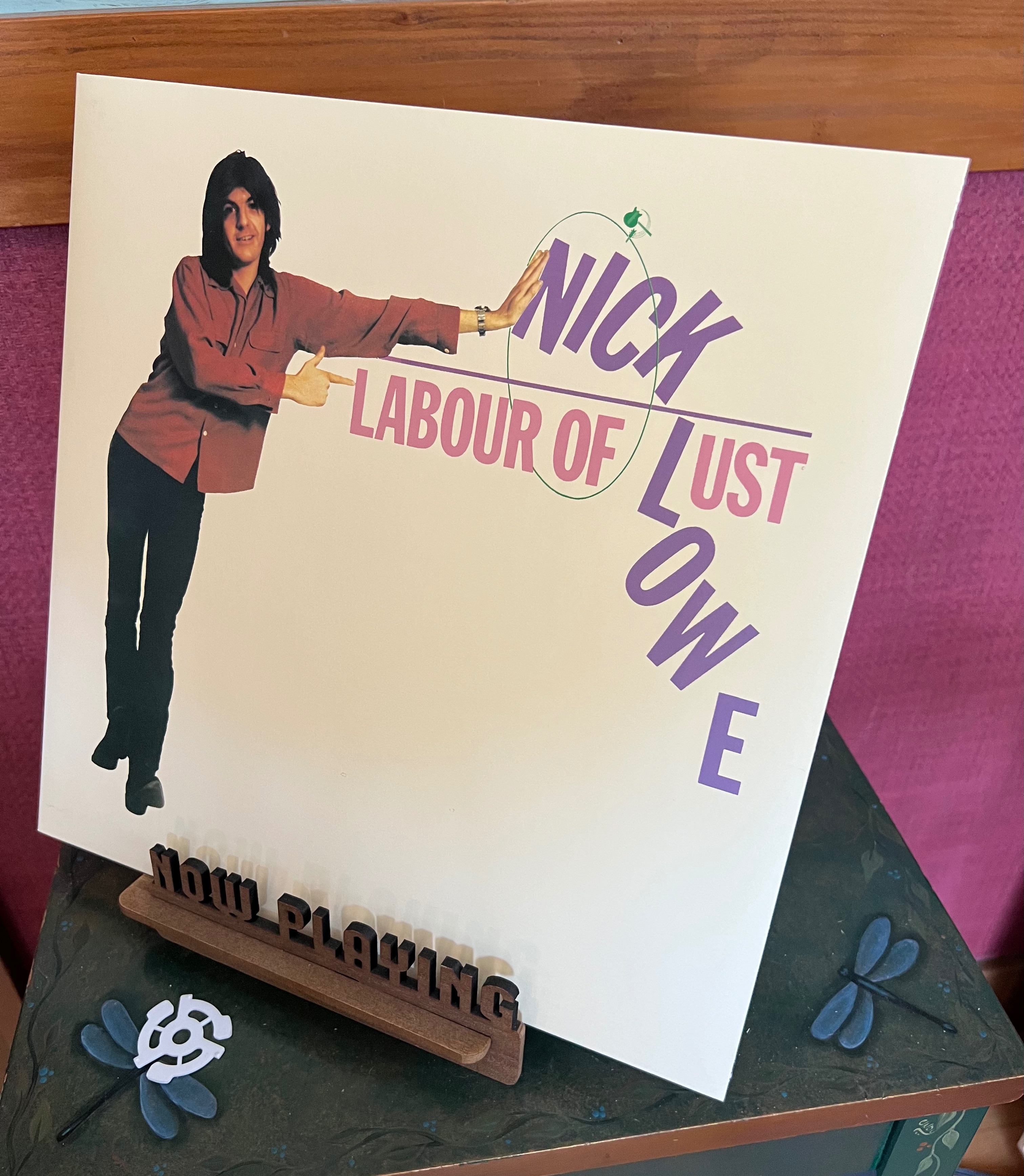
“Cruel To Be Kind” is likely the
greatest pop song of the new
wave era that I, inexplicably, never
acquired. Outside of seeing the video
for that very first hit of his on MTV
more times than it is possible to count,
I never bought a Nick Lowe album.
I knew who he was. I knew he was
a producer and collaborator with
Elvis Costello. I knew he wrote
“(What’s So Funny) About Peace, Love
and Understanding.” Maybe I knew
that he was a member of the short-
lived Rockpile band. And I had seen
the covers of his first two albums on
display at my favorite record stores.
How I escaped him, I don’t know.
He finally caught me, I guess, as
here I am now with this 2011
reissue of the classic Labour of Lust,
from 1979, not my first Nick Lowe
acquisition, but my first and only
on vinyl. It’s a spectacular record.
And it sounds like an Elvis Costello
album, as it should, because Nick was
at the helm for some of those early
Elvis classics, this record, contemporary
with This Year’s Model and Armed Forces.
But there are distinct differences.
Barely any keyboards, for one.
It’s a more classically rock and roll
pop sound, with nods to country and
folk and blues, as if new wave and its
instrumental expansion and punk-adjacent
attitude was not really of interest
to him where his own songs were concerned.
He produced that stuff, but he didn’t want
to make it. I’m glad I have this album now.
It’s punchy and energetic, the lyrics are
clever and mostly fun, and he has a terrific
English voice somewhere between Glen
Tilbrook and Robyn Hitchcock, hummable
melodies coming out of his ears and into ours.
Notes on the vinyl edition: Labour of Lust, Yep Rock Records, 2011 (reissue of the 1979 recording), black vinyl
In case you don’t already know: I’m listening to almost everything in my vinyl collection, A to Z, and writing at least one, sometimes two or three long skinny poem-like-things in response for each artist, and on a few occasions, writing a long skinny poem-like-thing in response to more than one artist. As a poet and a student of poetry, I understand that these things look like poems, but they don’t really sound much like poetry, hence, I call them “poem-like-things.” I’ll admit that they’re just long, skinny essays that veer every now and then into the poetic or lyric.
 michael jarmer