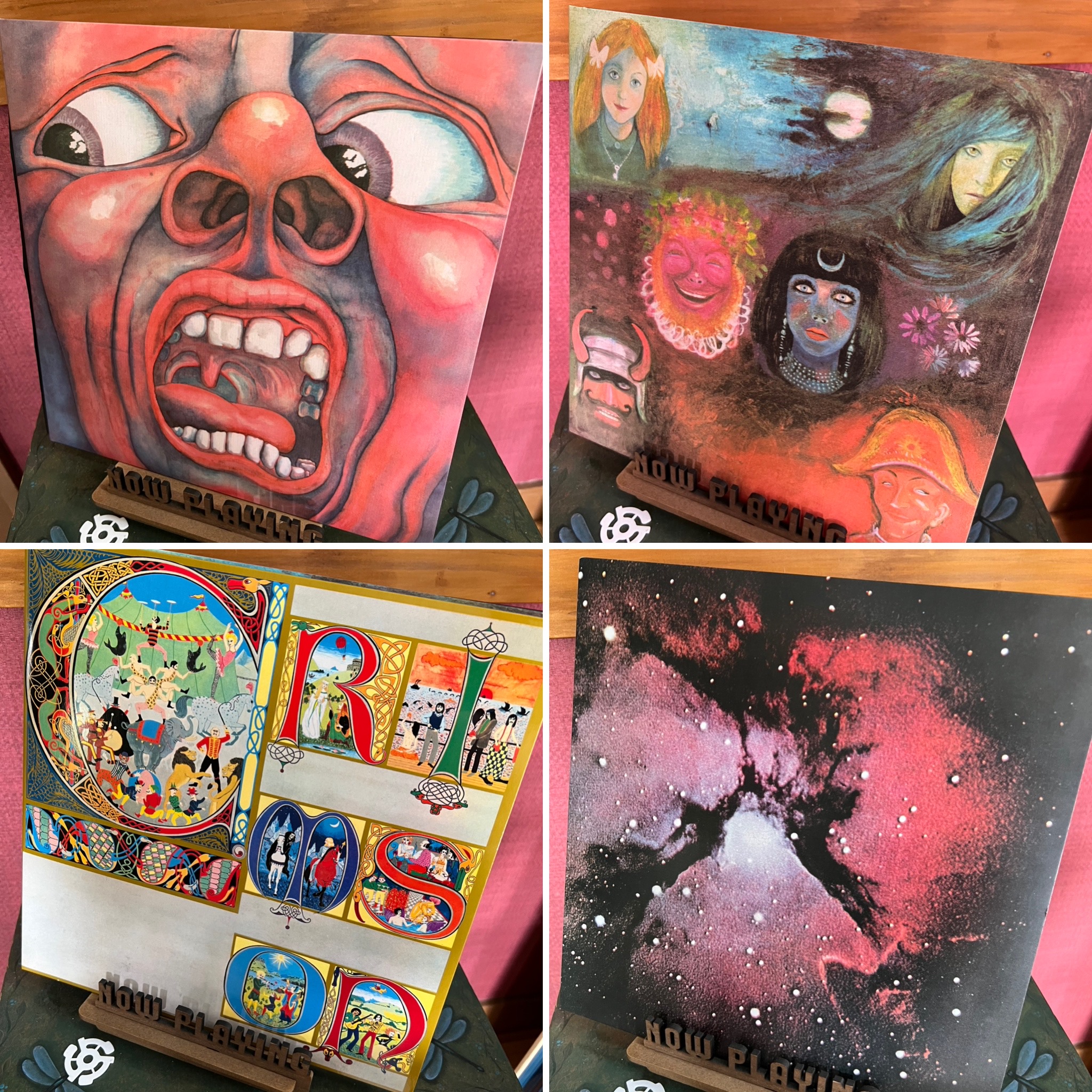
There are certain records
I have bought, entire collections
sometimes, in boxes no less,
costing hundreds of dollars,
of music that I have never
heard, but nevertheless feel
compelled, not only to hear,
but to hold, to own, to possess.
The literary equivalent: I’ve
never read Moby Dick, say, but
believe I should have, and
vow to do so someday, and, to
formalize this vow, I will
buy a copy right now, and
maybe, to complete the deal,
I will purchase several volumes,
the complete works of Herman
Melville. Maybe I will read
Moby Dick, maybe I won’t, but
I feel, obsessively even, that it
should be on the book shelf.
The back catalog
of King Crimson was like this
for me, as was the back
catalog of David Bowie.
I’m not sure what to make
of this. Ridiculous, really, but
somehow, deeply satisfying.
But unlike the Melville, I
have “read” the complete
David Bowie; I have “read’
the complete King Crimson.
Listening this morning to
In the Wake of Poseidon, Lizard,
and Islands in “quick” succession,
I wonder at, despite the unfamiliarity
of the music (I’ve maybe only
listened to these albums a couple
of times since I purchased them
years ago), how much I enjoy
them. They’re edifying, entertaining,
never dull, sometimes pretentious,
sometimes funny (“Cat Food,”
anyone?), experimental, wacky,
but nevertheless, listenable,
while still chock-full of
virtuosic demonstrations
that don’t seem like musicians
showing off, but musicians trying
to make art together. Every once
in a while, like during “The Devil’s
Triangle,” I hear the King Crimson
that I met and loved from
the 80’s and 90’s, straddling the
very edge between musicality
and experimental tediousness,
improvisational noise followed
by the sweet crooning of Greg Lake.
If the documentary about King
Crimson, named after their debut album,
is any indication, Robert Fripp was
no picnic to work with. By the time
the third album comes around,
Greg Lake has left the band, the
drummer has left the band. By the
time the fourth album comes around
Gordon Haskell has left the band, and
over the next few years, there will
be a bit of a revolving door of
musicians, all ultimately at the
service of the genius direction of
Robert Fripp. Despite the various
configurations, there is nevertheless
a consistency between these
first four albums, but also a steady
progression toward more weirdness,
however, Islands pulls back considerably
on the strange and moves oddly
toward something almost classical,
orchestral, maybe the first chamber pop
album in the history of the world.
One consistency, a detail of which, that
until now with some closer looks at the liner
notes, I was completely unaware, is that on
the first four King Crimson albums there
was a member of the band whose sole
responsibility it was to write the lyrics,
although he is credited with other things:
pictures, illuminations, sounds and visions.
His name was Peter Sinfield, a guy whose
name had until today never crossed my
lips. But then, a vague memory kicks in of
the first time I watched that 50th anniversary
documentary of a guy being interviewed
about a split between himself and Fripp,
an interview that was pretty charged
with what clearly was a significant loss
for this guy, and I remember thinking,
who is this man? Now, I think I know.
I’m inspired now to do two things: rewatch
that documentary (I bought the dvd!),
and to look more closely at this guy’s lyrics.
Peter Sinfield died in 2024, but in the early
70’s, he penned lyrics for the the King Crimson
albums like this one, the song “Letters”
from the album Islands:
With quill and silver knife
She carved a poison pen
Wrote to her lover’s wife
“Your husband’s seed has fed my flesh.”As if a leper’s face
That tainted letter graced
The wife with choke-stone throat
Ran to the day with tear blind eyes.Impaled on nails of ice
And raked with emerald fire
The wife with soul like snow
With steady hand begins to write.“I’m still, I need no life
To serve on boys and men
What’s mine was yours is dead
I take my leave of mortal flesh.”
This is not necessarily my idea
of a “good” song lyric, nor does it
strike me as particularly good poetry,
but there is something so absolutely
prog rock about it, and, as I discovered
plunking around on the internet,
King Crimson is considered by
many to be the first progressive rock
band, and much of that is due to
the way Peter Sinfield carved out
a kind of poetry that stylistically and
topically would become the stuff
and substance of progressive rock
for decades to come: mythological
and fantastical subject matter, bucolic
or medieval settings, a kind of
rock and roll romanticism hearkening
back to 19th century English literature.
As I grew up a bit, became an adult,
it was this very thing that I grew
kind of sour on, preferring to read
Wordsworth and Coleridge rather
than hear my rock musicians sing
about mountains and elves and
mystical beings in the forest.
It’s still not a thing that I love,
but I feel more charitable toward
this development than I used to,
just out of an appreciation for the
attempt to make pop music more
weighty, substantive, intellectual.
As I move through my King Crimson
collection, I am interested to find out
how quickly they abandoned this romantic
tendency. I know that the split between
Fripp and Sinfield occurred between
Islands and their next album. Who will
be their next lyricist? We’ll have to open
up the next box to find out: 1972 to 1974.
Notes on the vinyl edition: In the Court of the Crimson King, In the Wake of Poseidon, Lizard, Islands, and Alternative Guide to King Crimson (alternative versions, 69-72), Digital Global Mobile Records, 2018 reissue and remix of the 1970 and 71 albums, in a five album (six discs) box set, King Crimson, 1969 to 1972, black vinyl, 200 gram pressing.
In case you don’t already know: I’m listening to almost everything in my vinyl collection, A to Z, and writing at least one, sometimes two or three long skinny poem-like-things in response for each artist, and on a few occasions, writing a long skinny poem-like-thing in response to more than one artist. As a poet and a student of poetry, I understand that these things look like poems, but they don’t really sound much like poetry, hence, I call them “poem-like-things.” I’ll admit that they’re just long, skinny essays that veer every now and then into the poetic or lyric.

