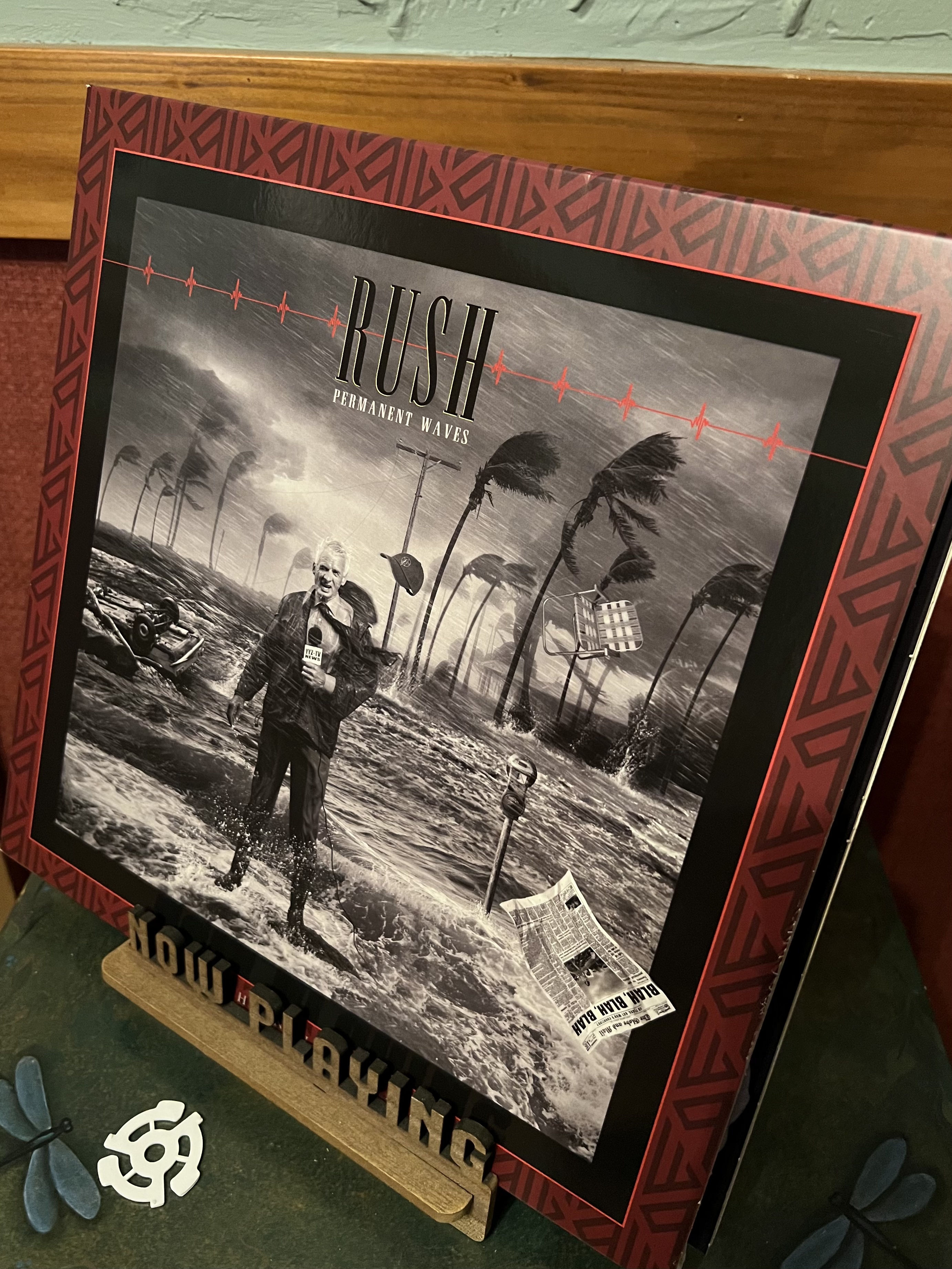
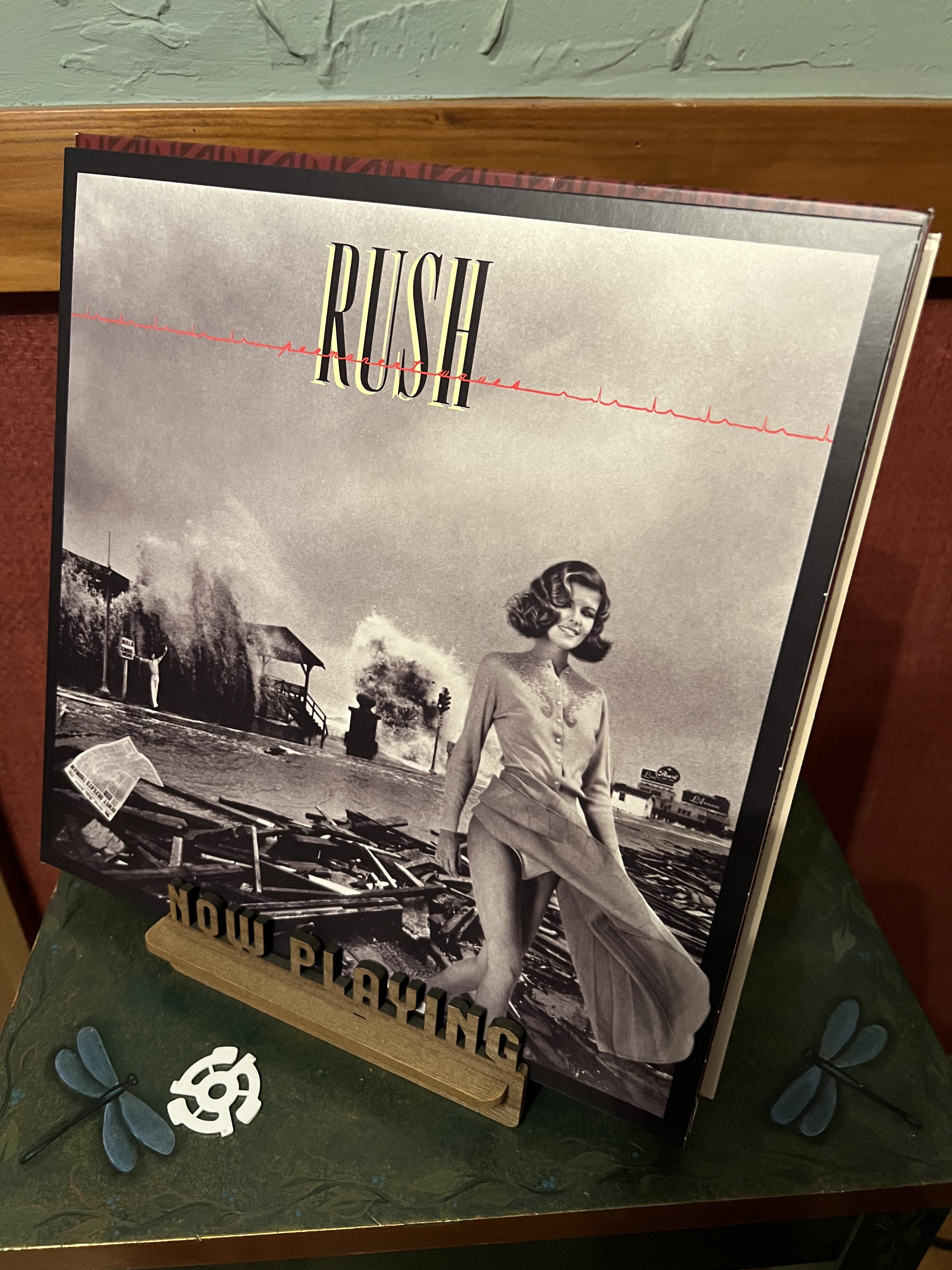
It might be said that Permanent Waves
was the band’s first hit record. “Spirit
of the Radio” and “Free Will” were both
bonafide hit singles, not simply album
tracks that got airplay on
album-oriented-radio. At least that’s
how I remember it. They both are, after
all, quintessentially perfect blends between
the elements of prog rock and pure
unadulterated pop music, the catchiest,
most memorable Rush tunes ever, I’d wager,
at least up to 1980, even borrowing in
“Spirit” in particular the reggae vibe
made suddenly totally hip by The Police.
Something else is happening,
too, on this record: Geddy Lee’s singing
has come down in register a couple of
solid notches, which made, for people
who found the singing on previous records
shrill or grating, a much more accessible
group of songs, pop melodicism notwithstanding.
I loved this record, but this was a pivotal
moment for 16 year old me; my tastes were
shifting, I was becoming deeply interested
in all things punk and new wave, and for
me, the weirder it was, the better, and
Rush had perhaps in my point of view
become a kind of beloved institution and
ceased to be weird enough for me in any
imaginable way. And yet, there was no
denying their greatness on this fantastic
album, six big songs, none of which were
skippable. It may have been, though, the
last Rush album I bought when it came out.
I have been pretty much ignoring the
exhaustive live recordings on these 40th
anniversary editions, but in this case,
on this tour, I am especially drawn to
side 5 of this three-album box set, where
we find “Cygnus X-1, Book One” and “Book
Two” from Hemispheres back to back. It’s
a pretty inspiring performance, in London,
where the opening bass riff gets a kind
of call and response effect with the
audience, and some pretty idiosyncratic
interpretation from the band, including
a theremin of all things. It’s great to
hear the playfulness of that. The liner
notes say that both Book One and Book
Two are from the same performance, but
disappointingly, they are separated from
each other on the LP by a fade–so Rush
obviously didn’t segue the two tunes
together, must have separated them in
the set list–or the fade, perhaps, just
gets rid of some wasted stage time
elapsing between the two pieces. It’s
hard to say, definitively; all I know
is that I don’t like it. I would have
liked to have seen how they’d pull that
off, how they would play the two pieces
as a contiguous piece of music. Oh, well.
One can’t have everything.
Notes on the vinyl edition: Permanent Waves, Mercury Records, 2020, three album box set on black vinyl. Includes remastered original 1980 album and a live recordings from the Permanent Waves tour.
In case you don’t already know: I’m listening to almost everything in my vinyl collection, A to Z, and writing at least one, sometimes two or three long skinny poem-like-things in response for each artist, and on a few occasions, writing a long skinny poem-like-thing in response to more than one artist. As a poet and a student of poetry, I understand that these things look like poems, but they don’t really sound much like poetry, hence, I call them “poem-like-things.” I’ll admit that they’re just long, skinny essays that veer every now and then into the poetic or lyric.

