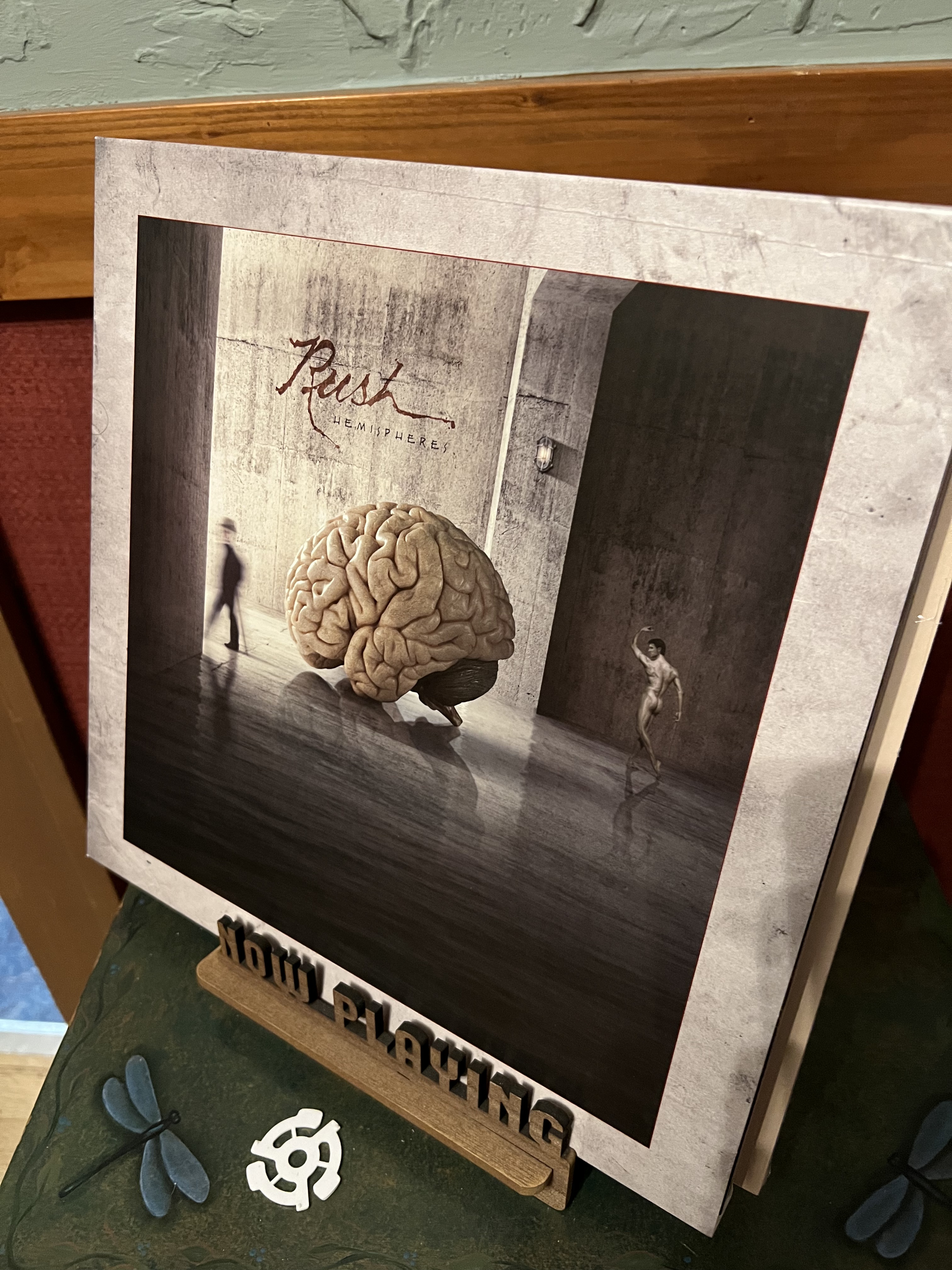
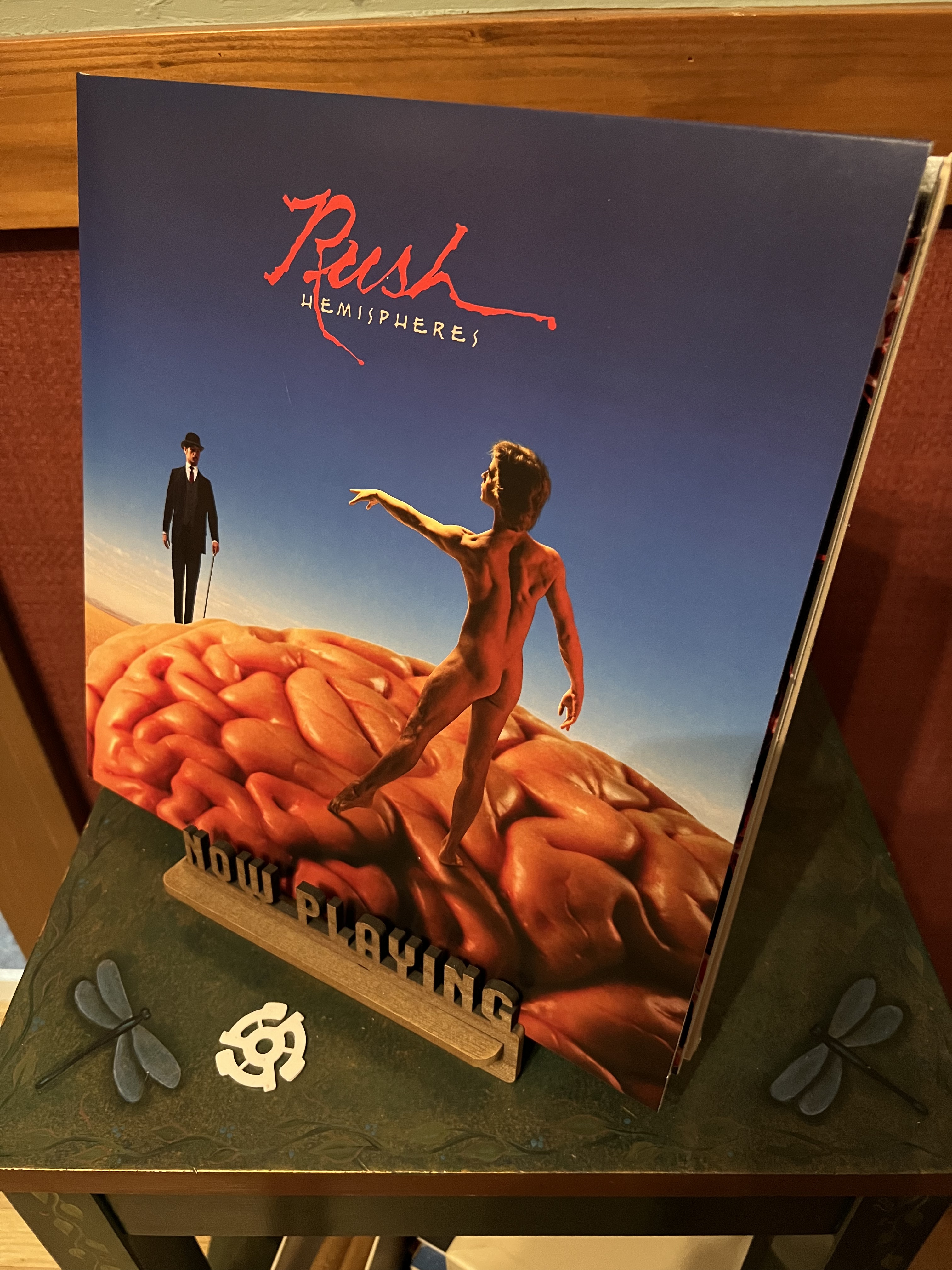
There are four tracks on this album,
the first of which, the entire first side of
the record, is the “Cygnus X-1 Book II,
Hemispheres” suite, clocking in at just a
smidge over 18 minutes. For my youthful
listening ears, in 1978, this was a first
for me, a revolutionary thing, a revelatory
thing, that a rock band could play an
18 minute song, one for which every movement
is intriguing to listen to and integral
to the whole.
I knew that, conceptually,
this musical suite was the sequel to the
closing track on the previous album, the
one about the astronaut getting sucked
into a black hole, but I don’t think I had
any clue, as maybe I still don’t, about
how the two came together to make a
contiguous whole, no pun intended.
Geddy is singing (Neil’s lyrics) about
some ancient human society, likely ancient
Greece, singing about a culture of men
interacting with the gods and goddesses,
moving forward, evolving, but not
without a significant degree of hubris
and greed that breeds conflict and war
and disaster over the millennia, resulting
in the “world being torn asunder into
hollow hemispheres.” As I listen, about
three quarters of the way through this
opus, I gather that the astronauts are
escapees from this society, obviously,
thousands of years from the one
described by the lyrics at the start,
and of course, things do not go well for
the escapees, you know, the black hole
and all. But ultimately, in some kind of
redemptive denouement, it seems the gods
all come together around our hero on
the other side of his ordeal, ordain
him “Cygnus, the god of balance.”
Somehow, heart and mind, in the end,
are united in a “single, perfect sphere.”
From a literary perspective, this all
seems pretty easy to me, and it’s not
clear why Reason is restored in the end,
what the black hole had to do with it,
and why the gods and goddesses have to
be involved in any of it. Deus Ex Machina much?
I forgive you, Neil. It’s still a great
fucking piece of music.
In 1978, as a 14 year old
boy, I only vaguely understood this
narrative arc, was ignorant about the
mythology references, could not have spelled
out the connection between book one and
book two of “Cygnus X-1,” except for the
musical motifs from the first piece
echoed brilliantly in the second. At
that point in my development, I don’t
think I cared very much about the story,
was more interested in the pyrotechnics
of the musical performances. At an earlier
age, however, I remember being so inspired
by a Rush tune from Caress of Steel
called “The Necromancer,” that I wrote
an entire ream of bad beginner’s fiction
inspired by that thing. More evidence of
Neil Peart’s influence on my young,
impressionable brain, my hemispheres.
I think I may have him to thank,
not only for me becoming interested
in literature, but for, at least in
some degree, turning me into a writer.
Side Two of Hemispheres includes three
undeniable Rush classics in a row.
“Circumstances,” “Trees,” and especially
“La Villa Strangiato,” all brilliant,
inspiring, virtuosic, memorable tunes
that became “hits” in the way I think
that few progressive rock songs have
ever become hits in the entire history
of rock and roll. I can think off the
top of my head of only two other
contenders: Yes and Kansas. But I am
unable to say who did it best. Are
“Roundabout” and “Carry On My Wayward
Son” better songs than these?
I am doubtful. My verdict is that
Hemispheres is a brilliant album.
Notes on the vinyl edition: Hemispheres, Mercury Records, 2018, three album box set on black vinyl. Includes remastered original 1978 album and a live recordings from 1978 and 1979.
In case you don’t already know: I’m listening to almost everything in my vinyl collection, A to Z, and writing at least one, sometimes two or three long skinny poem-like-things in response for each artist, and on a few occasions, writing a long skinny poem-like-thing in response to more than one artist. As a poet and a student of poetry, I understand that these things look like poems, but they don’t really sound much like poetry, hence, I call them “poem-like-things.” I’ll admit that they’re just long, skinny essays that veer every now and then into the poetic or lyric.

