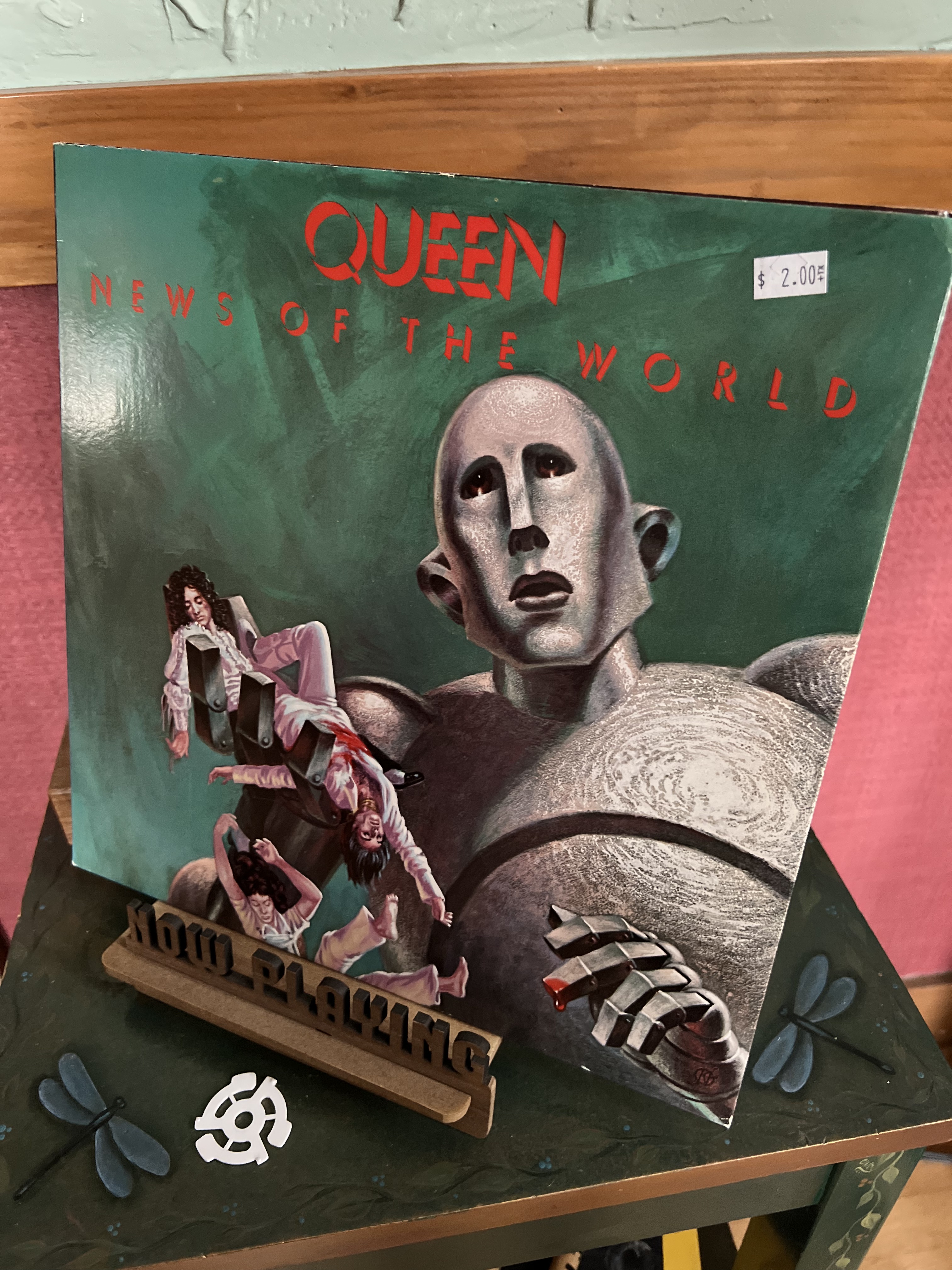
I was nine years old when Queen released
their first single in 1973. “Keep
Yourself Alive” must have reached my
ears through AM pop radio, and while
I don’t remember the first time I heard
it, I can’t imagine that I was not
enthralled by its exuberance. And two years
later, in grade school, I had a music
teacher so impressed by “Bohemian Rhapsody”
that he played it for impressionable
eleven year old Michael Jarmer and the rest
of his classmates during music class.
I may not at that time have been able
to connect the two songs to the same
band, and I think that was a theme all
the way into and through my pre-teenage
years. I would hear them on the radio,
like what I heard, maybe even love it,
but wouldn’t have been able to name
the band. News of the World, in 1977,
was the first record of Queen’s that
I heard from start to finish. I never
owned a copy, but I remember that for
a long time it was an album constantly
spinning whenever I visited the houses
of my teenage buddies, and we’d listen
to it together every chance we got.
I was well into adulthood, maybe even
in my thirties, when I became a completist
all in one fell swoop, when I bought
the Crown Jewels CD box set that included
the entire catalog on Elektra Records up
to 1980’s The Game. News of the World
stands out to me from that entire 17 year
era as the band’s best album, and somehow,
I came across this nearly perfect specimen
of a copy on vinyl for a whopping two dollars.
By now, twenty million listens later, I am
pretty much sick to death of “We Will Rock You,”
so much so that it becomes almost impossible to
remember how radical that thing was when it
opened that album in 1977. The boom boom
chuck drums, a spoken word rap thing,
that epic chorus chant, and that unreal guitar
solo, it must have blown our little
minds, and then, that beautiful and
tight edit into the “I’ve paid my dues” first
line of “We Are The Champions,” which, conversely,
is a tune that never ceases to be great, never
gets old. “Sheer Heart Attack” is a pure punk
rock song, trashy, noisy, sloppy, insanely
lo-fi. And it’s followed by the exquisite piano
intro to the vaudevillian “All Dead, All Dead,”
deftly demonstrating one of the amazing things
about Queen: how quickly and radically they could
shift gears. From punk rock to Beatles pop–tell
me Freddie does not sound like Paul McCartney
in that tune. Another anthem follows:
“Spread Your Wings” for a little aspirational
uplift.
I don’t know what I thought the first time
I heard “Get Down Make Love.” I mean, I knew
it was provocative, I knew it was naughty,
but I don’t think I knew the half of it.
I knew that it was a great fucking song but
I’m not sure I knew it was a song about fucking.
In the 70’s, I think, it was pretty common to
understand the phrase “make love” as a kind of
courtship term. Boy, were we green in those days.
“Sleeping on the Sidewalk” is Brian May on
lead vocals, a lovely change-up. Given the
elaborate and sophisticated background vocals
that Queen is universally famous for, I shouldn’t
have been surprised that he’s a good singer.
The rest of side two is not nearly as memorable
to me, but “My Melancholy Blues” is a beautiful
way to end, again, with another sharp left turn
into a jazzy torch song. That last tune, featuring
the exquisite and versatile vocals of likely
one of the very best rock singers from the era,
serves as a stark reminder of the tragic loss
of Freddie Mercury, and how green, again, we were,
how puritanical, how narrow-minded and stupid,
moving as we were blindly toward the AIDS epidemic,
about to lose to it a treasure like Mercury, who would
never in his lifetime feel safe enough to own
his sexuality in any kind of public way.
Notes on the vinyl edition: News of the World, Elektra Records, 1977, black vinyl, used in great condition, purchased for $2!
In case you don’t already know: I’m listening to almost everything in my vinyl collection, A to Z, and writing at least one, sometimes two or three long skinny poem-like-things in response for each artist, and on a few occasions, writing a long skinny poem-like-thing in response to more than one artist. As a poet and a student of poetry, I understand that these things look like poems, but they don’t really sound much like poetry, hence, I call them “poem-like-things.” I’ll admit that they’re just long, skinny essays that veer every now and then into the poetic or lyric.

