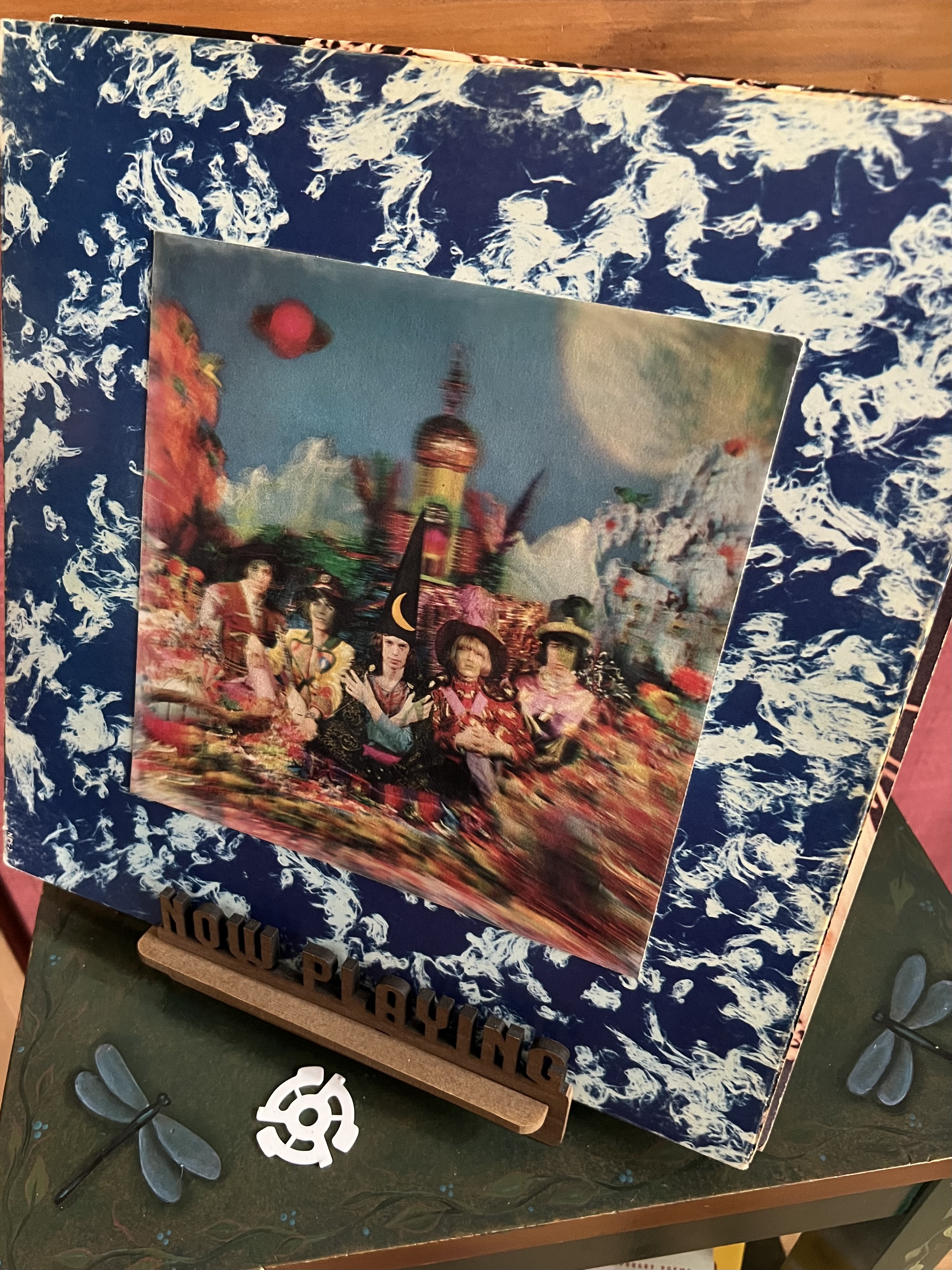
Took me forever to collect anything
from The Rolling Stones. My love for
them has always been luke-warm at best.
I have early childhood memories of listening
to my sister’s records, many of which were
Stones records, the earliest ones, and
those albums did float my little rock and
roll boat. “Under My Thumb,” “Satisfaction,”
“Get Off My Cloud,” were undeniably
cool songs, but none of it, even the
Flowers compilation album, held a candle
to what I was hearing from The Beatles,
at least from my perspective, then and
now. I don’t have a single CD in my
collection, and all the LPs I have were
found somewhere used or inherited from
my brother-in-law, an inheritance that’s
only about four years old at this point.
My enthusiasm for the Stones is such,
in fact, that this morning, I stall by
listening to three other artists on records
released in the last year before breaking out
my meager Stones collection: Their Satanic
Majesties Request, Flowers, and Hot Rocks:
1964-1971.
Their Satanic Majesties Request is an
objectively silly album, wildly uneven,
goofy, trashy sounding, improvisational,
experimental, almost punk in its seeming
“let’s try a bunch of shit and see what
sticks” aesthetic. I mean, it feels like
they’re trying to build a Sgt. Peppers
record, but they’re failing spectacularly,
mostly just because the songs aren’t here.
As far as I can tell, there are only two
things that recommend this album: the song
“She’s a Rainbow,” and the 3D cover art, a
lenticular photo of the band framed by
psychedelic print that spreads out in blue
and white and orange and red throughout
with an ancient Chinese graphic motif in
the gatefold, complete with meditative
labyrinth puzzle. It’s pretty cool to
look at, and my copy is in good shape.
Otherwise, I can hardly justify keeping
this record in the collection, if, in lieu
of holding on to things for their historical
significance or value, I’d like to make
room for newer or better music.
I just learned today that Flowers was
not a bonafide studio album, but rather
a compilation of singles and b-sides from
the previous three years of the band’s
career, songs that hadn’t yet found a home
on an album. I remember liking this album
a lot as a kid. In memory, looking at
the titles of the tracks, every song was
good, nearly all of them were hits, or
because I played this record so many
times, seemed like hits. “Ruby Tuesday”
is certifiably a great song, as is about
a half a dozen other tunes on this
record; “Have You Seen Your Mother,
Baby, Standing in the Shadows,” “Let’s
Spend the Night Together,” “Mother’s
Little Helper,” all great. And the songs
hold up, but interestingly, what doesn’t
necessarily hold up, are the performances.
Mick is pitchy. Inarguably a great performer,
he really is not, or has never been, a great
singer. And I know this will offend some,
but Charlie Watts, I think, is an overrated
rock drummer. But somehow, despite both
of these nit picker complaints, Flowers
is a pretty good collection of tunes.
But really, if you were after the best
of the best of the first most pivotal
seven years of The Rolling Stones career,
the only record you need, in my opinion,
is this Hot Rocks greatest hits record.
While not a fan of greatest hits records,
generally speaking, I give a pass to those
bands whose albums were spotty but whose
hits were spectacularly good. That’s the
Stones all over in the first act of their
long, long, long, long, long, long, long
career.
Notes on the vinyl. editions:
- Their Satanic Majesties Request, London Records, 1967, black vinyl.
- Flowers, London Records, 1967, black vinyl.
- Hot Rocks, 1964-1971, London Records, 1971, black double vinyl
In case you don’t already know: I’m listening to almost everything in my vinyl collection, A to Z, and writing at least one, sometimes two or three long skinny poem-like-things in response for each artist, and on a few occasions, writing a long skinny poem-like-thing in response to more than one artist. As a poet and a student of poetry, I understand that these things look like poems, but they don’t really sound much like poetry, hence, I call them “poem-like-things.” I’ll admit that they’re just long, skinny essays that veer every now and then into the poetic or lyric.

