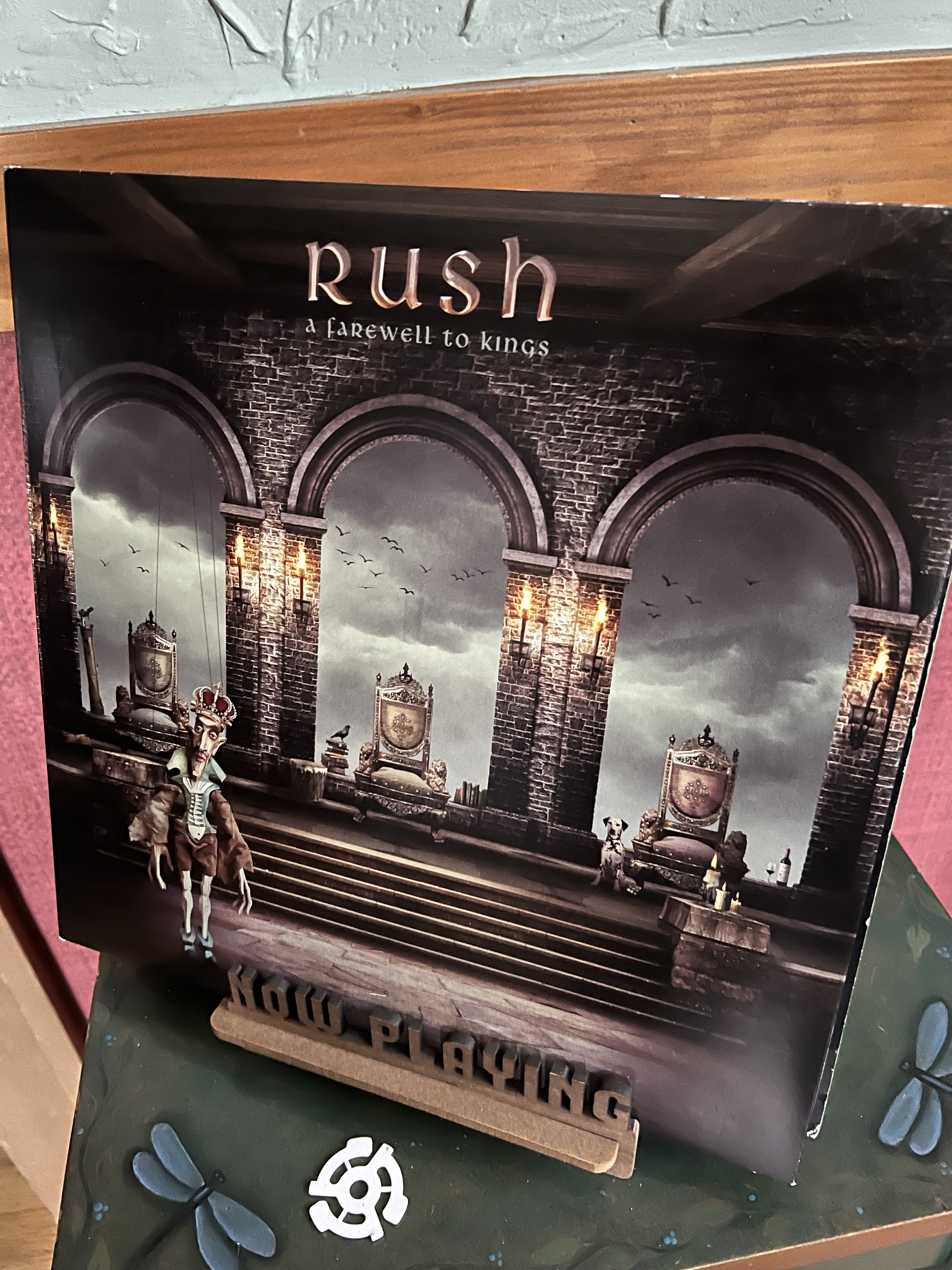
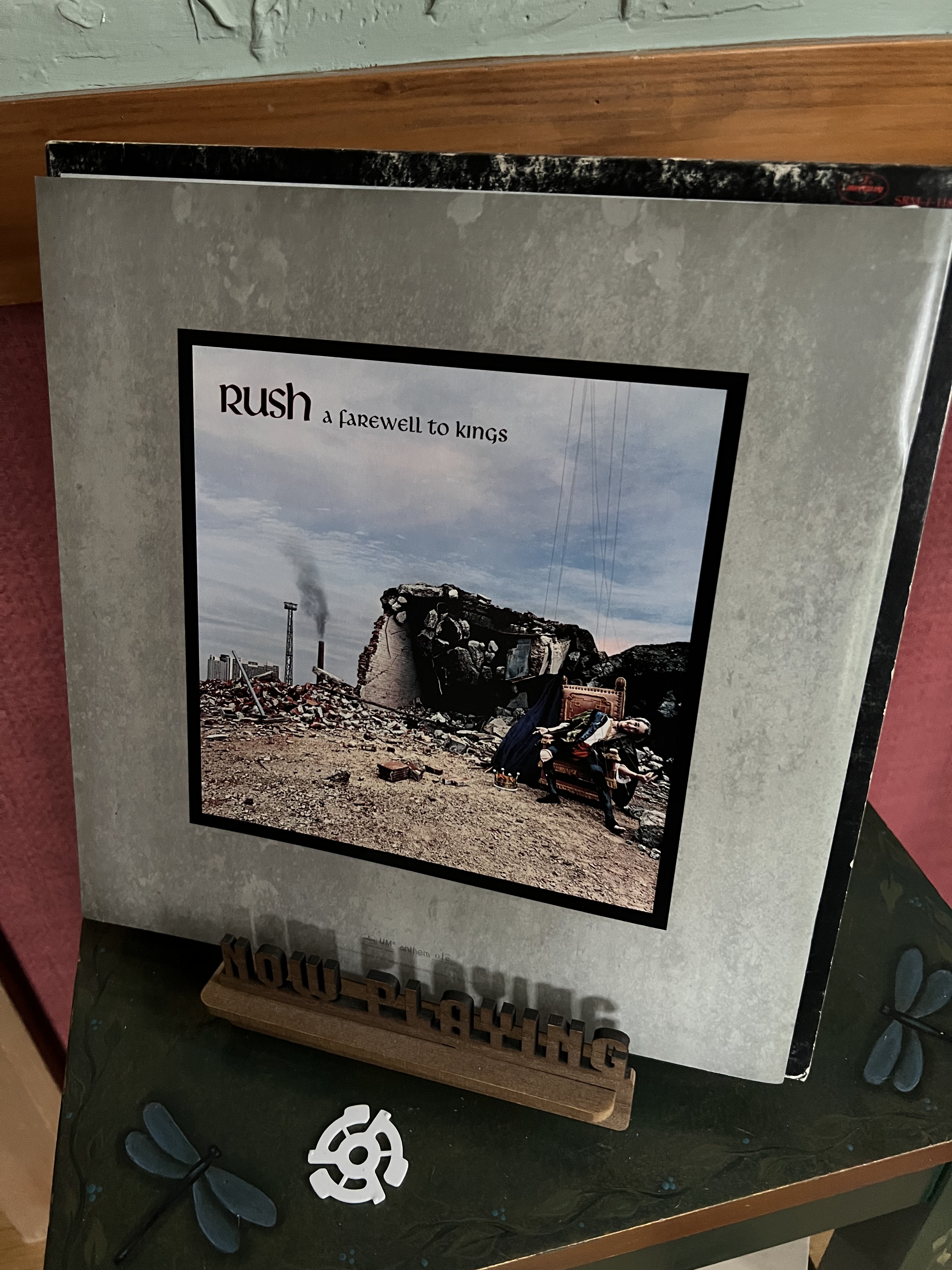
I may as well come clean.
After my initial childhood,
pre-teen, and early teenage
infatuation with Rush, entering
my punk and new wave phase, I put
away childish things, I thought,
and distanced myself from the
Canadian prog rock power trio.
I came to see the band as
nerdy, taking itself far too
seriously for it’s own good,
writing music that I
could always appreciate for
its instrumental virtuosity
but that nevertheless ceased
to move me. This was a mistake.
What I had done, actually, was
to simply transfer my music love
from one kind of nerdy to another
kind of nerdy, a nerdy at the opposite
end of the nerd spectrum, from
the geeky show-off musicianship of
prog to the purer geeky nerdiness
of real nerds in the likes of Devo
and the B-52’s and Talking Heads
and Gary Numan–these cats were the
real outcasts, the real cutting
edge, the real anti-rockstars,
and Rush to me from that perspective
just seemed kind of pretentious.
At some point, within the last decade
even, in my 50’s, I got over my bad self,
started collecting the Rush boxsets on
CD, the ones packaged like touring
road cases, and then I moved forward
into that part of the Rush catalog
from the late 80’s and 90’s when I had,
for all intents and purposes, stopped
listening, and I scooped up everything
I missed. I listened to the whole shebang.
I rediscovered the nerdiness, dismissed
all my dismissals, realized how pivotal
they were to me, how they shaped me,
how manifestly revolutionary they were,
certainly not because they were the
first prog rock band, but because what
they were doing was a cut above, a truly
unique thing. No other prog rock band
sounded like Rush, and no other drummer
sounded like Neil Peart, no other drummer
created in his recorded output so many
absolutely iconic drum parts and fills.
And then the 40th anniversary editions
started rolling out on vinyl, and I could
not help myself. I started with perhaps
my favorite Rush album from their earliest
output, their fifth studio album, Farewell
To Kings. As I enter into this endeavor,
I’m not certain I will want to spin every
disc in these 40th anniversary editions,
all of which contain the original albums
remastered along with entire live shows
from the era, and this one, the Farewell
to Kings 40th, has eight sides(!), the
last side a collection of cover recordings
of tunes from this album by the likes
of Dream Theater, Big Wreck, The Trews,
Alain Johannes, and a studio outtake
of “Cygnus X-1.” If I skip the live sets,
I think I must listen again to these
cover versions.* Let us begin with
the original studio tracks.
“Scheming demons dressed in kingly guise.”
I don’t know about you, but it feels to me
like the lyrics to the title track are
totally relevant to our situation here in
2026 America, seem like an indictment against
MAGA and all things Trump-era, and that last
line: “Can’t we raise our eyes/and make a
start/Can’t we find the minds/to lead us
closer to the Heart.” It appears that, in
this most recent mid-term election, that
we have resoundingly done exactly that.
Those are the first things that occurred
to me listening to that glorious opening
track for the first time in many years.
But what an opening track, what a terrific
piece of music, how exciting it still feels
and how sonically full. And my god that
middle instrumental section with the guitar
solo–unbelievably good. And “Xanadu,”
my god, how fantastic is it that Peart
was writing a lyric inspired by a Coleridge
poem that I would not even be aware of
for another six or seven years. I would
have no idea as a 13 year old boy that
I would one day read the source material
in an English class, that I would go on
to study literature in college. Who knows,
could Peart have planted a seed in me
that would grow me into an English major?
Sure, let’s just say that he did. And
musically, “Xanadu” is epic from start to
finish, an 11 minute tune that seems to
fly by in half the space, every single
minute of it as engaging as the last.
The first three songs on side two are
all fabulous, lovely, conceptually clear
and smart, including the hit “Closer to
the Heart,” and for my money a couple
of the best album tracks on any of their
records; but some special attention must be
paid to the last song on the album, a song
that must have broken my 13 year old brain,
“Cygnus X-1.”
First off, for years all of my high
school drummer friends would try to
show off on the band room drum kit
trying to replicate Neil Peart’s drum
parts on this tune, but outside of
that dumb stuff, I don’t think very
many of us had ever heard anything quite
like it. A ten and a half minute opus,
a cinematic, vivid, and super spooky
tune about an astronaut being sucked
into a black hole. Little did we know
that the entire first side of Rush’s
next album would be a sequel to this
tune–another first in our musical
world, I bet, and maybe Rush was the
first to do it: a sequence of songs
over more than one album that follow
a single narrative lyric. At some
point, I imagine, some upstart musicians
would try to out-song-sequence the
Rush masterpiece: hence: The Dear
Hunter’s ACTS sequence, a concept
album over five records, nine LPs!
I have to wonder if Casey Crescenzo
was listening to Rush as a child,
taking in “Cygnus X-1” and “Hemishperes”
right along with his mother’s milk.
On a final note, I was surprised by
how joyful I felt listening to this
record again–unaccountably happy,
moved nearly to tears, excited in
the same way I was perhaps listening
to these songs for the first time
as a 13 year old, full of wonder
and awestruck again.
*I tried to listen to these covers and I gave up. The Dream Theater slavishly follows the original “Xanadu,” the faithful but metal version of “Closer to the Heart” is a kind of blasphemy, and I lifted up the stylus halfway through the cover of “Cinderella Man” from the Trews. No–covering Rush, it seems, is a lose-lose situation, unless you’re going to do something radical, commensurate with the radical nature of the source material.
Notes on the vinyl edition: Farewell to Kings, Mercury Records, 2017, four album box set on black vinyl.
In case you don’t already know: I’m listening to almost everything in my vinyl collection, A to Z, and writing at least one, sometimes two or three long skinny poem-like-things in response for each artist, and on a few occasions, writing a long skinny poem-like-thing in response to more than one artist. As a poet and a student of poetry, I understand that these things look like poems, but they don’t really sound much like poetry, hence, I call them “poem-like-things.” I’ll admit that they’re just long, skinny essays that veer every now and then into the poetic or lyric.

