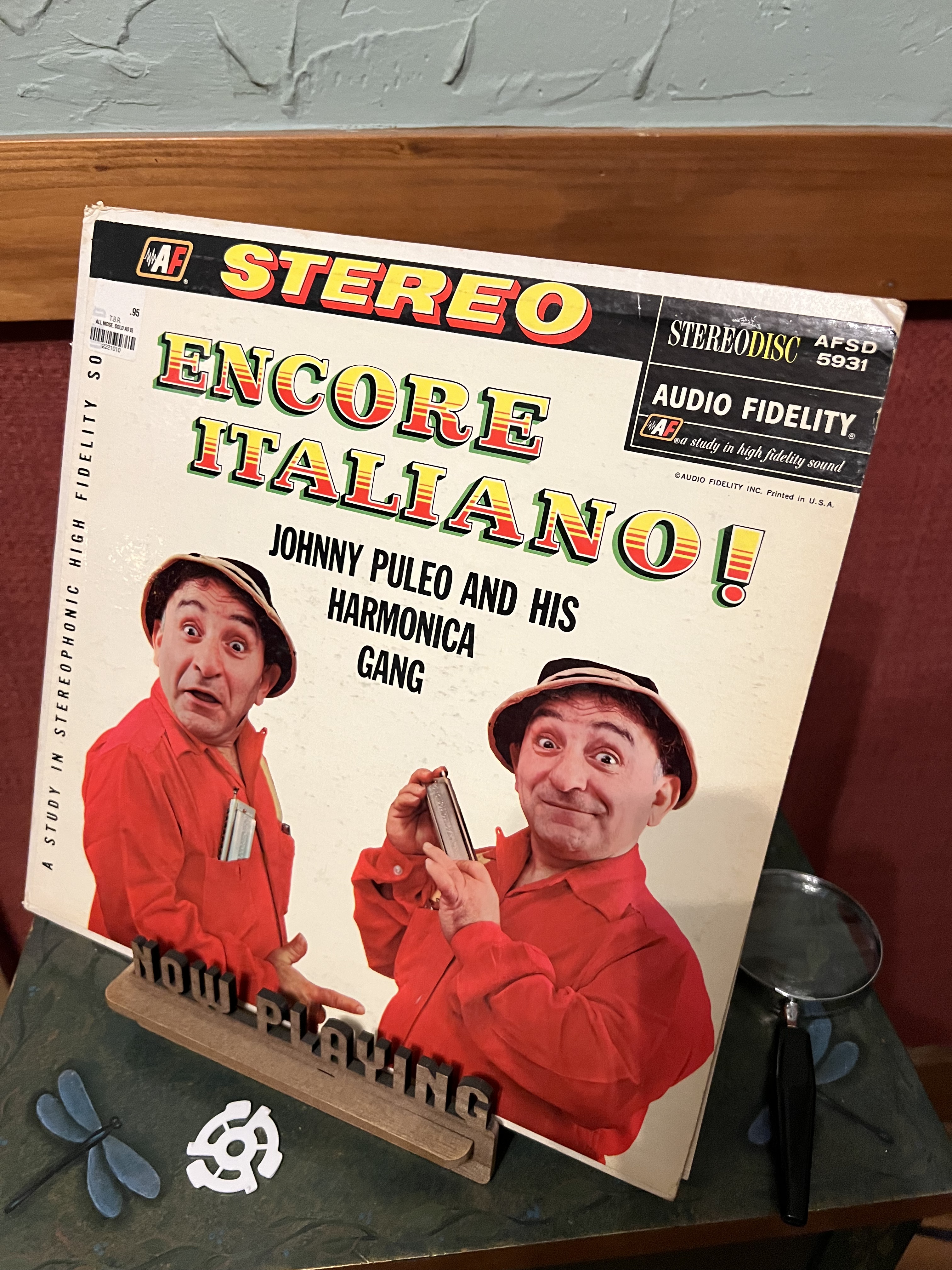
Every time I pull a record from
the stacks and exclaim, what the hell
is this, I can with some certainty tell
you that the album found its way into my
stacks courtesy of my friend Curtis,
who loves, more than any music fan I have
ever known, to listen to everything,
anything, loves the completely unfamiliar,
loves the wacky, loves the things that
are the farthest from the things that
he’s ever heard or loved. And because he
wants to spread the joy, so to speak, he will
sometimes make a holiday or a birthday
gift of some of the weirdest things
he’s discovered at his favorite local
used record stores, garage sales, and
thrift shops. This thing, part
of a series titled Encore Italiano, is
a record by Johnny Puleo and His
Harmonica Gang. Curtis splurged on this
one. The .95 price tag is still on
the cover. I don’t like harmonicas,
in particular, and I’ve tried to avoid
most gangs, but this Harmonica Gang,
despite the crazy uncle gangster type
photo of Johnny Puleo on the cover,
is pretty tight. This is not blues
harmonica, in fact, the prominent
instrument seems to be accordion and
maybe some flute. It’s rhythmically
lively despite the lack of any percussion.
The harmonicas are there, to be sure,
but they’re not doing the thing
that American harmonicas do, in fact,
they are barely recognizable as
harmonicas. René is in the other room
and she says she feels like an espresso
or a pizza. Waltzes and polkas, those
kinds of things, all of it, Italian
100%. The playing is undeniably
superb, and the fidelity on this
record from 1960 is nothing short of a
wonder. There is not a pop or a
scratch or a hint of distortion
anywhere on this record. I’m having
fun listening to this thing. It makes
me feel groovy. It makes me laugh.
I am grateful for Johnny Puleo and
His Harmonica Gang, as I am grateful
for my friend Curtis, without whom
I would not be having such a splendid
Italian time on this Sunday evening.
Notes on the vinyl edition: Encore Italiano, Johnny Puleo and His Harmonica Gang, Audio Fidelity Records, 1960, black vinyl. What’s fun about the records from this era, partly anyway, are the liner notes on the back covers. You typically get, as you do on this thing, a long, professionally written description, biography, and some critical analysis of the artist in question. But also, at least in this case, which is most interesting to me, you get a technical description of the recording’s “technical data,” that is, how it was recorded, what equipment was used, and how to get the best results from it’s playback, right down to the settings you should choose on your “extreme wide range and fidelity equipment,” including low frequency limit, high frequency limit, crossover, and rolloff settings! Okay. I think the record sounded good, but I have no control over any of these parameters on my stereo. What did high end stereos look like in 1960?
In case you don’t already know: I’m listening to almost everything in my vinyl collection, A to Z, and writing at least one, sometimes two or three long skinny poem-like-things in response for each artist, and on a few occasions, writing a long skinny poem-like-thing in response to more than one artist. As a poet and a student of poetry, I understand that these things look like poems, but they don’t really sound much like poetry, hence, I call them “poem-like-things.” I’ll admit that they’re just long, skinny essays that veer every now and then into the poetic or lyric.

