Sitting on a park bench.
Snot dripping down his nose.
Both of my Jethro Tull albums
are used acquisitions, Aqualung
still has a price tag on it of
$1.99. Aqualung, my friend,
don’t you start away uneasy.
You poor old sod, you see,
it’s only me. And I want to
know who has a friend named
after a piece of scuba diving
equipment? Nevertheless,
here’s one of the most famous
guitar riffs in rock and roll
history. Ian Anderson might
be a great flautist, but he’s
kind of a terrible singer. No,
allow me to amend that.
He can sing nicely, as he does
on a bunch of these songs.
It’s when he’s doing the “rock”
thing, on “Aqualung” and “Cross-
Eyed Mary,” when his voice
sounds like an old man who started
smoking as an infant.
Outside of the recognition of the
importance of Jethro Tull during
its heyday, having never listened to
these records back then, Aqualung
especially does almost nothing for
me now. It’s serviceable hard rock
with progressive leanings and
some folk music tendrils, but while
the performances might be
impressive, the songs don’t move
me, aren’t inviting me for repeated
listens, do not suggest any memorable
melodies outside of the ones on that
title track, and maybe “Locomotive Breath,”
the two big hits from the record.
This may be only the second time I’ve
listened to this album, once after I bought
it, and today. I think I understand why.
However, it must be said, that I do dig
the faux Bible verse on the back cover
regarding Man’s creation of God over
seven million days and the formation
of the Aqualung from the dust of the Earth.
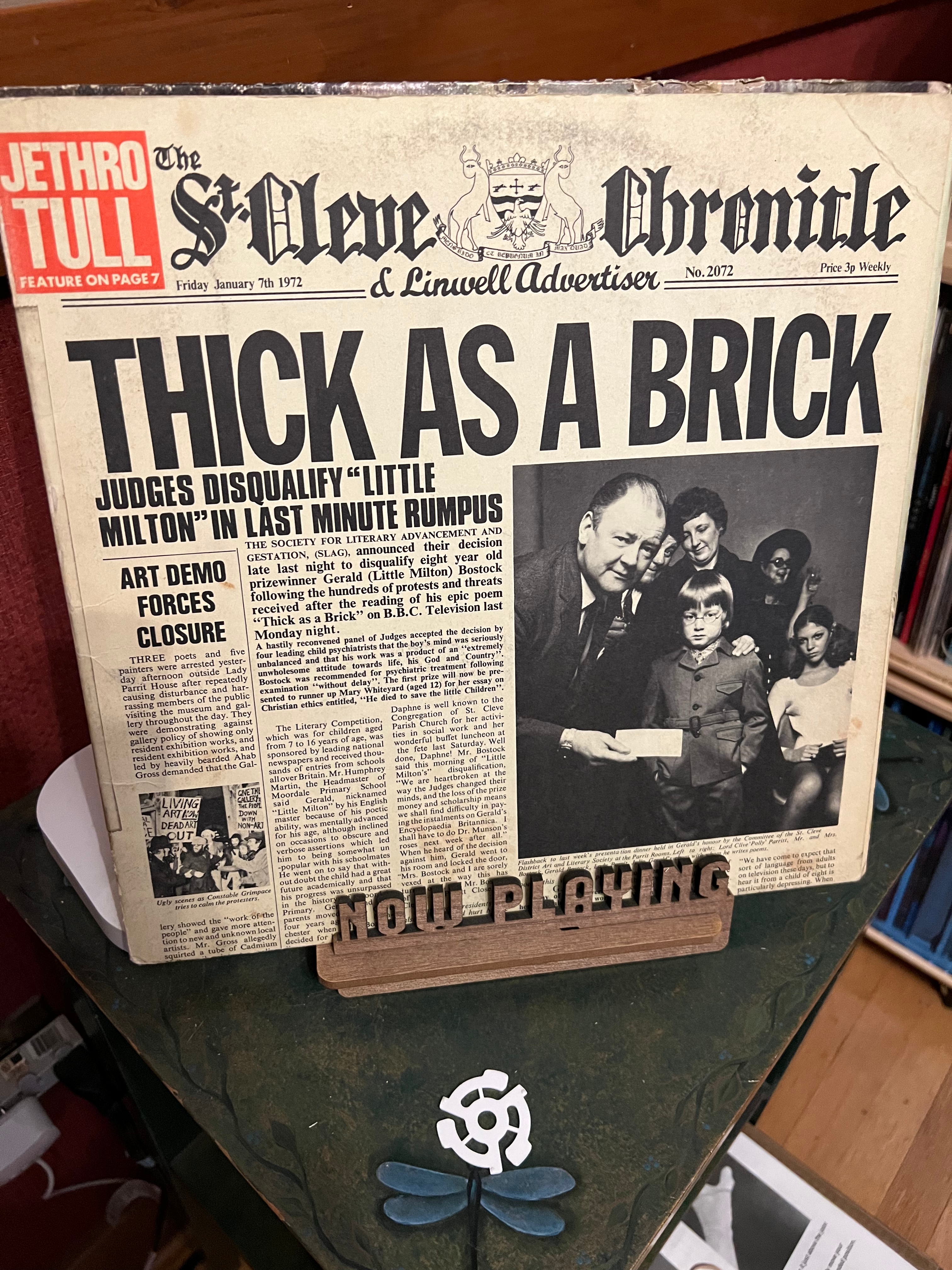
Thick As A Brick opens with a folky little
jaunt that feels Irish or straight from the
Tolkien shire with a jab here and there
of hard rock hits in quasi-random places.
It’s getting super proggy up in here,
only two tracks, each clocking in at about 22
minutes, and it’s super arty. I can’t find the track
listing or the performance credits anywhere
on this crazy newspaper art,
approximating a full-on replication of the
The St. Cleve Chronicle, likely a fabrication, but
it’s hard to tell,. It’s goofy as hell, complete
with political news, a sports page, an obituary,
local crime news, human interest stories,
the mundane, the bizarre, ads, and a strange
story about a “major beat group” fronted by
the one-legged flautist Ian Anderson that
puts the epic poem of some child prodigy to
music. The cover art, this twelve page
newspaper that folds out of the jacket like
an accordion, all by itself might be
worth whatever I paid for this used version,
likely an original copy and in decent playing
condition. The music? Again, 22 minutes
of contiguous play on side one and two,
movement after movement, hardly a moment
that represents anything like conventional
rock song structure. The last thing on the band’s
strategy list was a hit song. The record is
reported to be a parody of contemporary
prog rock of the early 70’s, although it feels
less like parody and more like the real deal.
I’ll admit though that the patriotic sounding
flute over the drum solo on side two is funny.
All I can say is that perhaps the commercial
success of Aqualung gave these guys a blank
check to do whatever the hell they wanted,
and apparently, this is what they wanted.
I can also say that, even though after this
listen I can recall or remember almost
nothing of what I heard, substantively,
it nevertheless strikes me as a more interesting
record than Aqualung. Are these records
worth holding on to? That is the question.
Notes on the vinyl edtions: Aqualung, Chrysalis Records, 1971, black vinyl, used copy in relative good shape. Thick As A Brick, Chrysalis Records, 1972, black vinyl, used copy, newspaper cover art is complete and in relatively good condition.
In case you don’t already know: I’m listening to almost everything in my vinyl collection, A to Z, and writing at least one, sometimes two or three long skinny poem-like-things in response for each artist, and on a few occasions, writing a long skinny poem-like-thing in response to more than one artist. As a poet and a student of poetry, I understand that these things look like poems, but they don’t really sound much like poetry, hence, I call them “poem-like-things.” I’ll admit that they’re just long, skinny essays that veer every now and then into the poetic or lyric.

