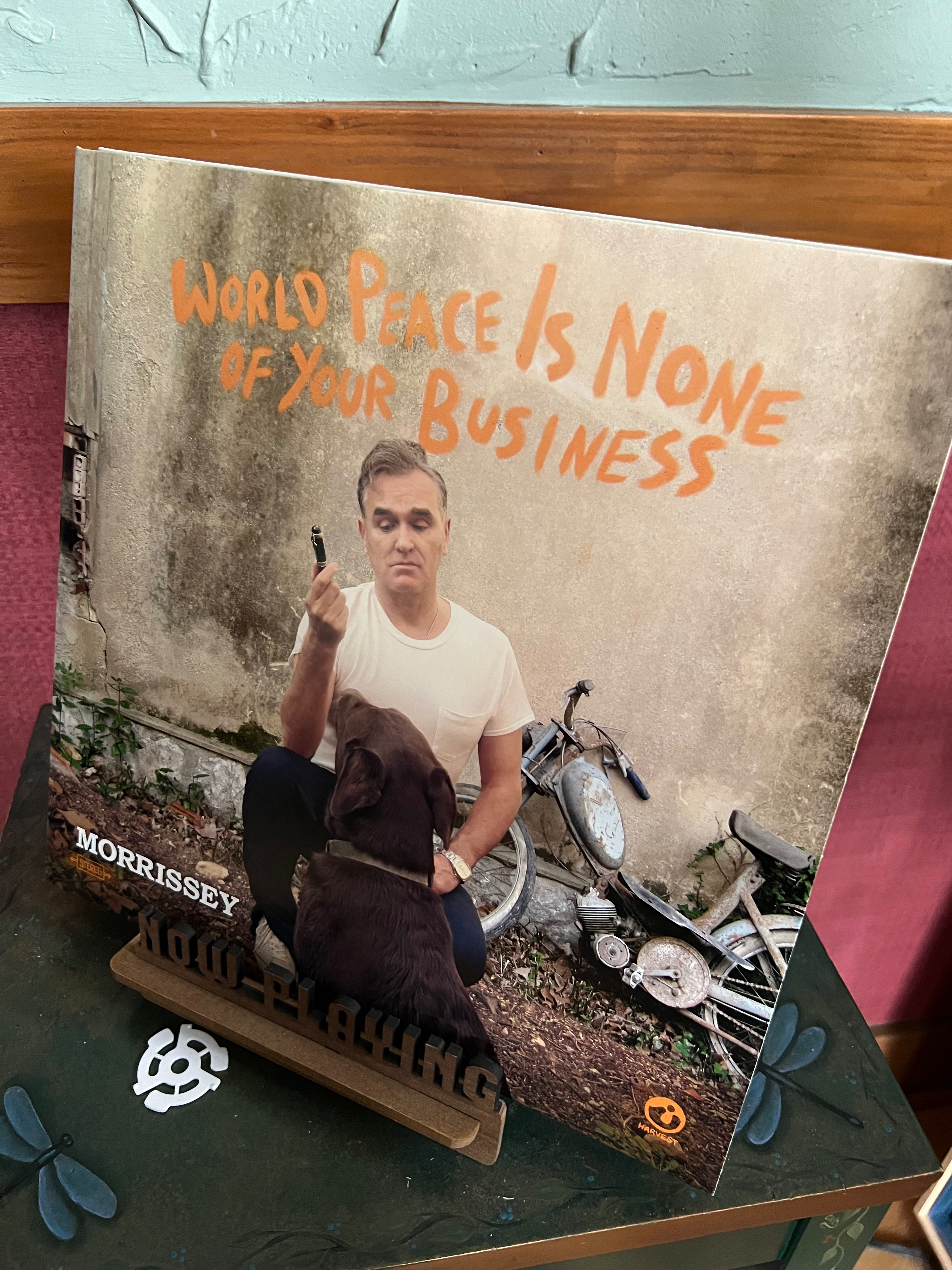
This one is troubling, this entry about
the British singer Morrissey, who emerged
into fame during the 80’s with the
mopey rock outfit, an undeniably great
band, The Smiths. We have to talk
about that age-old question,
more firmly in the public consciousness
over the last couple of decades than
it has ever been: is it possible to
separate the art from the artist? Can
one appreciate and support the
otherwise masterful, even genius art
(acting, writing, music, painting) of a
human being who is morally or ethically
vile? Morrissey has rightfully come
under fire for a number of stupid,
racist, inflammatory, and insane
statements and positions over the
years, and as the guy ages, it just
seems to get worse and worse,
or, as Morrissey might put it, worser
and worser, to the point where,
I understand, he had nearly an impossible
time finding a record label who would
release his most recent record, as he
was blacklisted by most of the mainstream
entertainment industry, or so he claims.
I heard Morrissey before I heard
The Smiths. For some strange reason,
the existence of a band called The Smiths,
embarrassingly, flew entirely by my radar.
Somehow, after I quit listening to radio,
MTV had become irrelevant, and decades
before streaming, I learned of Morrissey
through my reading or by a friend’s
recommendation, and I bought his debut
1988 solo effort on CD, Viva Hate. I don’t
remember precisely, but I may have
swallowed up his next two albums,
Bona Drag and Kill Uncle, before ever
purchasing a record by The Smiths.
While not a completist, (I have
almost every album by The Smiths
except for the earliest ones–terrible
records in my estimation), I have
every Morrissey solo album between
my CD and vinyl collection except
for two. I do not have his record of
cover songs, California Son, and I don’t
have his most recent studio album,
Make-Up Is a Lie. In all those years of
listening to Morrissey, I have never
felt that his lyrics, while sometimes
startling and provocative, were all
that controversial–except in the
usual literary way of being ironic, or
in the way of an artist trying on
a persona. I have always found his
most disturbing lyrics to be quite
hilariously funny, despite or maybe
because of his legendary
mopey disposition. It’s also possible
that I haven’t been listening carefully
enough to catch his politics
emerging. As I listen to my vinyl
Morrissey albums, all from the 21st
century, I’ll try to listen more closely.
I mean, the title track that opens up
the 2014 album World Peace Is None of Your
Business, on the one hand, seems kind
of provocative, but also true for most
human beings: how much influence
does a single life have on the turnings
of the entire planet? Certainly, one
could argue that individuals can have
tremendous impact–but that would
be an optimistic message, and that would
not be Morrissey. In “I Am Not A Man”
he sings about his veganism and
general pro-environmental stance.
Nothing surprising or icky about that.
Musically, as I listen to this
record, I don’t recognize it at all.
How many times did I spin this album?
Not very many times, apparently.
The playing is good, the production
is big and full, but man, are these tunes
forgettable. I’m only four or five songs
into the beginning of the album,
you know, where the strongest tunes
usually (but not always) fall, and it’s
mostly a wash. The latin, almost flamenco
feel of “Earth Is the Loneliest Planet”
is kind of fun, a vibe that perhaps
Morrissey has never tried before, but
even this tune, when the guitars get
heavy, becomes kind of a wash, and
the vocal melody (never Morrissey’s
strongest suit) is minimal and tired.
I’m thinking that maybe the best thing
about this album might be the
contribution of multi-instrumentalist
Gustavo Manzur, the only person
of color in the band, and the musician
who is providing the most interesting
sonic contributions, from flamenco
guitar, trumpet, accordion, and, wildly,
didgeridoo! The best songs on the
album? “Kiss Me A Lot” is in the running,
Morrissey in a most uncharacteristically
cheerful mood. The balladry of “Smiler
with a Knife” is pretty lovely, but not as
good as some of his earlier crooners.
“Kick the Bride Down the Isle” is cynical
and funny in his typical fashion and
memorable primarily for its acerbic
lyric. Conclusion: this is not a great
album. I’m curious: why did I keep going
back to him, outside of a kind of sentimental
loyalty to an artist that deeply moved
me as a young adult? Was that it?
Low In High School opens with the rocking,
heavy, almost metal sounding shuffle of
“My Love, I’d Do Anything For You.”
The chorus hook is mostly about a huge
sounding horn riff, while Morrissey just
Ohs and Mmms, but it’s undeniably good,
high energy, rock. Followed by the funky
“I Wish You Lonely,” it almost feels like
a return to form, or at least, to more engaging
songwriting. But again, I don’t recognize these
songs. Clearly, this one was not in heavy rotation
either. The songs here are shorter, punchier,
more melodic, more interesting and enjoyable
to hear. Why’ didn’t I play it more often?
I’ve said this before, but it bears repeating.
When records stopped coming with download
cards inside the jacket, music was no longer
portable, unless you were subscribed to a
streamer, and the end result was that a
record only got listened to when one was
at home, in the listening space with disposable
minutes to commit to spinning a record.
Yeah, you might say, but wasn’t that the case
when you were in your teens and twenties?
You know what we did. We recorded our LPs
on to hi-fidelity cassette tapes, and we
listened to those records wherever we were,
whenever we wanted.
Let’s get back to this music: Morrissey
is less successful when he’s overtly political.
Here, at the end of side one, is a song about
the way an individual soldier sets aside
his own personal accountability, his
moral responsibility, his very identity
in following orders in service of God
and country to do heinous things.
For me, there’s nothing controversial about
that; it appears from my perspective a
true statement about what warfare can do
to mess with and mess up an individual’s
sense of right and wrong, but does it make
compelling lyrical content? I don’t know.
Sure, it does, or it can, but I’m less interested
in Morrissey’s commentary about big issues
and more kind of longing for when he used
to sing about driving his girlfriend home.
Likewise, “In Your Lap,” a song about love
during the Arab Spring, is just too deadly
serious. On this record, he wants to
gravitate his subject toward the Middle East,
which is an area where he has run into
trouble, but “The Girl From Tel-Aviv Who
Wouldn’t Kneel” is about a young woman
who appears critical of state and nation,
and answers the question, “what do you
think all these conflicts are for?” with
the reasonable, “it’s just because the land
weeps oil.” And in the next song, despite
the threat of nuclear annihilation and
whatever political regime is in power at
any given moment, “all the young people
must fall in love.” Still, it’s hard to find in
his lyrics anything politically incendiary
or anything that would make most of his
liberal fans or critics crap their pants.
The album closer, a bit of an ode or a
love song to Israel, avoids controversy
with the bridge lyric, “I can’t answer/for
what armies do/they are not you.”
This record, musically, is better than the
last one, by a long shot, I think. Lyrically,
I’m not as much of a fan. I guess
that the price of one’s loyalty to an artist
is that every once in a while, one will
experience disappointments, ups and
downs. Our favorite artists are only human
after all, and we can’t expect them to
bat a thousand every time.
Morrissey’s penultimate studio album to
date, I Am Not A Dog On A Chain, opens with
some serious synth bass and an up tempo
rock thing and the explicitly dark lyric of
“Jim Jim Falls”: “If you’re gonna jump, then jump
. . . if you’re gonna kill yourself, then, for god’s
sake, just kill yourself.” And the follow up
to that opener is nearly as bleak: “Love is
on it’s way out,” he croons. I mean, what does
one expect? This is Morrissey, after all.
There are some sonic surprises
here: more synths than usual, some drum
programming to augment and compliment
the real drums, some kick-ass female
backing vocals, more super effective horn
work, and the American wunderkind from
Jellyfish and the side guy for Beck’s big band,
Roger Manning, on keyboards and backing
vocals. But best of all is that, lyrically,
while still dark, still acerbic, still sometimes
funny, the tunes move away from the
political, away from tackling the big issues
of the world order, and back to the personal,
the local, the social–and that’s all to the
good, I think. And these songs are pretty
tuneful. These are songs I can imagine
myself singing along to after repeated
listenings. There’s a continuity here, too,
as many of the musicians on the last two
albums make a return here. It’s a strong
band, for sure, and these are good recordings.
The good news is that, while his recent
output might not be on par with his first
four solo albums from decades ago,
Morrissey’s music does not seem to be
getting any worse, and while each
subsequent record in this decade from
2014 to 2019 gets successively better,
there’s hope that he’ll continue to be
productive and vital in the coming years.
I have streamed the brand new 2026
album once, and so far, the jury is out,
either because I have finally heard enough,
or I can’t help but be turned off by all
the recent negative news about his
snotty behavior.
I’d like to return to that initial question
about our ability and willingness to
separate the artist from the art. Here’s
my take, for what it’s worth. He’s always
been a loudmouth. He’s never been a
very nice guy. It’s not an act or a persona,
not that I can tell. He’s just kind of a snob,
and doesn’t filter his speech, and likes
to fight with fellow celebrities. I don’t like it.
He and I, if given an opportunity, might not
be friends. But it does not mean that he
has not offered something unique and
valuable to the history of rock and pop
music. He is not the best singer, but no
one sounds like him and his lyrical voice
was singular, to be sure. His early work
inhabits my musical body even to this
day. Every time I check a mic I find myself
singing “Heaven Knows I’m Miserable” or
“Girlfriend in a Coma.” We can’t outright
dismiss Morrissey any more than we could
dismiss Ernest Hemingway or Ezra Pound
or Roald Dahl or Dr. Seuss. These are all
dudes (all dudes) who contributed mightily to
to the world of literature who might have
been outright canceled in this current
cultural milieu. As long as he doesn’t do
anything criminal, allow Morrissey to be
stupid and to keep creating his art. And
we can always choose to listen–or not.
Notes on the vinyl editions:
- World Peace Is None of Your Business, Harvest Records, 2014, double black vinyl.
- Low in High School, BMG Records, 2017, translucent green vinyl.
- I Am Not A Dog On A Chain, BMG Records, 2020, translucent red vinyl.
In case you don’t already know: I’m listening to almost everything in my vinyl collection, A to Z, and writing at least one, sometimes two or three long skinny poem-like-things in response for each artist, and on a few occasions, writing a long skinny poem-like-thing in response to more than one artist. As a poet and a student of poetry, I understand that these things look like poems, but they don’t really sound much like poetry, hence, I call them “poem-like-things.” I’ll admit that they’re just long, skinny essays that veer every now and then into the poetic or lyric.

