Prologue
Rivaled only by XTC, The Flaming Lips
and David Bowie, a tie with the former
two artists and lagging a full mittful of albums
behind the latter, I have twelve records
by The Mountain Goats in the vinyl collection.
Like a lot of bands and musicians
that have captured my music heart,
I was late to The Mountain Goats
party. I arrived, finally, and it looks as
though I am here to stay. John Darnielle,
the brains behind the project and the principle
songwriter and always the lead singer, is
not a perfect musical artist: his voice is not
for everybody, and in his prolific output
(he’ll release a Mountain Goats album
nearly every single year), any
close listener will find some crutches,
some melodic moves or vocal mannerisms
here and there on repeat, but despite
these potential pitfalls he is to
me one of the most fascinating singer
songwriters in contemporary American
music. First, he is a musician after my
own heart—not just a lyricist, but a fiction
writer, a poet, an essayist, a genuinely
super smart guy, and super nerdy. His lyrics,
therefore, are literary, full of allusion,
narrative in nature or character driven, and
often tied in a single album to an over-
arching theme or story. Many albums by
The Mountain Goats are concept records,
records about goth rockers, Dungeons
and Dragons, professional wrestlers,
Greek mythology, and most recently,
three survivors of the shipwreck of a
fishing boat. He is my kind of songwriter.
Musical and literary hero material.
Prolific? How prolific has he been, this John
Darnielle guy, under the moniker of The
Mountain Goats? Since 1994, the “band”
has released 23 albums. And how long did
it take Michael Jarmer to be aware of them
enough to buy one of their records? My first
record by The Mountain Goats was a 2017
release, and I’m pretty certain I only heard
of it and bought that record a year or two
after its release, and I know that, because
hard on the heels of my purchasing that album,
the next one came out. So since about 2018,
I have moved forward with John Darnielle with
almost perfect loyalty, and I have also gone
backwards in the catalog, but not exhaustively,
as far back as 2002, so that’s where we will begin,
when the century was young, during the quaint
(in hindsight) but blundering presidency of
George W. Bush, a year after the 9/11 World
Trade Center attack, a year before the second
Gulf War. Buckle up, buttercup.
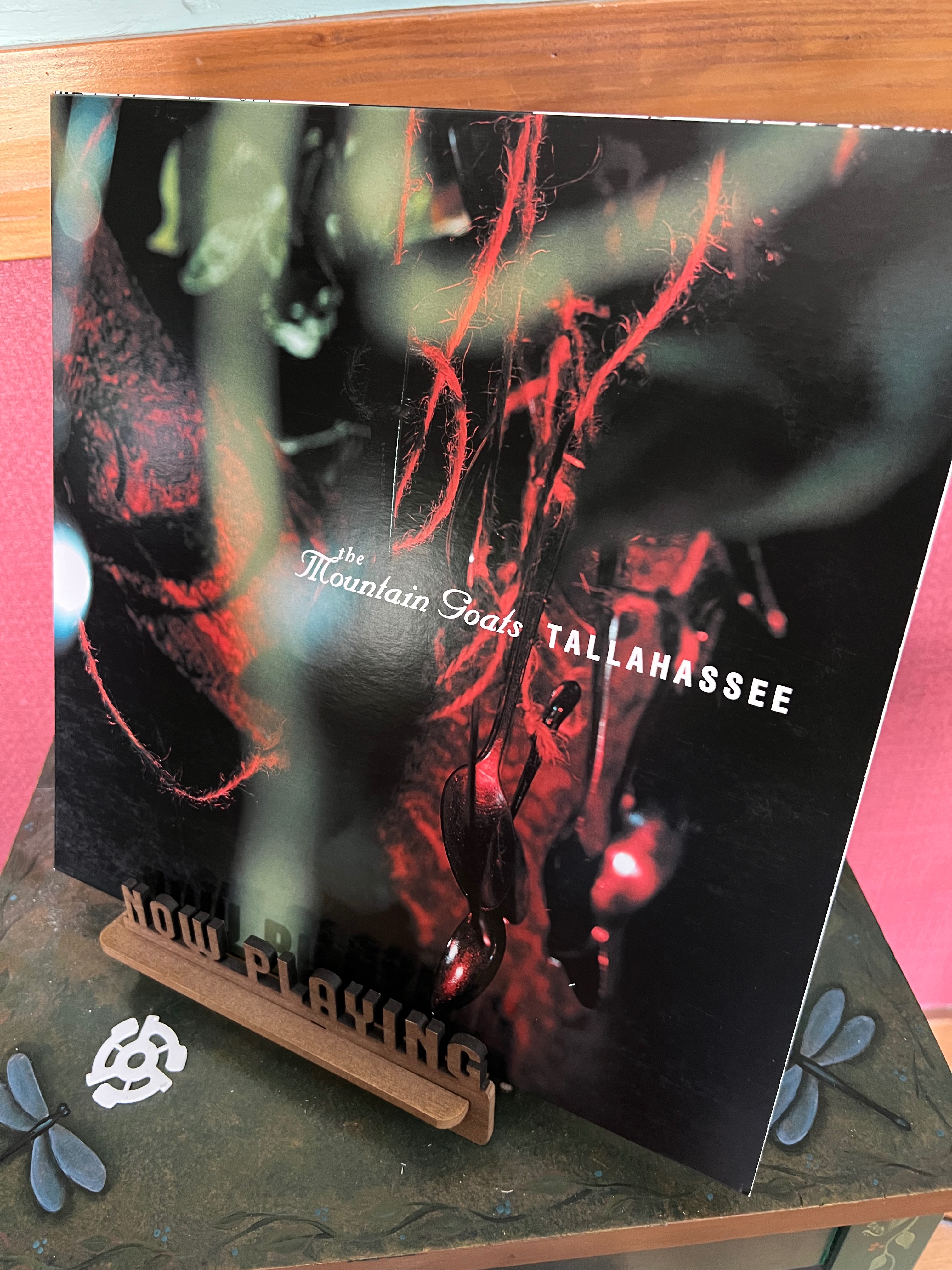
Tallahassee
2002 is as far back as I go with
The Mountain Goats, and for good
reason–albeit personal and idiosyncratic.
John Darnielle’s journey as a songwriter
began with a number of super lo-fi
albums, super, extremely, terrible
sounding lo-fi recordings. He recorded
his first albums to cassette using
the shitty microphones on a boom
box, for Christ’s sake. He wouldn’t
have been the first. The 90’s, when
Darnielle begins recording, were
rife with this kind of aesthetic as
shitty recordings were all the rage,
a kind of middle finger to the industry.
Paradoxically,
I both love and hate this. First,
I love the fact that Darnielle somehow
established a music career with these
shitty recordings, but on the other
hand, I have never had a stomach
for shitty recordings, no matter how
good the songs are. It’s a personal
problem, I know. It’s not very punk
rock of me. Tallahassee,
I understand, is the first album
on a major/indy table, the first one
John Darnielle recorded in a professional
studio, his first entry into hi-fi, and
the first record he made partially
with a full band, as his earlier outings
were primarily singer-guy-with-guitar.
On a few of these tunes, in particular
the rockers, I hear Stan Ridgeway
from Wall of Voodoo. That, I think,
is the best comparison I can come
up with to describe John Darnielle’s
voice, except when he’s singing pretty,
and then he belongs to a long line
of some of my favorite singers whose
voices bear a striking resemblance
to Kermit the Frog.
I accidentally play this album
side two first, a mistake I made
by not looking closely enough
at the track list on the jacket,
and because of the stupid graphic
art decision not to clearly indicate
on the center label the side number.
I didn’t notice at first, would not
ever have noticed, unless I was
moved to look up a lyric on the
internet, and not finding it under
the title of the song I thought
I was listening to, realized the
mistake. The lyric was this gem:
“Our love is like the border between
Greece and Albania.” I don’t quite
understand it, but I love this line.
Also of note: the fact that I didn’t
realize I was listening to the album
backwards shows how many times
I have listened to this record: not
many. It is my least favorite album
by The Mountain Goats–too folky,
too strummy-strummy, full band
minimal, not nearly as memorable
from a lyric or melodic standpoint,
although, lyrically, there are some other
gems: “They say friends don’t destroy
each other/What do they know about
friends,” but you’ve got to be paying
close attention, and for me, the
musically minimalist approach here
doesn’t sufficiently hold my attention.
However, the last two songs on side
one, “Idylls of the King” and “No
Children” are great songs, indicating
what might be next as John Darnielle
got better and better at his craft–
and he did. Here’s this rousing chorus
in the point of view of man who is
on the verge of a divorce:
In my life, I hope I lie
And tell everyone you were a good wife
And I hope you die
I hope we both die
The Sunset Tree
In that same snarky, ironic tone, this
2005 album has what may be the most
well known song in the Mountain Goats
catalog with the angsty chorus of:
“I am gonna make it through
this year, if it kills me.” This record has
a full band, string sections, beautiful
songs, scary songs, and sad. It marks,
for me, the beginning of his maturation
as a songwriter, even though he had
already been busy making records for
thirteen years or more. At least to my
tastes, this record is the very best
of his earliest work–a good starting
point for the Goat curious. The second
side leans heavily into that earlier
acoustic, minimalist approach, so
The Sunset Tree will give you an intro
to the best of both of Darnielle’s early worlds.
Transcendental Youth
I think that after I got my first records
by The Mountain Goats, I started going
backwards in the catalog until I reached
this one, the previous two earlier records
being the very last ones I picked up.
I think it was kind of a random progression
based only on what was available at the
time in the record store I was at when
I was feeling the need for more music from
John Darnielle. So, it happened that, between
this 2012 album and my next one from
2005 were seven years and five albums, none
of which I have heard. By this time, drummer
John Wurster had joined the band, and is still
recording and touring with TMG in 2026.
This is significant, and for those of you who
doubt what a good drummer can do for a
band, look no further than this record
compared to the last record that didn’t
have this guy on the traps. This album is
even a larger jump forward toward a
more sophisticated sound: more rhythmically
various, more instrumentally interesting,
more sonically full–and the tunes are
better. I think John Darnielle knew that
the way toward consistent improvement
as a songwriter and performer was to
surround himself with musicians who
were more skilled than he. And the
soundscape here is wider, with piano
and horns and synthesizers. And this is
the first TMG album, in my collection
anyway, that is clearly concept driven:
a collection of songs about social outcasts,
each song for a different persona.
Because I have never heard the 5 previous albums
to this one, I can’t say it with authority,
but I’ll say it anyway: this is the first great
album from The Mountain Goats, a record
with which, as I listen to it today for the first
time in maybe a few years, I would like
to spin more often.
Notes on the vinyl editions:
- Tallahassee, 4AD Records, 2002, black vinyl
- The Sunset Tree, 4AD Records, 2005, 20th anniversary edition, opaque peach vinyl
- Transcendental Youth, Merge Records, 2012, black vinyl
In case you don’t already know: I’m listening to almost everything in my vinyl collection, A to Z, and writing at least one, sometimes two or three long skinny poem-like-things in response for each artist, and on a few occasions, writing a long skinny poem-like-thing in response to more than one artist. As a poet and a student of poetry, I understand that these things look like poems, but they don’t really sound much like poetry, hence, I call them “poem-like-things.” I’ll admit that they’re just long, skinny essays that veer every now and then into the poetic or lyric.

