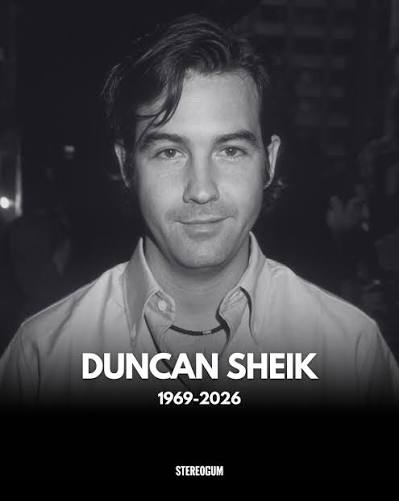
I don’t know that I have ever been so shaken by the death of a rock star. Mostly, the deaths of famous people seem abstract, not quite real, because our relationships to these folks, as human beings (unless of course we knew them personally), are mostly imagined, contained only in our relationship to their art, because no matter how much their music or their films or their writings meant to us, their passing feels a little bit like the death of a fictional character in a novel. Friday, alone in my study, I listened to the songs on Phantom Moon and openly wept. No one was home, but I wept so deeply that the dogs were concerned, really concerned. I should have known better: this record brought me to tears when it came out 26 years ago. Now Duncan Sheik’s death was a part of it, the depth of that feeling, the sadness of the music coupled with the loss of the songwriter, and, too, likely coupled with a lot of other stuff going on in this writer’s heart and head. And, he was 56, nearly six years my junior.
Before I had ever heard of Duncan Sheik, my wife René and I had written and recorded the songs for our 2001 Here Comes Everybody album, Astronauts. We were mixing those songs in the studio, and Bob, our mixing engineer, as engineers do, would play CD’s through the studio monitors by artists that he admired, in particular, to listen to production choices that he might want to emulate in a mix. He put in Duncan Sheik’s Phantom Moon as a reference and played it right along side our songs. In that moment, my affinity with Sheik’s music began. Aesthetically, our tastes were quite different, at least they were previous to this point. In stark contrast to Sheik, my approach to lyric writing and singing was somewhat clownish; I was a joker and my songs were often satirical, silly, witty, delivered often in a manic, hyperactive singing style. Even though I would write the occasional serious lyric, the Astronauts album for the first time featured an entire collection of tunes from which there was not a single funny song. It was also a moment in my musical evolution where I decided to try an entirely new singing strategy–to avoid straining my voice, to sing quietly as opposed to yelling, to sing at the lower and middle ends of my range instead of always reaching for the top. So, in short, before I had ever heard Duncan Sheik’s music, I had started to kind of sing like him. Bob’s choice to A/B Phantom Moon next to our music, Duncan’s singing next to mine, was an inspired choice. Since then, I have felt a musical kinship with this guy.
As my musical choices and my introduction to Sheik were concurrent, I couldn’t really call him an influence–but that day in the studio stuck with me, I started buying his records, and have been pretty loyal all the way through. But what strikes me most about my connection to his music and my response to his death, is that Duncan Sheik has been, for the last 26 years, a kind of soundtrack to heartbreak. I reach for his music often when I want to feel deeply, when I am sad, when I am going through a rough patch. No, it does not make me feel “better,” at least not in the short term, but it does provide a kind of cathartic experience, a kind of emotional cleansing which feels necessary and therefore “good.” One of his chief skills as a songwriter, I think, through the seemingly magical alchemy between the right lyric, the right melody, the plaintive, soothing tone of his singing voice (especially in lower registers), is that he is able to tap into some deeply emotional resonances for his listeners.
Just this morning I saw a clip of a podcast where some intellectual was talking about Proust and his claim that, given the choice between a conversation with the wisest person that ever lived or being with a lover that would break your heart, enlightenment would come more likely from the latter, not from wisdom gleaned, but from suffering. That rang especially true for me this morning. I heard the same idea expressed recently by the poet David Whyte. So I thank Duncan Sheik for making me suffer for so many years. Or rather, for helping me bring whatever suffering I was experiencing at the time to the forefront where I could express it, live it, process it, learn from it. In this way, he has offered us an art of the highest utilitarian value, an art that will undoubtedly live far beyond his short life, an art that will certainly be close at hand for me the next time I feel my heart breaking and for the rest of my life. Good night, sweet prince. Good night, Duncan.

