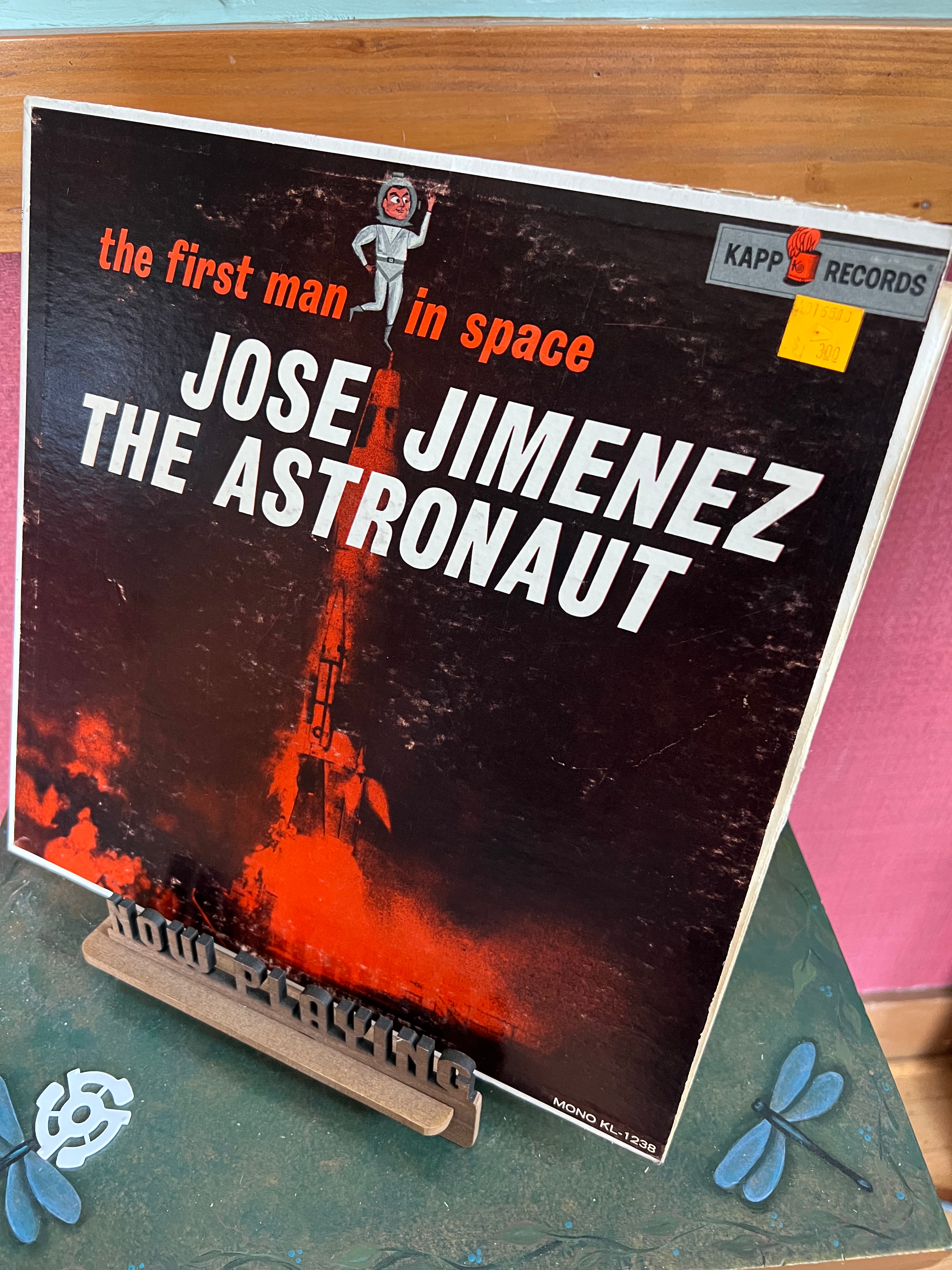
Filed under Jimenez, and not under
Bill Dana, the name of the comedian who
plays the character–José Jimenez
The Astronaut, the First Man in Space,
is the only comedy record album
in my collection, the only record in
the collection that was once part
of my parent’s record collection.
That record was lost to me until
I found a used copy somewhere and
picked it up. The album holds for me
a significant but somewhat embarrassing
pre-teen memory, a shameful little
chapter of that childhood which
nevertheless shaped in a positive
way my emergence as a performer.
As a middle school child, circa 1978,
I performed Bill Dana’s José Jimenez
First Astronaut In Outer Space
routine from the 1960 record album
for a comedic dialogue at a speech
competition and I won first place.
Nearly a decade after Bill Dana
himself stopped doing the routine,
I had no idea and my speech coach
had no idea and obviously the judges
had no idea that there might be
anything wrong with this material.
Our enlightened 21st century
perspective can detect the racism
here from a mile away, as Bill Dana
portrays his character José Jimenez
as a hapless, clueless, childlike and
silly individual who nevertheless
finds himself chosen to be the very
first American to travel into space.
José is not specifically identified
as Mexican, and there’s nothing in
the material that directly makes fun
of his heritage, or culture, or race;
he is just a person who is clueless
and somewhat trepidatious about
his role, clearly chosen for the job
because the powers that be are unsure
about his safe return so must choose
someone expendable, and he speaks
with a caricatured and inaccurate
Mexican American accent.
Bill Dana’s comic timing is impeccable
and his character is really quite lovable,
and yet, and yet, we know now, and
have probably known for decades,
that white actors and comedians
should on principle avoid performing
as and imitating the accents of people
of color. So, while I was naive and
innocent of any kind of racist intent,
I nevertheless feel pretty awkward
about this performance–while admittedly,
counting it as one of the most
significant early successes of my life.
And as such, this routine and its timing
are still indelibly burned into memory.
But don’t ask me for a reprise.
Side two of this album features Bill
Dana as himself on the first track
–but introduced by José, who invites
the audience to give him a “big round
of apathy” as he welcomes him to the stage.
I mean, he’s already on the stage.
Bill Dana thanks José and then says,
“You are a credit to your race,” and then
after a single beat he ads, “whatever that is.”
Maybe even in 1960 Dana had the
wherewithal to avoid profiling José’s ethnicity.
Sadly, but not surprisingly, Bill Dana is not
as funny as José. He’s clever, has a kind
of low-key Robin Williams vibe, where
the jokes in this particular short routine
have to do with invented nonsense words
representing the very strange language of
the aliens on the planet Venus.
The album ends with a pretty skippable
question and answer session between the
audience at the Hungry I nightclub and José
Jimenez, skippable, because in this 1960
recording, sometimes it’s hard to hear the
questions from the audience, and when
they are audible, the questions are kind of stupid
and barely give Dana (as Jimenez) anything
to chew on. I don’t remember much of
this last bit, because even as a kid I likely
found it rather tedious. Today, I pull up the stylus
about three minutes from the end.
I’ve relived a little piece of my childhood,
but I’ve had enough of that for now.
Notes on the vinyl edition: José Jimenez–the Astronaut: The First Man in Space, Kapp Records, 1960, black vinyl, used copy in pretty great condition.
In case you don’t already know: I’m listening to almost everything in my vinyl collection, A to Z, and writing at least one, sometimes two or three long skinny poem-like-things in response for each artist, and on a few occasions, writing a long skinny poem-like-thing in response to more than one artist. As a poet and a student of poetry, I understand that these things look like poems, but they don’t really sound much like poetry, hence, I call them “poem-like-things.” I’ll admit that they’re just long, skinny essays that veer every now and then into the poetic or lyric.
.

