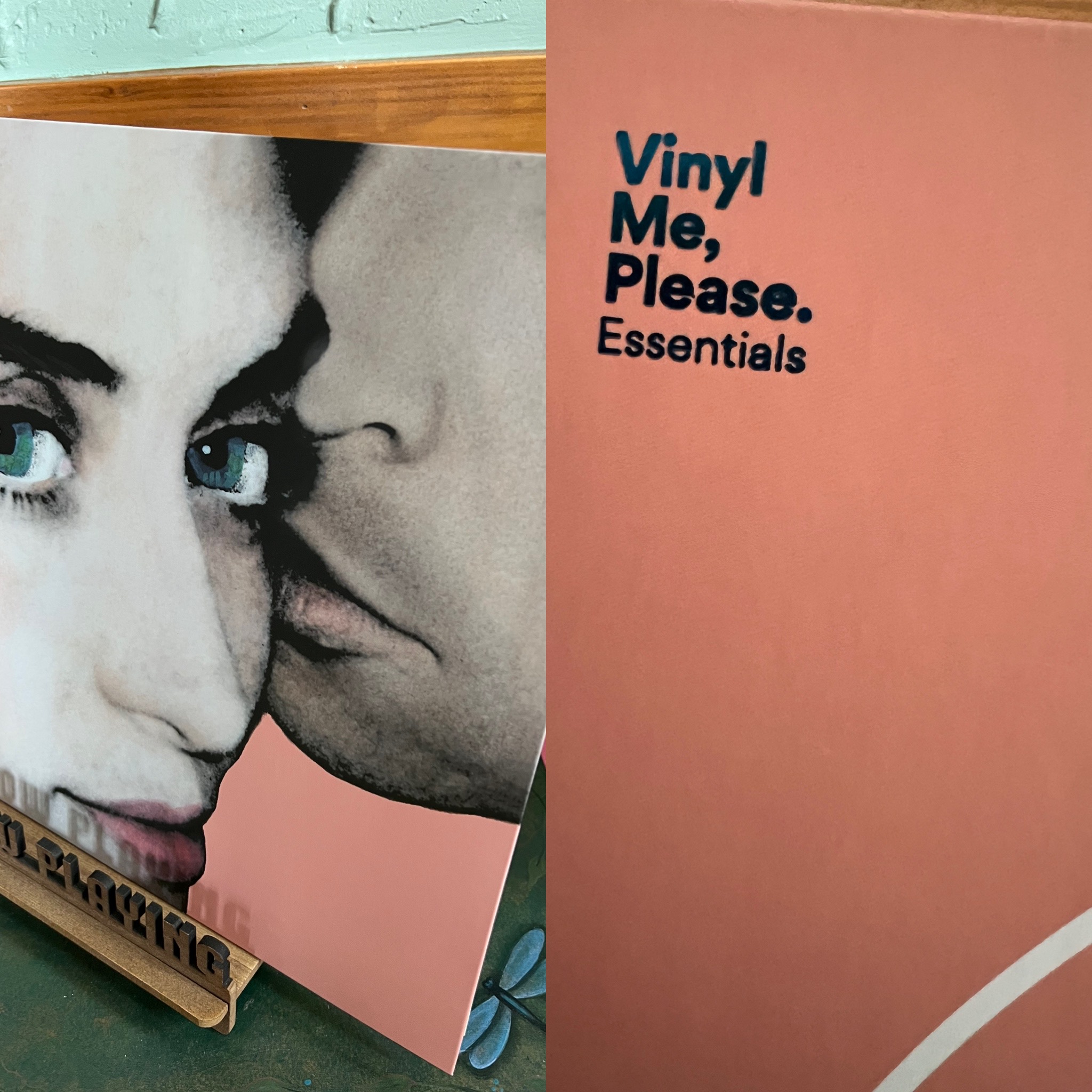
It’s been decades since I participated
in any kind of record club situation.
When I was young and poor it was
the easiest and cheapest way to
accumulate a CD collection, and when
I was a kid, my dad allowed me to order
records from his subscription at
Columbia House. When I became an adult,
I put away childish things and made
trips to the record store a kind of sacred
pilgrimage. But there was one detour,
perhaps about six or seven years ago,
when some internet ad sucked me into
this company calling themselves
Vinyl Me, Please. They promised special
editions of classic records or otherwise
critically acclaimed contemporaries, and their
ads must have been sufficiently enticing.
I had no idea at the time who Feist was,
but I ended up ordering her major label
debut, Let It Die, from Vinyl Me, Please.
I remember the thing that made
their records kind of special was their
ability to offer exclusive one-off varietals
of very particularly curated titles, so
if you ordered a record from them, it
would look different, have a stamp of
Vinyl Me, Please authenticity, and maybe contain
different kinds of goodies from everybody
else’s edition, which I couldn’t care less
about. So I’m not sure how I got hooked.
If I remember correctly, it was a favorite
Flaming Lips record on orange vinyl.
At any rate, Feist arrived along with
or shortly after Clouds Taste Metallic.
Mostly original tunes inside the infectious
pop sweetness vein of the single
“Mushaboom,” and including inspired
versions of The Bee Gees song “Love
You Inside and Out,” a classic French
cabaret song from 1957, and a classic
from the Glenn Miller Orchestra. So
Feist, at least at the time, was straddling
the divide between pure pop goodness
and torch song jazz and she was doing it
brilliantly. I love this record. I remember
it as Winter music in the household,
playing it with some frequency around
the November and December holidays,
maybe a cocktail in hand, a fire blazing.
It’s that kind of record. Why didn’t I pursue
the rest of the Feist catalogue, now about
twenty years or more strong? I’m not sure.
And learning that in the very early oughts
she was part of a musical collaborative called
Broken Social Scene, why didn’t I check
that out? I don’t know the answer to that
either. Listening again to Let It Die for the
first time in a few years, I am reminded that
I have some homework to do.
As for Vinyl Me, Please, soon after my second
or third order I ended up saying, no, thank you.
Notes on the vinyl edition: Let It Die, Polydor/Interscope Records, 2004/2018, sea green translucent vinyl.
In case you don’t already know: I’m listening to almost everything in my vinyl collection, A to Z, and writing at least one, sometimes two or three long skinny poem-like-things in response for each artist, and on a few occasions, writing a long skinny poem-like-thing in response to more than one artist. As a poet and a student of poetry, I understand that these things look like poems, but they don’t really sound much like poetry, hence, I call them “poem-like-things.” I’ll admit that they’re just long, skinny essays that veer every now and then into the poetic or lyric.
 michael jarmer