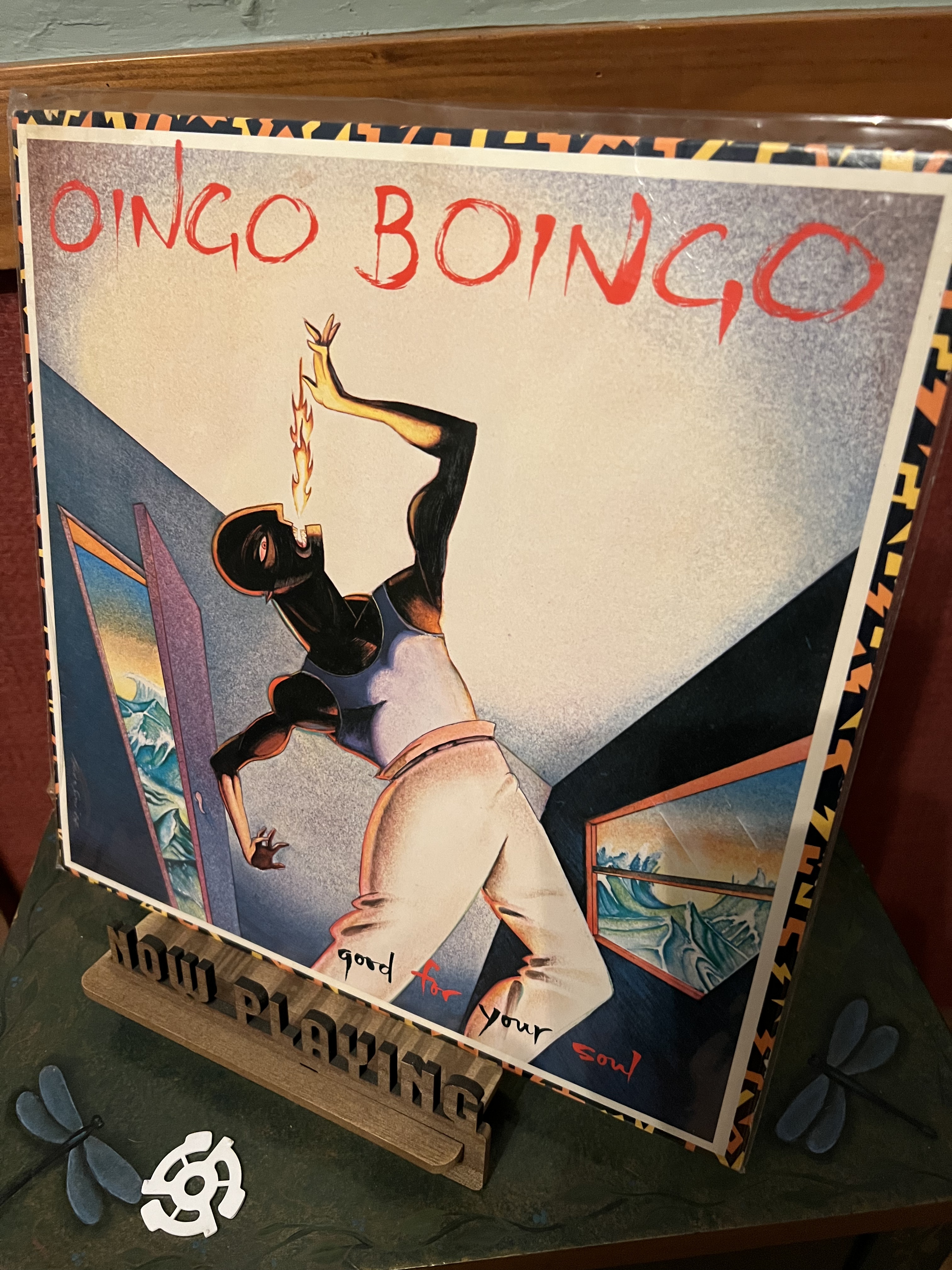
I recently wondered to myself:
it’s not in my CD collection,
why don’t I have Oingo Boingo’s
Good for Your Soul on vinyl?
The notion seemed ridiculous.
Somehow, I had never found a
copy to replace the one I lost
during the great vinyl purge of
1988, and my record store friend
tells me it’s become hard to find.
So, as I am methodically moving
through the alphabet and come after
The Police to The Polyphonic Spree,
I discover an extra heft to the Yes,
It’s True album in gatefold, and discover,
much to my surprise, a copy of Good
For Your Soul tucked away inside the next
album in the alphabet. Mon Dieu,
Sacre Bleu! I had the album I was missing
all along! I decide, in Gandalf fashion,
that this shall not pass. I must go back
and listen to what has become a kind
of rare Oingo Boing find: Good for the
soul, indeed. As it was the last of their
albums to be replaced*, and as it was
that I had forgotten I had it, the
third album by the art-rock punk new wave
band from Los Angeles must not have been my
favorite, but as I’m listening to it
this morning, I remember its greatness.
Before their next big hit and their
inclusion into the soundtracks of a
few mainstream films, and a full decade
before Elfman’s masterful Nightmare Before
Christmas, this record is intensely
weird, manic, spooky, bitingly satirical,
includes not one but two powerful and
prescient references to George Orwell
(“No Spill Blood” and “Wake Up: It’s 1984”),
and, on top of all that, it rocks
really hard. A great record, and a
wonderful easter egg find from the stacks!
*I have a burned CD copy of their debut
album, Only A Lad, from a download of the
album I actually purchased. So I don’t
know if I can officially say that it’s
“in the collection.”
Notes on the vinyl edition: Good for Your Soul, A&M Records, 1983, black vinyl. Original pressing? Maybe.
In case you don’t already know: I’m listening to almost everything in my vinyl collection, A to Z, and writing at least one, sometimes two or three long skinny poem-like-things in response for each artist, and on a few occasions, writing a long skinny poem-like-thing in response to more than one artist. As a poet and a student of poetry, I understand that these things look like poems, but they don’t really sound much like poetry, hence, I call them “poem-like-things.” I’ll admit that they’re just long, skinny essays that veer every now and then into the poetic or lyric.

