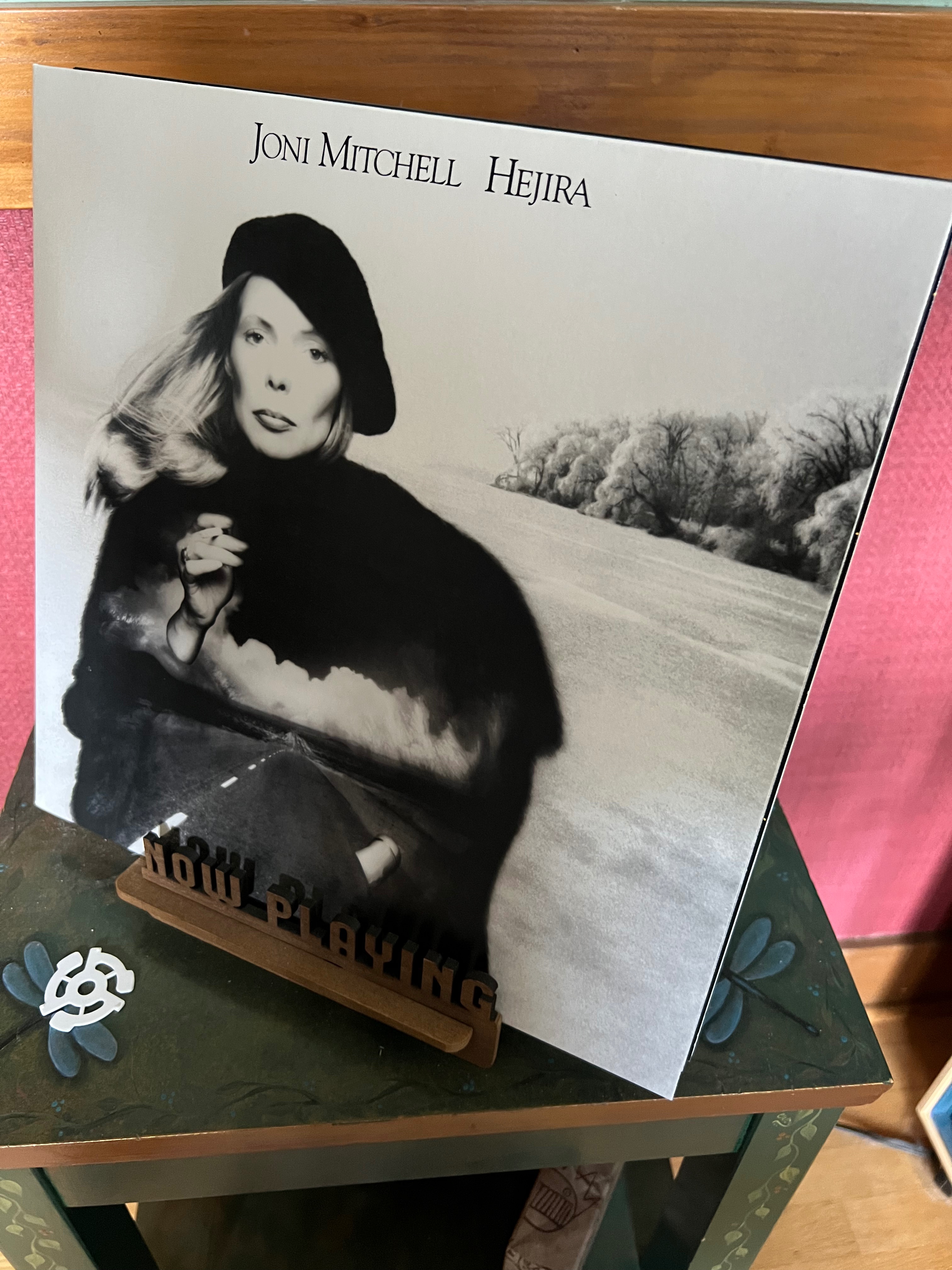
I didn’t really start listening
to Joni until the 80’s as I moved
from the hard rock of my childhood
and the new wave and punk of my
teenage years and learned to be a more
sophisticated listener. A musician friend
of mine turned me on to Wild Things Run
Fast and I was hooked. I followed Joni
forward pretty religiously until she
stopped making records, until her last
studio album, Shine, in 2007. Outside
of the Blue album, which I have on CD,
I had never really explored the back
catalogue, so within the last few years,
I picked up a used copy of Ladies of the
Canyon from 1970, and recently picked
up a boxset, The Asylum Years, 1976-1980,
which culminates with a studio album
I was familiar with, her first and maybe
only explicitly or true jazz record, the
collaboration with and tribute to
Charles Mingus.
The music from Ladies of the Canyon,
released in 1970, featuring a number
of songs that were written and recorded
as early as 1966, is a folky, minimalist
treasure. Absent of any drum set or
full band work, it is primarily guitar
and vocal, or piano and vocal, with
appearances by a number of other
instrumental voices, some cello, sax,
some woodwinds, light percussion.
This is the record with maybe her first
hit singles, “Big Blue Taxi” and “Woodstock,”
the latter made famous by Crosby, Stills,
Nash and Young, the former inextricably
tied to Joni’s indelible voice and her
super smart, literary lyricism and hippy
credibility. “You paved paradise, put up
a parking lot.” It’s the voice I remember,
but so much younger and quieter here
than what she would evolve into through
the coming years and albums, records
that would feature big bands and some
of the finest musicians working in jazz
and rock. Ladies of the Canyon is a terrific
album. I wish my copy of it was pristine.
By 1976’s Hejira, Joni is joined by a
number of musical luminaries, Jaco
Pastorius on bass and Larry Carlton on
guitar, so the tunes are percolating
a lot faster, are more jazzy, the production
is thicker, but there’s still rarely a set
of drums, rarely that sense of a rock
band anywhere in sight. The first tune
to feature a drum track is a ballad, “Furry
Sings the Blues.” My god, Joni sang
a ton of words, and her lyrics are story-
like and expansive, rarely rhyming,
and her melodies are all of them
so complex as to kind of defy a sense
of verse and chorus. The songs just
simply progress over a series of dense
chords and surprising changes. It’s
fabulous while not being overtly hooky.
Don Juan’s Reckless Daughter is weird
from the get-go. It begins with an
overture to “Cotton Avenue,” a
seemingly free-form improvisational
jam using guitar chords hitherto unknown
in our part of the galaxy, crazy choral
background vocals, and Jaco’s spooky
fretless noodling, until it busts into the
swing of that first tune, which brings us
back down to earth, but only a little.
But here, on this first tune, we have for
the first time in my listening from oldest
to newest, here in 1977, a full band:
drums, crazy Jaco bass, guitars, and Joni’s
jazzy warble. Even on the second tune,
“Talk To Me,” without drums, Jaco and
Joni manage to rock pretty hard. This is
exciting music, full of intensity, humor,
and lyrical inventiveness. At 16:19, side
two of the album contains one track,
the epic “Paprika Plains.” It’s piano and
voice, it’s orchestration, it feels at points
improvised, completely free of structure,
and then in the last few minutes a full
band kicks in with a sax soloist to take
it home. Some of these tunes, like “Otis
and Marleena,” I heard for the first time
on Joni’s Travelogue album, on which she
performs with a full on orchestra a bunch
of songs from the back catalog. Maybe
it’s just because I’ve heard some of this
music first on that 2002 album, but those
versions seem more accessible to me,
more melodically predictable. When I
hear the original studio versions for
the first time, I’m often hard pressed
to recognize the tune from what I remember.
I’m sure that for fans who bought these
albums when they were released, that the
opposite of my experience might be true.
At any rate, Don Juan’s Restless Daughter
is a challenging, beautiful, densely arranged,
masterful album.
Bass players of the Earth: if you have
never heard Jaco Pastorius play bass,
you have not yet lived. This last of a trio
of studio albums, Mingus, is a masterclass
of jazz bass playing, not to mention a
masterclass in the music of Charles Mingus,
not to mention a masterclass of Joni’s
incredible skill at moving comfortably from
genre to genre, from folk to fusion to jazz.
This album is the one that I already knew
well from my initial Joni education of the
mid to late 80’s. I remember it well. I listened
to it so often I could sing along with Joni’s
insanely complex and surprising melodies
and can still, to an extent. And here I am,
40 years later, checking out these interludes
between the tracks of Mingus and Mitchell
in conversation, referred to in the liner notes
as “raps,” and I can’t help but think of that
album by Solange, A Seat At The Table, and
its similar use of these kinds of spoken
interludes, and I realize how far Joni’s influence
reached out into 21st century American music.
Mingus was the last studio record she would make
in the 70’s, an incredibly powerful and prescient
dedication to the great jazz man, who would
die a year after these recordings were made.
Three years later she would demonstrate
her virtuosity one more time by making
Wild Things Run Fast, arguably the first
Joni album that could be stylistically
and accurately described as a “rock” album.
Another fantastic transformation.
I close out my Joni marathon with the
1980 live recording called Shadows and
Light. Pat Metheny is on this record playing
guitar. Don Alias on the drums. Jaco’s back.
What an incredible, kick-ass band. Although
I’ve never seen it, I think this concert found
it’s way to film. That’s one for the bucket list.
It’s easy to tell with the energy and precision
of this performance where Joni is moving
and where she will take us in the next
decade–a place more cozy with the rock/pop
universe, a place where a young Michael
Jarmer might find her and think, holy crap,
what have I been missing?
Notes on the vinyl editions:
- Ladies of the Canyon, Warner Brothers Records, 1970, used copy on black vinyl in decent shape.
- The Asylum Albums, 1976-1980, Rhino Record, 2024 (boxset includes the albums Hejira, Don Juan’s Reckless Daughter, Mingus, and Shadows and Light) six LPs on black vinyl.
In case you don’t already know: I’m listening to almost everything in my vinyl collection, A to Z, and writing at least one, sometimes two or three long skinny poem-like-things in response for each artist, and on a few occasions, writing a long skinny poem-like-thing in response to more than one artist. As a poet and a student of poetry, I understand that these things look like poems, but they don’t really sound much like poetry, hence, I call them “poem-like-things.” I’ll admit that they’re just long, skinny essays that veer every now and then into the poetic or lyric.

