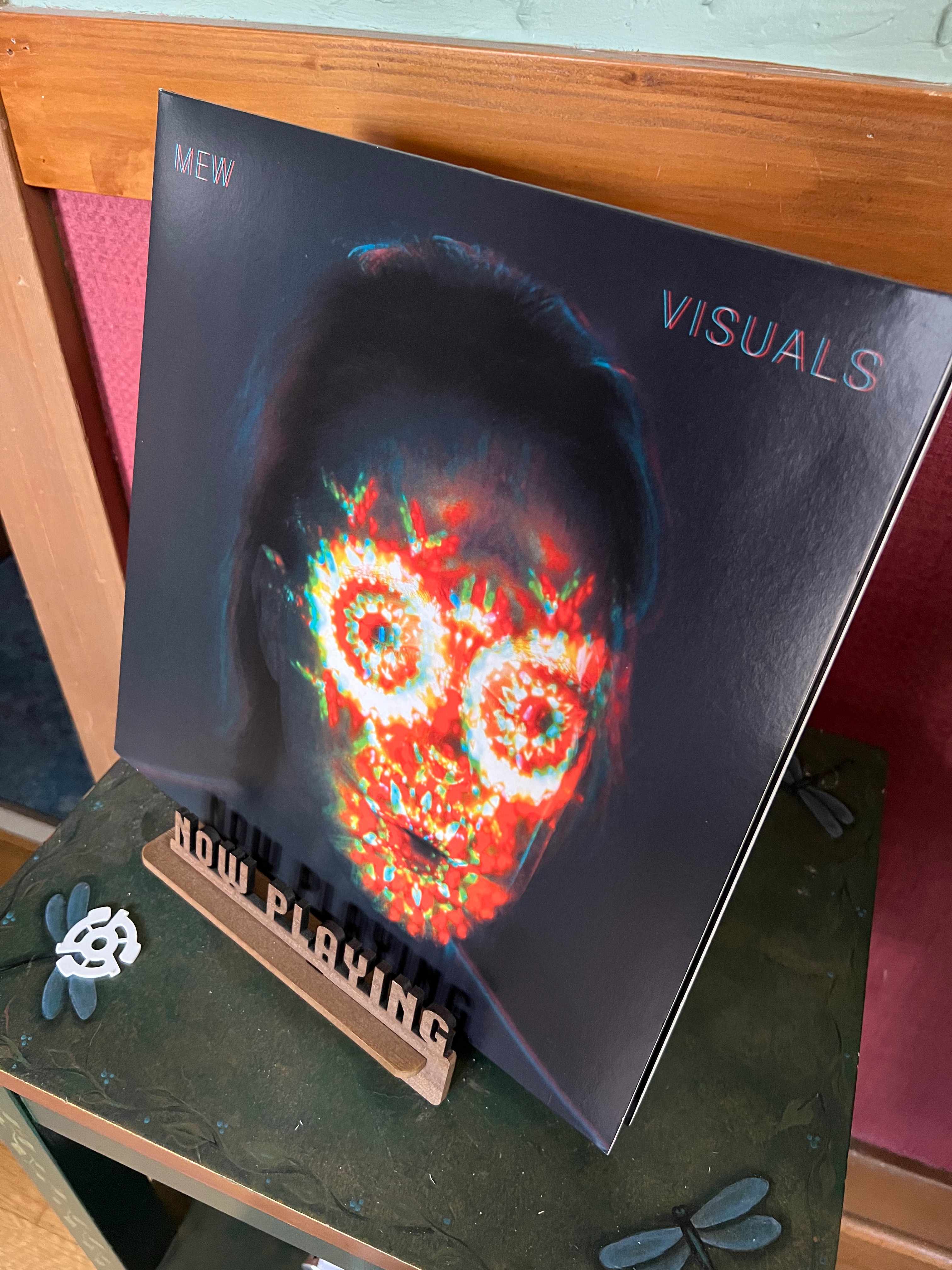
I haven’t listened to any radio
other than NPR for decades now,
and music television doesn’t exist,
so mostly, I learn about new music
by sampling things on the streaming
service, getting a recommendation
from a friend, or by accidentally
stumbling upon something new
on the inter webs, you know, in
the way that everyone and their dog
discovered Angine de Poitrine on
KEXP’s live video showcases.
All this is to say that, in 2015,
before my first subscription to a
streamer, before I was even aware
of KEXP, somehow I stumbled upon
Mew, this high energy, 80’s imbued
pop band from Copenhagen, Denmark.
My memory of it is hazy, but I think
I heard them on a listening station
at my favorite record store, which
was, for me, outside of reading reviews,
the place to discover new
music, and on that day I bought a
CD from Mew called +/-. I haven’t
heard it in a long time, but what I
remember is that it was a pretty
stellar album of synthesizer heavy,
super melodic, and slightly progressive
pop music. Two years later, with
that positivity about the band still
with me, I bought their 2017 album,
the album that would turn out
to be their last, an album called
Visuals. Listening to it this morning,
I find it undeniably good, but I hardly
remember it. It used to really bug
me when new records didn’t come
with a download card, a practice that
used to be ubiquitous and then
completely dropped off when Spotify
took over and started to destroy
the music business. I bring this up
essentially to explain why certain
really good records in my collection
did not get played as often as they
deserved: because I could not take
them on the road. Without a download
card or code, I could not get that
music on to my phone and thus
into the car, where, when I was working,
or when I was traveling to a gig,
I listened to a boat load of music.
And there was something fundamentally
different about downloading music
as opposed to, what we mostly do
these days, streaming in a car,
simply because (I think) of the sheer
volume of possibilities open to us
now. We are paralyzed by choices.
These days, when I buy a new
album, I try to download it from my
streaming service so that I can listen
while traveling. That has restored,
in part, the practice of being able
to listen on the go to the music
from a vinyl record I’ve recently purchased,
but truth be told, I would much
rather have those download cards
back so I’m not forced to pay twice
for the music I love.
Should I write about Mew?
First, let me just say that the lead
singer for Mew, one Jonas Bjerre,
has likely the sweetest, most
comforting, beautiful tenors I’ve
ever heard in pop music. He’s
rivaled maybe only by Morten
Harket, the lead singer of the 80’s
Norwegian pop stars, A-ha. Jonas
Bjerre has a voice that can
break your heart purely by
its sound–I mean, he could be
singing about grocery shopping
for all I care, and it might still
have the same effect. He’s not,
by the way, singing about grocery
shopping, but truthfully, I’m not
sure what he’s singing about
and I’m not sure that I care.
It’s enough almost to just get
lost in his beautiful singing.
Musically, the pop that these
guys craft is pretty sophisticated.
They move way beyond the standard
structure of verse chorus verse
chorus bridge chorus. Songs contain
movements and interesting,
unpredictable changes. Their
instrumentation is lush, their
production is full and easy on
the ears, even when they’re rocking.
And they do rock. While the keys
are prominent, some great guitar
work is also integral and the drums
are propulsive and active and then
sometimes dramatically just
disappear while the music takes
on a kind of orchestral move.
I enjoyed the experience of listening
to Visuals so much that I grabbed
the CD of the previous album from
the stacks, the oddly titled +/- and
I gave it a spin. A little more
bombastic than Visuals, it’s
equally engaging but a bit more
progressive, with long expansive
songs, five of which clock in over
six minutes, one of which coming in
at 10:42. As far as I understand,
Mew is no longer a band, having
performed a number of “Farewell”
shows as late as this year, even
though their last album is nearly
ten years old. They were an exceptional
band that’s worth having in the
collection. Those Nordic countries
continue to produce brilliant musical
artists, by now, more than I can count.
Notes on the vinyl edition: Visuals, PIAS Records, 2017, black vinyl.
In case you don’t already know: I’m listening to almost everything in my vinyl collection, A to Z, and writing at least one, sometimes two or three long skinny poem-like-things in response for each artist, and on a few occasions, writing a long skinny poem-like-thing in response to more than one artist. As a poet and a student of poetry, I understand that these things look like poems, but they don’t really sound much like poetry, hence, I call them “poem-like-things.” I’ll admit that they’re just long, skinny essays that veer every now and then into the poetic or lyric.

