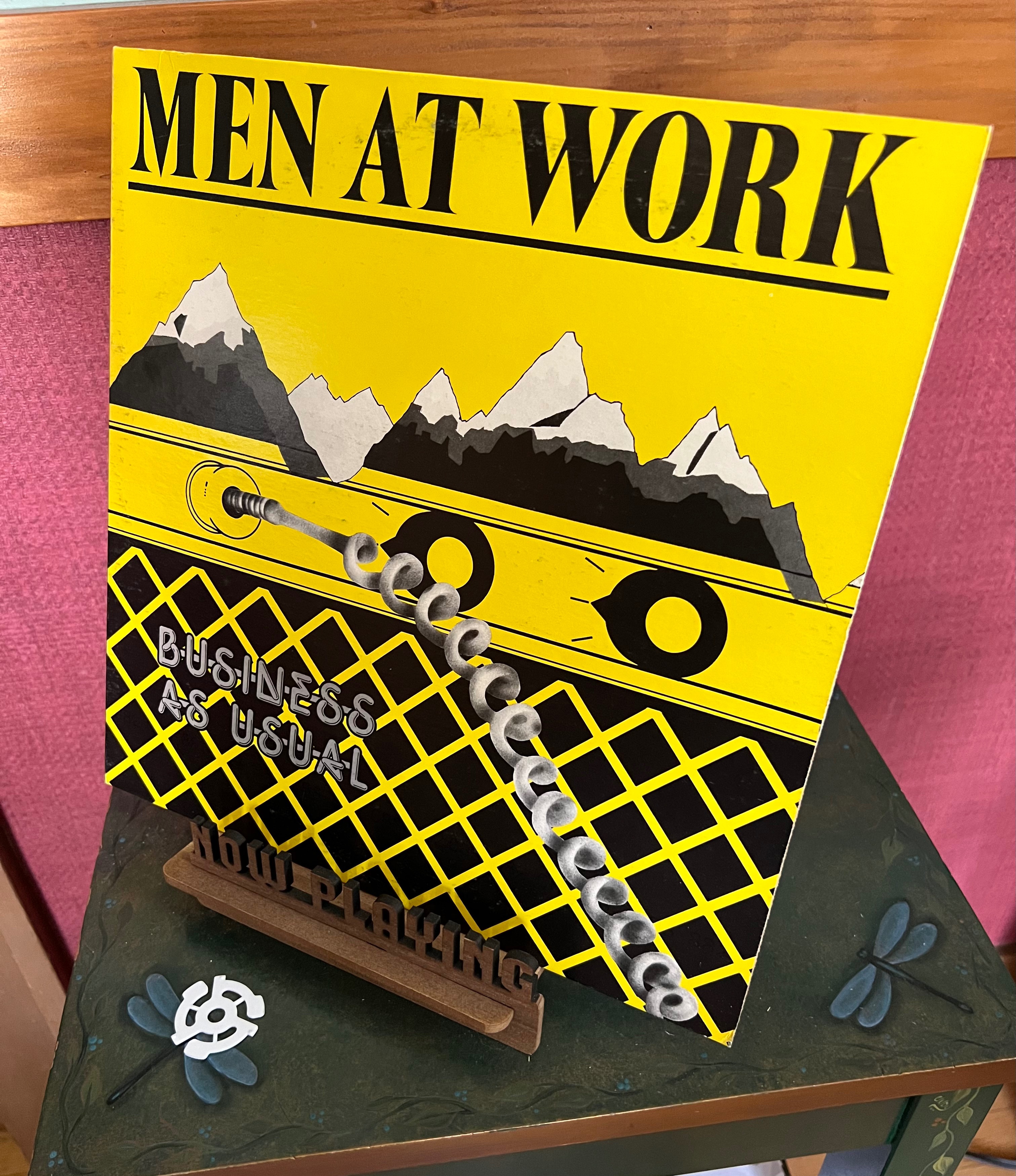
I will confess straight away
that, while I liked them all right,
and appreciated Colin Hay’s manic
presence on the music video
station, I didn’t buy a single
album from Men At Work.
Recently, when my brother decided he
would not likely ever play a record
again, he bequeathed to me his
collection of albums, and the debut
and the sophomore effort were
in there, and I kept them, so here
we are. An iconic sax riff, and then
“who can it be now,” the introvert
(or paranoia) anthem of the
decade, opens that debut record.
It’s a memorable song, hooky,
straight forward, witty. I always
liked that snare drum tap emulating
the knocking on the door. And the
third tune on the record, maybe
even more memorable than the
first single, has that famous Aussie
chorus: “I live in the land down under.”
Most Americans had never heard
of Vegemite before and suddenly
it was a household word, although,
until today, I would not have been
able to tell you what it was. Those
first two singles were pretty much
unforgettable. Less memorable,
but also kind of weird,
almost annoying in its theatricality,
is the third single off the debut
album, “Be Good Johnny.”
Outside of these three singles, the
album tracks are solid songs, but
hardly worth writing home about.
They must have been a busy band;
both the first and the second album,
Cargo, were released in the same year.
The claim to fame for the sophomore
record was the single “Overkill,” an
objectively good song–another terrific
saxophone hook and great melodic
turns from Colin Hay. This song
captures this odd, but lovely effect
of feeling kind of chill or mellow while
clipping along at 144 beats per minute.
A super strong moment on an album
that otherwise is workaday good,
workman-like solid, Men-At-Work-like
consistent, but this music, other
than the nostalgia I feel while listening
to the singles, doesn’t really move me.
Men At Work were playing a kind of
cleaned up, squeaky clean new wave,
songs that were easy to digest,
toe-tapping, minimally produced,
melodically strong, featuring Colin
Hay’s powerful (almost Sting-like) tenor,
and a group of musicians who
knew what they were doing.
But I don’t know that I will ever reach
for these albums again. I can’t think
of a single compelling argument for
keeping them in the collection.
Notes on the vinyl editions: Business As Usual, Columbia Records, 1982, black vinyl. Cargo, Columbia Records, 1982, black vinyl.
In case you don’t already know: I’m listening to almost everything in my vinyl collection, A to Z, and writing at least one, sometimes two or three long skinny poem-like-things in response for each artist, and on a few occasions, writing a long skinny poem-like-thing in response to more than one artist. As a poet and a student of poetry, I understand that these things look like poems, but they don’t really sound much like poetry, hence, I call them “poem-like-things.” I’ll admit that they’re just long, skinny essays that veer every now and then into the poetic or lyric.


If only I had a record player…
You could bequeath them to me, I love both and don’t own either, in ANY format, sadly…
I had them at one time in digital form on my computer, but that tower went through a house fire to being lost forever at a former housemate’s place…
Oh well.
Such is life!
Hang in there, friend. Somehow, someday, that music will return to you!
I always liked the wordplay twist on Johnny B. Goode in “Be Good Johnny.” Thanks for rattling my memory. -JB
Devo has a riff off that song as well!