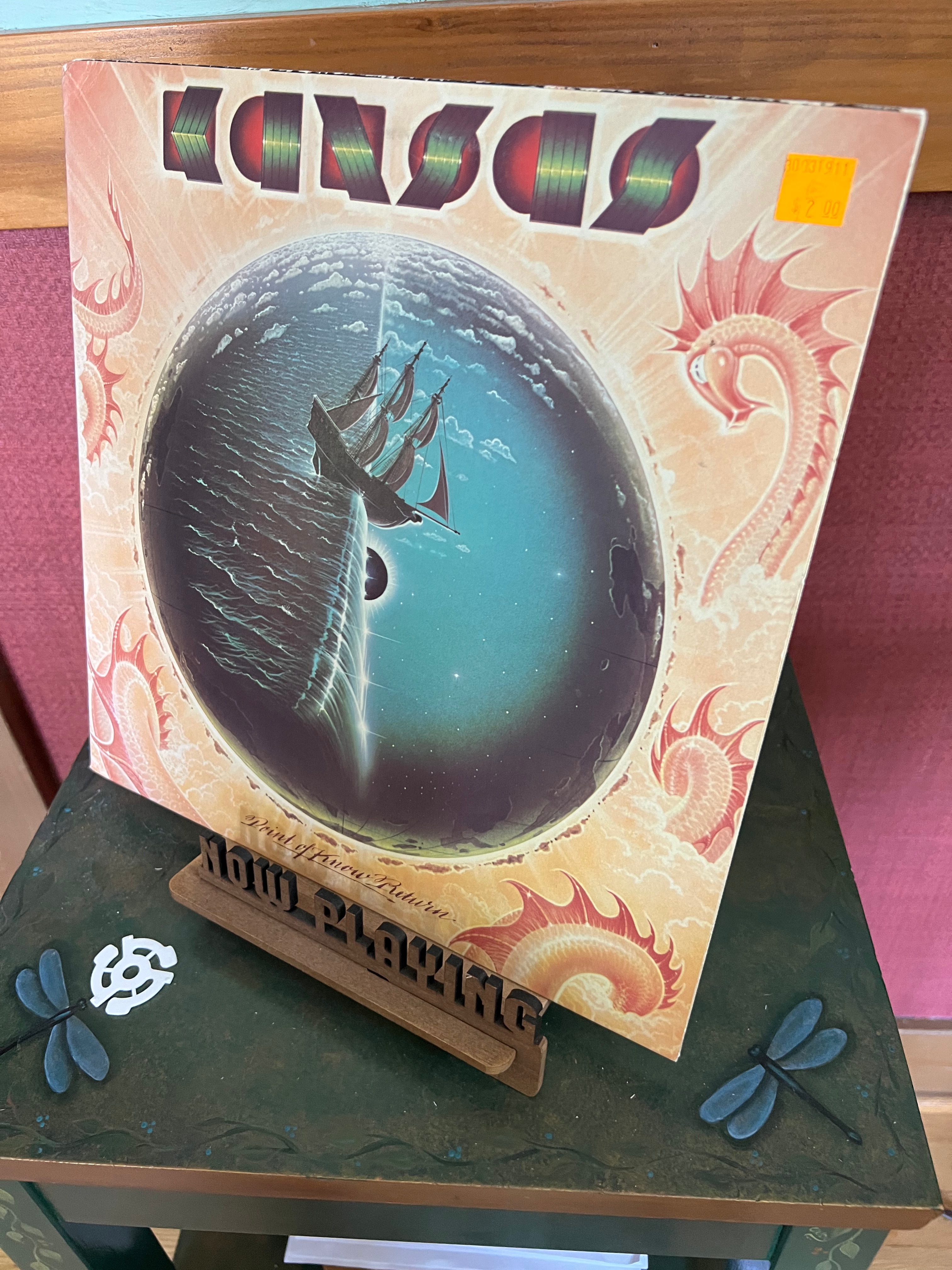
It may be a kind of curse
for progressive rock bands
to have big hits. “Carry On
My Wayward Son” is arguably
one of the greatest and
most catchy prog rock songs
in history, rivaled only by
maybe “Roundabout” from
Yes. But what’s also clear
is that after Leftoverture
and Point of No Return and
a sequence of a couple
of giant hit songs from those
albums, those Kansan
musicians called Kansas
never once rose again
to those kinds of crossover
heights. I’m sure they’re not
really complaining. One or
two hits is better than none,
those tunes are still played
over and over everywhere,
and as far as I can tell,
these cats, in various lineups,
have “carried on” all the way
into the 21st century, not a single
inactive decade, their most
recent studio album coming out
in 2020 and their most recent
tour dates in this year of 2026.
Not surprisingly, there are only
two original Kansans left, and
both of them have had to stop
touring due to health issues.
So this is not your mama’s Kansas.
We are not really in Kansas anymore.
It’s become a brand instead of a band,
but at least from my perspective,
the new kids are taking on the mantle
with great aplomb and respect
for the band’s history.
In fact, I like the 2020 album just
fine, in some ways, even more than
I like the classics from the 70’s.
It sounds better, for one. Lyrically,
it might be less goofy, but
Point of No Return is still
unquestionably, unreservedly a great
album, way stronger than
Leftoverture, notwithstanding the hit,
“Carry On My Wayward Son.”
I have the album Monolith in the
stacks, the follow-up to No Return,
and before playing it today
I remember nothing whatsoever
about it. As much as I liked
its predecessor, I did not continue
to buy Kansas albums into my
teens. So I’ve listened to Monolith
maybe only one other time,
when I bought it, and I can’t for
the life of me remember what
I thought. Listening now, it seems
wholly unfamiliar, like I may have
purchased it used somewhere and
never, not once, gave it a spin.
I do recognize “People of the South
Wind,” and, on side two, “Stay Out of
Trouble,” but I think that might be because
these tunes got some radio or video
action in 1979 or 80, the year MTV aired
for the first time. It sounds like
classic Kansas, maybe a little less
progressive, more rocking, and
while I may have liked it a lot
in my freshman year of high school
if I had picked it up back then,
it doesn’t do a whole heck of a lot
for me now. I’m doing my duty,
playing both sides, but I’m truly
looking forward to culminating
my listening experience today
with the 2020 album, The Absence of
Presence, the most salient feature
of which, for me, at least, is the inclusion
of new keyboardist and songwriting
contributor, Tom Brislin.
I first heard Tom Brislin as the
front man and keyboardist of the
alternative pop rock band
You Were Spiraling in the 90’s,
then in the early oughts when
the band shortened its name
to simply Spiraling, and I learned
of him, initially, from students
of mine who saw him open for
They Might Be Giants and came
to school singing his praises.
His appearance two decades
later on a Kansas album (he
also toured with Yes), brings
together these two generations
of musicians in this wonderfully
collaborative way. I mean, these
Kansas guys are older than I am
by a decade and Tom Brislin is
younger than I am by about a
decade. There’s some real cool
symmetry about that, isn’t there?
And I like to think that Brislin’s
contribution made a better Kansas
album, but alas, I’ve run out of time
in the day, and will have to listen
to The Absence of Presence tomorrow.
Notes on the vinyl editions:
- Leftoverture, CBS Records, 1976, black vinyl, used in good shape, kind of noisy.
- Point of No Return, CBS Records, 1977, black vinyl, used, super clean copy.
- Monolith, CBS Records, 1979, black vinyl, used, clean. Note: buying used vinyl is kind of a crapshoot. You can’t tell, often, just by looking at the disc, if it will sound good. My copy of Leftoverture, bought for $4, is noisy and poppy. Point of No Return, purchased for $2, is virtually perfect. This record, with another $4 price tag, plays perfectly and quietly. Another note: Good luck these days finding a good used record under $10!
- The Absence of Presence, Inside Out/Sony Records, 2020, opaque green double vinyl.
In case you don’t already know: I’m listening to almost everything in my vinyl collection, A to Z, and writing at least one, sometimes two or three long skinny poem-like-things in response for each artist, and on a few occasions, writing a long skinny poem-like-thing in response to more than one artist. As a poet and a student of poetry, I understand that these things look like poems, but they don’t really sound much like poetry, hence, I call them “poem-like-things.” I’ll admit that they’re just long, skinny essays that veer every now and then into the poetic or lyric.

