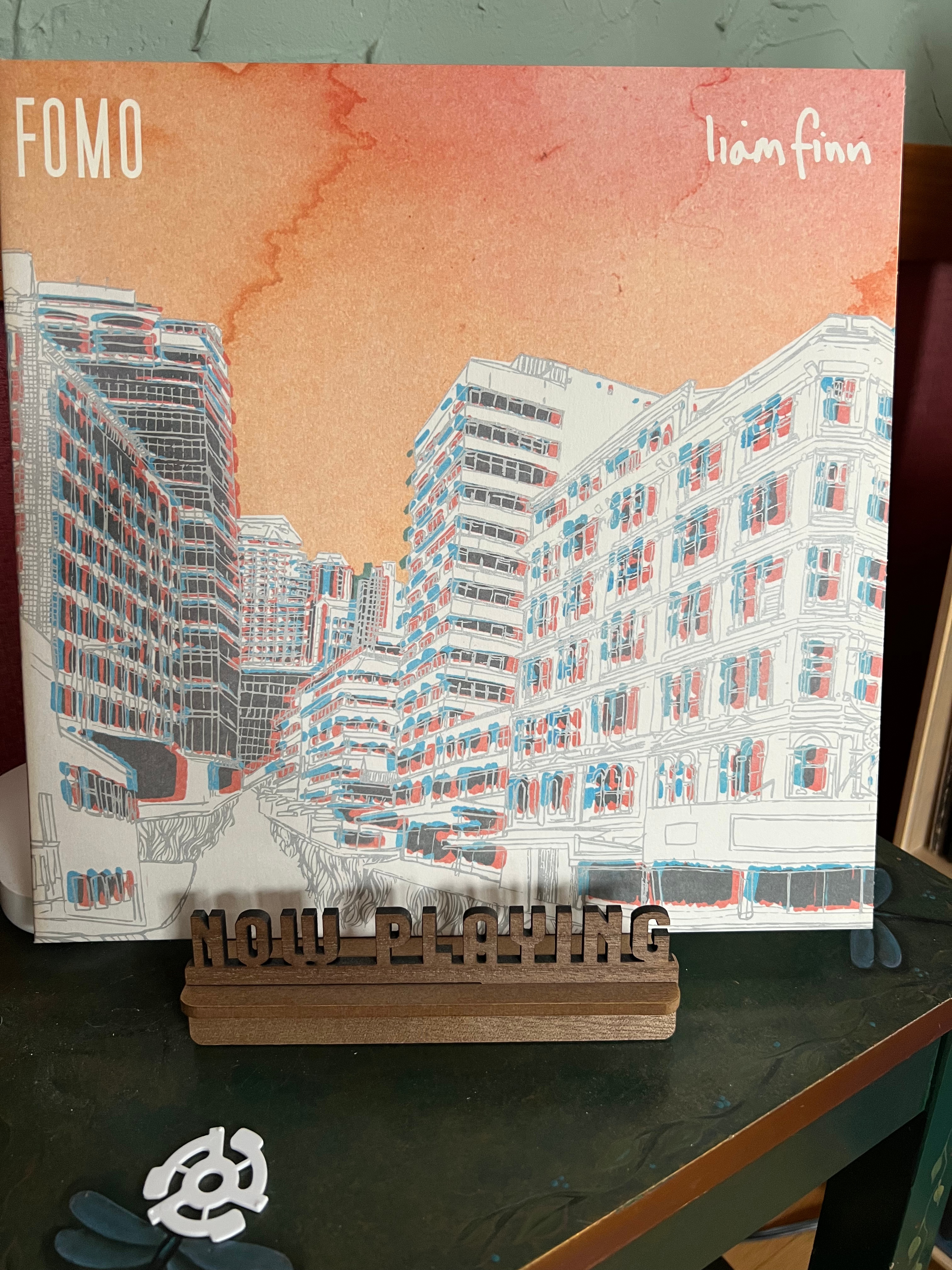
It seems like it was only a few days
ago when I was listening to Crowded House,
but it’s been actually about a month and a half.
Listening as much as I have been since the
start of October, sometimes the experience
becomes a bit of a blur. So I went all the way
back to January to reread my Crowded House
entry, lest I repeat myself in some way writing
again about members of this most gifted family.
The Finns, son Liam and father Neil, show up
again in the collection. When Liam was about
28 years old, he releases this solo album called
FOMA. Here’s another album that feels
like I am listening to it for the first time; it’s
been so long and, for some reason, it was not
a record I spun repeatedly. Listening now,
there’s no doubt: I like it a lot. It’s amazing how
similar Liam’s voice is to his dad’s, the same
kind of familial inheritance you can hear in
the voices of Lennon’s kids, or Harrison’s son.
I’ve never heard my own son full-throatedly
sing anything. I wonder if I would hear myself
in his voice like I hear Neil’s in Liam’s voice.
These tunes of Liam’s, like the songs of his dad,
are tuneful, lyrically smart, musically inventive,
expertly performed, almost single-handedly, at that.
Liam’s music is edgier,
noisier in places, more rocking, more
experimental in its production, more, day I say,
progressive. But that Finn energy going all
the way back to Split Enz is present here in
a big way. These are strong songs. Good, artful
pop music.
Next up is Neil Finn’s third solo album during
a kind of hiatus from Crowded House, Dizzy Heights.
I’m sure Neil was learning things from Liam,
because the production on this record is sometimes
more unhinged, unusual, atypical of a Neil Finn
outing. But while the sonic landscape might be
wilder, spookier, these are Neil’s beautiful melodies.
But even with the melodies, he sometimes stretches
out into experimental territory. It’s lovely to hear
and it’s lovely to imagine how his kids, both of whom
appear as instrumentalists on this album, are
steering Dad in all kinds of new directions.
And then
the last entry in my vinyl Finn collection
is the father and son collaboration, Lightsleeper,
which, for some reason, in this moment, on this
turntable, is unlistenable. The vocals are distorting.
I’ve cleaned the stylus, brushed the record, and
it’s still bad. I make the unconventional and
unorthodox choice, while the record spins over
there on my turntable with the tone-arm in
its resting place, to stream this album from TIDAL.
I don’t remember this one very well either.
Super chill and super weird, maybe the strangest
thing I’ve ever heard from Neil, at least.
Experimental, arty, surprisingly progressive. But
again, my response, like it was with that nearly
unrecognizable Liam Finn album, is entirely
positive. This is a record I could see myself listening
to repeatedly, so why didn’t I? It’s beautiful,
complex, understated in its strangeness, full
of unexpected synth noises and orchestral bits,
sometimes at the same time. It utilizes found noises,
it’s rhythmically minimalist (often there are no drums,
or just light percussion), and when the drums
do rock, the parts are unusual or idiosyncratic.
Again, because their voices are so similar, without
a close study of the liner notes it might be
impossible to distinguish Liam’s singing from
Neil’s singing. Certainly, a feature, not a bug.
Their voices are doing that thing you hear
in other family collaborations. It’s an incredible
blend of perfectly matched timbres and inflections.
As for the other Finns, Neil’s other son, Elroy, has not
released his own music that I know of, mostly plays
the drums on Neil’s solo stuff and in the last
Crowded House album, and Neil’s brother Tim,
while I have four or five of his solo albums on CD,
does not make an appearance in my vinyl collection.
It may be the most music in my collection
coming from the various members of a single family.
It’s a family affair.
Notes on the vinyl editions:
- Liam Finn, FOMA, Yep Roc Records, 2011, black vinyl.
- Neil Finn, Dizzy Heights, Lester Records, 2014, black vinyl.
- Neil Finn and Liam Finn, Lightsleeper, Lester Record, 2018, black double vinyl.
I have been thinking about a new turntable for some time now. What I’m using is a Pro-ject Elemental vertical turntable. It’s aesthetically a lot of fun, has always been a super cool conversation piece, and has worked pretty hard for me for many years now, but it started to sound bad (documented early on in this series), so I did the obvious thing and bought a new cartridge. There was immediate improvement (I thought), but, either because I’ve already worn out the new stylus, or because the turntable is inherently flawed, I’m having problems with distortion and ugly noise artifacts again. And the frustrating thing is that these terrible sounds are not consistent from record to record, indicating, what I might conclude, is evidence of bad pressings–lots of them. It’s the “lots of them” part that bothers me. No way has vinyl replication come to suck this bad. Am I going to buy a new turntable and learn that the records that sounded like shit still sound like shit? Somehow, I doubt this very much. My friend, Curtis, who hates my vertical turntable on principle, claims that its vertical position (even though the table slants slightly) is fighting against gravity, thus, preventing the stylus from tracking properly. I suspect he may be right.
Update: I got out a magnifying glass so I could look at my stylus up close and personal. Lo and behold, there was shit all over it. Apparently, my brush is not doing its job, and goo that the naked eye could not see was still gunking up the sound quality. It may not after all be a question of bad pressings, but some of my records might be dirtier than others. And perhaps, the position of the tone arm on this vertical turntable may, for some unknown reason, be accumulating more dirt. I think to myself, I may have to listen to Lightsleeper again! And I do. This is the first time in this whole process I have listened to an album in the sequence twice in a row. Worth it.
In case you don’t already know: I’m listening to almost everything in my vinyl collection, A to Z, and writing at least one, sometimes two or three long skinny poem-like-things in response for each artist, and on a few occasions, writing a long skinny poem-like-thing in response to more than one artist. As a poet and a student of poetry, I understand that these things look like poems, but they don’t really sound much like poetry, hence, I call them “poem-like-things.” I’ll admit that they’re just long, skinny essays that veer every now and then into the poetic or lyric.
 michael jarmer