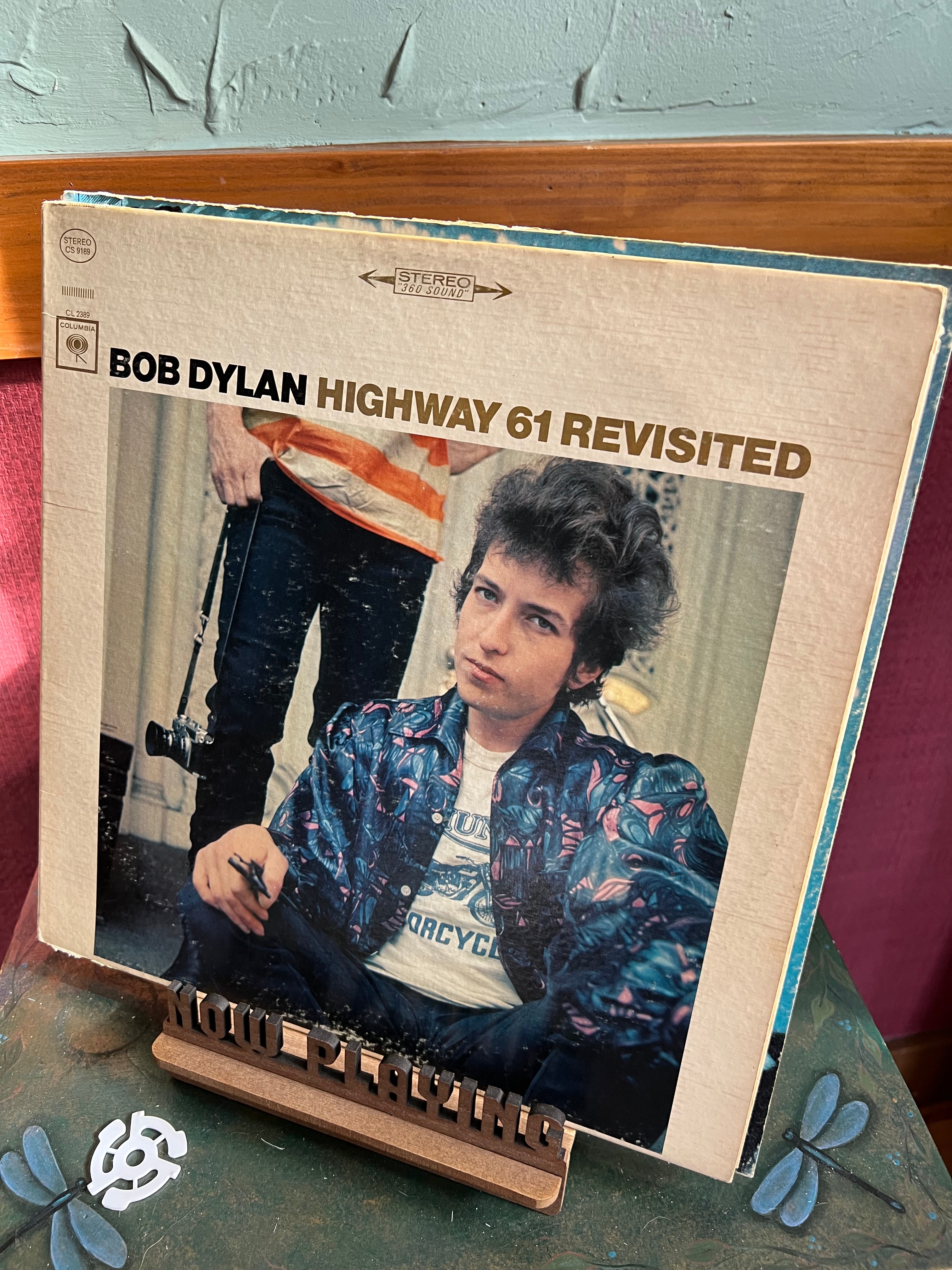
I have never really liked the music
of Bob Dylan. Only one or two exceptions
stand out in memory. The first: hearing
covers of Dylan’s music by the Byrds.
I liked the Byrds, and I liked their covers,
but, at the time, I had no clue these
were Bob Dylan’s songs. The second:
As a child there was one Dylan record
in the house, and it was Nashville Skyline.
And in this moment, looking at the track
list on the back cover, only one title
is recognizable to me. Still, I have a distinct
feeling that as a very young person
I liked this record. Confession: I have
never purchased a Bob Dylan album.
I inherited three albums from my late
brother-in-law Kevin, so I keep them in
the collection, in part to honor my
widowed sister’s husband, but also
because I understand and appreciate
the magnitude of Dylan’s impact on music
and on the world. He is a giant, no
doubt about that, and the figure on
the cover of Highway 61 Revisited
is about the coolest looking dude you
will ever see. Even by today’s standards,
that guy looks cool, timeless, influential,
important. So, a bit begrudgingly, in
deference to the end of the letter D
in the alphabet, and with respect to
the billions of people who site Dylan
as one of the most important musical
figures of the 20th century, I will
listen to the three Dylan albums in my
collection, courtesy of my brother-in-law,
Kevin, rest his soul.
“How does it feel to be without a home,
like a complete unknown, like a rolling
stone?” I’ll admit that this tune is pretty
much irresistible, harmonica notwithstanding.
“Tombstone Blues” is a song with two
chords, but is nevertheless, pretty engaging.
That damn harmonica, though, is likely
why I never really took to Dylan, and his
reliance on standard blues structures,
which as a kid I didn’t understand, and
as an adult who knows something about
music, I appreciate, but don’t gravitate to.
I forgive his lazy singing style, in part
because I have loved many a lazy singer.
And his lyrics are undeniably good, smart,
meaningful, he can rhyme like nobody’s
business, and often there’s a line or two
that just kind of demands attention.
“Something is happening, and you don’t
know what it is, do you, Mr. Jones,”
is a line that I like a great deal, I’m not
sure why–just because, I suppose, it
speaks to the obliviousness of so many
Americans, the wealthy, the powerful,
the anglo, about the real concerns of
our society and of our time. That’s as
true as it’s ever been, isn’t it, Mr. Jones?
I love that the “everybody must be stoned”
song is called “Rainy Day Women #12 and 35.”
I don’t know what’s up with that, but I find
it kind of hilarious. This may be the only
objectively funny song I know from Dylan
(he can be heard laughing out loud
during this performance, a wonderful thing),
and it’s the first tune on the 1967 Greatest
Hits compilation. To think Dylan had a
greatest hits record by the time ’67 rolled
around is kind of astounding. I guess
I’m just now learning that his debut album
comes out in 1962. Sure, five years of albums
is probably worthy of a big hits record.
And these tunes were undeniably hits,
all of them, universally famous, it seems,
except for maybe “Just Like a Woman,”
which to me feels totally unfamiliar.
I’m not usually a greatest hits fan, but
there’s only one tune on this record that
appears on the other two Dylan albums
I have, so it’s worth having, especially
since I will not likely be adding to my
Dylan collection any time soon. I’m good.
These three will do me fine service.
I know what you’re saying, that perhaps
I do protest too much. On the whole,
except for the harmonica, listening
to Highway 61 Revisited and the Greatest
Hits record has been an entirely pleasant
experience.
I am listening to Nashville Skyline for
the first time in decades, and yes, it’s
familiar. The bluegrass vibe of the title
instrumental track is a surprise, but yeah,
that opening duet with Johnny Cash,
I remember. And I remember the chill
nature of the songs on this record,
and I remember, hearing it as a child,
thinking absolutely not a second thought
about Dylan’s singing voice, which here,
sounds quite good, melodic, skillful.
It may have been, also, my first experience
as a child with music that was, at least,
adjacently country, and I didn’t hate it.
I understand the popularity of Jesse Welles.
He is our 21st century Dylan, and he sounds
like Dylan, too, which is weird, and at the same
time, appropriate. I like Jesse Welles, honestly,
more than I ever liked Dylan. But I like him,
as legions liked Dylan, for his relevance to
the times we find ourselves in. He is speaking
directly to the moment, directly in the moment,
seems entirely unpretentious, is taking clear
and unfair advantage of our social media
technology, and he is speaking truth to power.
He’s funnier than Dylan, is less urban than
Dylan, understands and uses irony better
than Dylan, and is, like Dylan was, cute,
albeit in a kind of homely, hillbilly way.
Ultimately, though, maybe it’s safe to say
that there would be no Jesse Welles
without Dylan. I’ll go ahead and make that claim.
Thank you, Bob. But a Nobel Prize in literature?
As much as I have learned to warm up to Dylan’s
music, this was and still is a difficult pill to swallow.
Notes on the vinyl editions: Because my Dylan benefactor, my brother-in-law Kevin, was in his early 70’s when he died, it would not surprise me if these Dylan records were not first editions. He took great care of his records. These three specimens are in nearly mint condition, but the covers look a little worn. He loved these albums, clearly. Yeah, these records are practically without noise. It raises the question, a question that riles me up, quite frankly: how is it possible that records manufactured in the 60’s sound better than some of the records released in 2025, at least in terms of noise artifacts, pops, crackles, distortion?
- Highway 61 Revisited, Columbia Records, 1965, black vinyl.
- Greatest Hits, Columbia Records, 1967, black vinyl.
- Nashville Skyline, Columbia Records, 1969, black vinyl.
In case you don’t already know: I’m listening to almost everything in my vinyl collection, A to Z, and writing a long skinny poem-like-thing in response for each artist, and on a few occasions, writing a long skinny poem-like-thing in response to more than one artist. As a poet and a student of poetry, I understand that these things look like poems, but they don’t really sound much like poetry, hence, I call them “poem-like-things.” I’ll admit that they’re just long, skinny essays that veer every now and then into the poetic or lyric. .
 michael jarmer
I think that Kevin would approve.