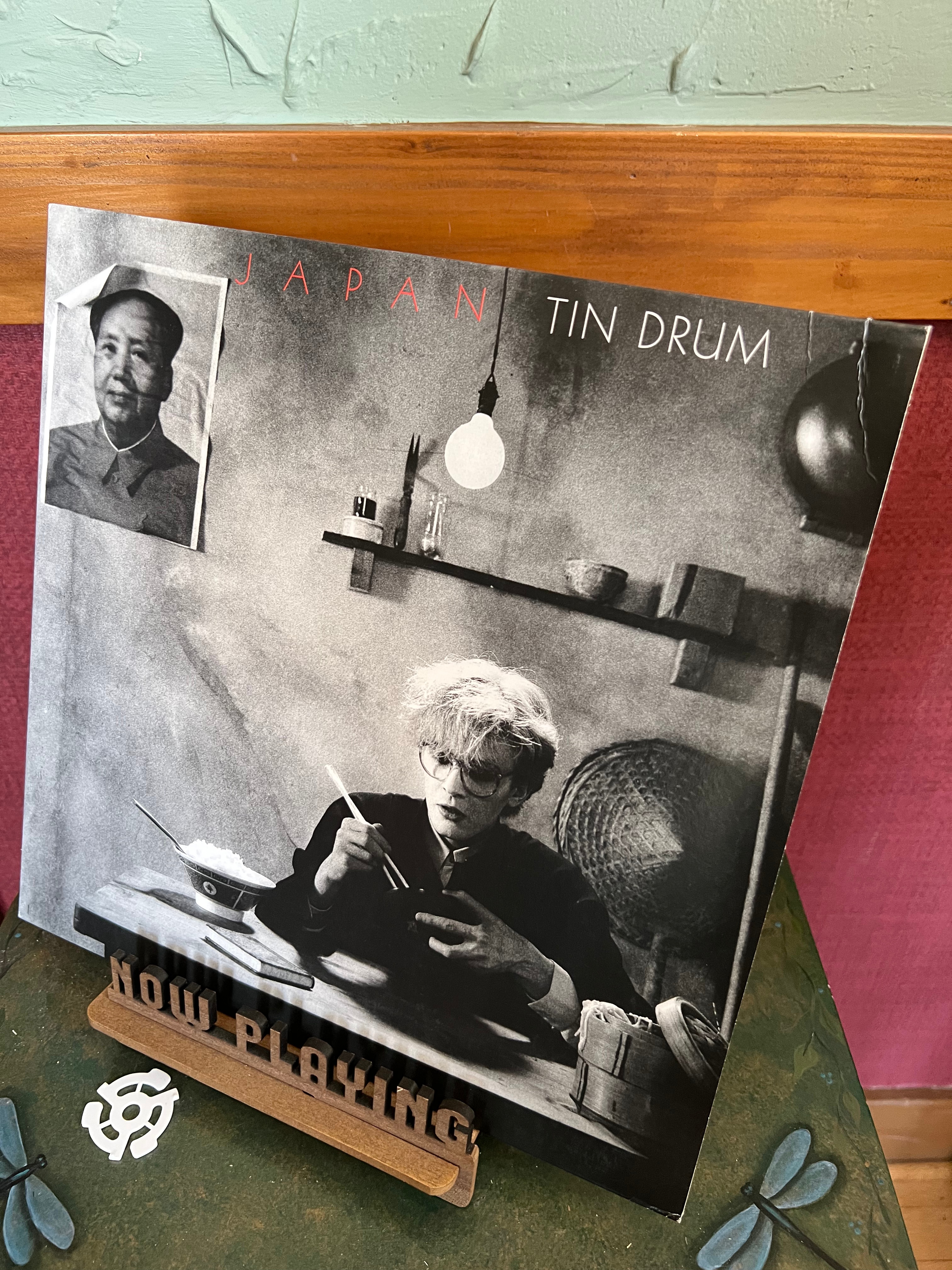
Even though I have never thought that
place proper nouns make good names for
rock bands, it makes some sense that
a band from Kansas would call themselves
Kansas, or a band from Boston would call
themselves Boston, or a band from
America might call themselves America.
This band here, Japan, one of my lasting
absolute favorite bands from my teen years,
well, they were from England.
It is instructive to listen to a band’s
discography backwards, which is what I did,
hearing them for the first time in 1982,
(unbeknownst to me, after the band had already
broken up), when I bought some weird U.S. pressing,
a compilation of songs from their last two records.
At the time, the only Japan albums available in
the U.S. were imports of the original albums,
and they were difficult to find, and then this thing
showed up at my neighborhood record
store, and I’m not sure why I took it home.
Either I was just struck by the cool photo of the
band, super handsome English boys, replete
with new wave hair and make up, but dressed
like members of The People’s Liberation Army,
or the band was highly recommended by the guy
working the store that day. But this compilation
thing absolutely did the trick; it was my gateway drug.
I bought all their albums, in reverse chronological
order, as soon as I could find them,
and I continue up to this day to follow the output
of individual members, David Sylvian, Richard Barbieri,
Steve Jansen, and the late Mick Karn, one of the
greatest rock bass players, I think, of the era.
So even though I discovered them backwards,
I am listening today forwards, from 1978 to 1981,
five studio albums released over three or four years,
a discography that demonstrates, during a super
short musical career, the most radical sonic
transformation of any band in my entire collection.
In 1978 on their debut album, Adolescent Sex,
they are a long-haired, guitar-driven, glam-inspired,
funk metal band with silly rock and roll lyrics.
On their sophomore effort, Obscure Alternatives,
they maintain that vibe for the most part, but
start to introduce a reggae beat here and there,
they get more moody, things slow down a notch,
the lyrics get spooky, more artful, more heady.
Mick Karn puts on a fretless bass and the
keyboards take a more active role–perhaps,
the two key ingredients for the wild transformation
about to take place with the third album, Quiet Life.
Synthesizers forward, arpeggiated programming
on top of Steve Jansen’s remarkable live drums,
the introduction of the saxophone,
and strings in the vein of “Madman Across the Water,”
suddenly in 1979 they are a full blown new wave band
with huge progressive leanings, and Sylvian’s singing
and lyrics are barely recognizable from the earlier records.
From a tenor rock and roll squawk, he transforms into
a baritone crooner with an endearing vibrato,
and from a typical glam sex, drugs, and rock
kind of lyrical palette, suddenly he’s a poet,
a philosopher, singing about the quiet life.
If Japan ever had anything like a hit, especially
here in the United States, it was the title track
opening their fourth studio album, “Gentlemen
Take Polaroids.” With a tempo just fast enough
to dance to, it nevertheless is one of the most
chill pop songs of the era, the closest thing
to it might be found on Roxy Music’s Avalon.
On this record, David Sylvian is settling into his
new voice, a voice that would carry him forward
into his solo work after the band’s last record,
a voice with a little bit of Ferry, a little bit of
Bowie, a gentle croon that was, despite my
comparisons, at least to my ears, unique and
ultimately soothing, like a rock and roll warm
blanket. And Mick Karn’s work on his fretless
bass leant a kind of rubberiness to Steve Jansen’s
intricate and groove-laden drum tracks. Even
though I understand that relationships became
strained in the last year or two of their career,
it seems to me that, at least among my 80’s
heroes, no four musicians were better suited
to each other than these cats. I loved this band
so much–and they felt like they were mine.
In 1980 suburbia, it felt to me like I was the only
human being listening to and loving their music.
Their last and their best album, Tin Drum,
is a desert island disc. If for some reason I had
to jettison my entire record collection except for
ten albums, Tin Drum would be one of those.
This record was the pinnacle, the ultimate
expression of the monstrous talent of these
four musicians. Rhythmically more sophisticated
than anything that came before, lyrically more
abstract and arty, and melodically masterful,
there are no skippable songs; every single tune
is a gem of the best new wave synth-based
songwriting of the entire movement. If I
remember correctly, the first two songs on
Tin Drum were also the first two songs on
that strange compilation record that got me
started, “The Art of Parties” and “Talking Drum,”
in my mind, two specimens of absolute perfect
pop confection.
I seem to remember reading
an interview with David Sylvian where he
expressed some embarrassment about the Japan
years. I don’t understand it, but perhaps an
insight might be drawn from some of the strange
cultural appropriation. Here’s an English band
called Japan, presenting their final album,
the cover of which features iconography that
is clearly Chinese, the music on which borrows
sometimes obviously from Japanese, Chinese,
and Middle Eastern motifs, with titles like
“Canton,” “Visions of China,” and “Cantonese Boy.”
Far from being racist, I think, the worst that
could be said is that Sylvian was perhaps
romanticizing cultures he knew nothing about.
But that’s not a fair assessment. Sylvian had
a long creative relationship and friendship
with the influential Japanese musician and
producer Ryuchi Sakamoto. More like, it was
that David Sylvian was 23 years old. Maybe
we all do embarrassing things when we’re
23 (I know I did), and as creative types, we’re
not likely to be proud of everything we did
in our twenties (I know I’m not). Nevertheless,
I’d give up an arm to have written a song as
good as “Still Life In Mobile Homes” or “Ghosts,”
to have made an album that sounds as good
as Tin Drum sounds.
Notes on the vinyl editions:
- Adolescent Sex, Hansa International Records, 1978, black vinyl, import.
- Obscure Alternatives, Hansa International Records, 1979, black vinyl, import.
- Quiet Life, BMG Records, 1979/80, 2021 box set reissue: the original album, remastered, on heavyweight black vinyl, and three bonus CD’s, one of the remastered album, one of alternative mixes, rarities and the Live in Japan EP, and one Live At Budokan concert from 1980.
- Gentlemen Take Polaroids, Virgin Records, 1980, heavyweight black vinyl, new pressing.
- Tin Drum, Virgin Records, 1981, heavyweight black vinyl, new pressing.
In case you don’t already know: I’m listening to almost everything in my vinyl collection, A to Z, and writing at least one, sometimes two or three long skinny poem-like-things in response for each artist, and on a few occasions, writing a long skinny poem-like-thing in response to more than one artist. As a poet and a student of poetry, I understand that these things look like poems, but they don’t really sound much like poetry, hence, I call them “poem-like-things.” I’ll admit that they’re just long, skinny essays that veer every now and then into the poetic or lyric.
 michael jarmer