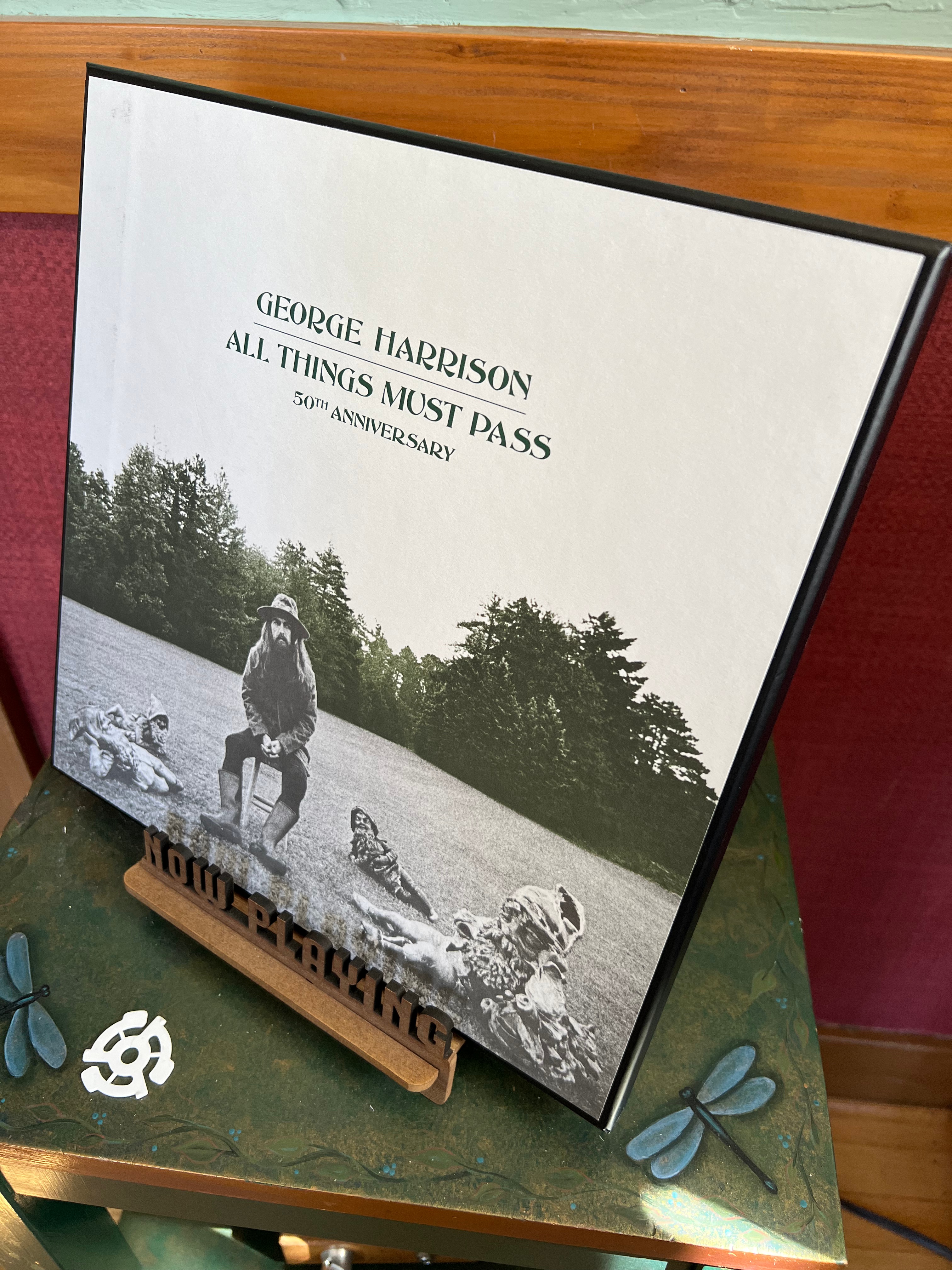
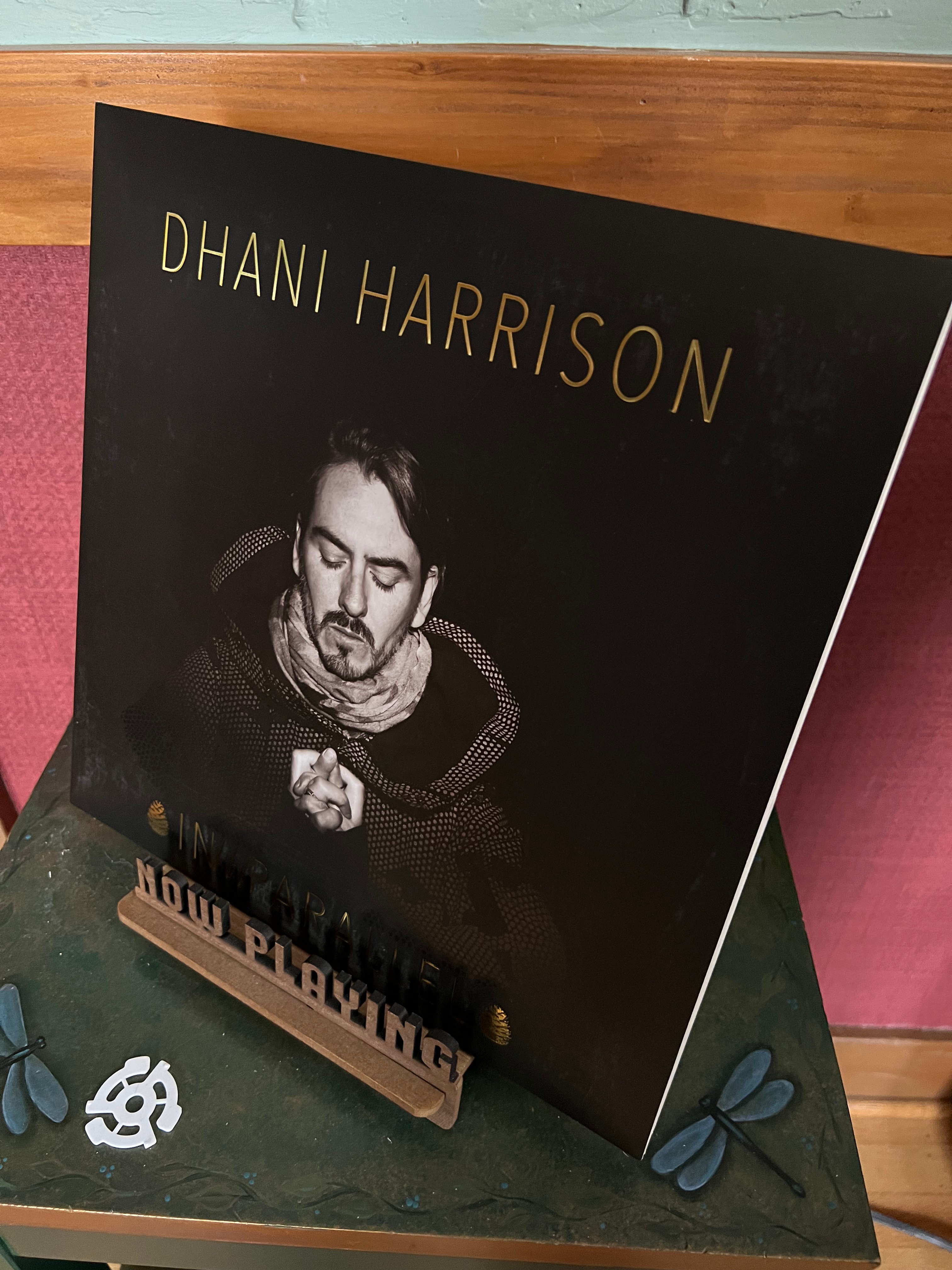
Prologue
Not the first time
listening to music by
offspring of another famous
musician, (Liam and Elroy Finn),
and not the first time writing about
the music made by an offspring of one
of The Beatles, (Sean Lennon), this IS
the first time listening to and writing about
the music of both The Beatle and their offspring
in the same poem-like-thing. People of Earth,
I give you George Harrison and his son Dhani.
George
As a child in the 70’s, I heard George
Harrison’s solo work on the radio,
but for some reason never took the plunge.
I would be an adult before purchasing
a full album of George Harrison’s music,
and that was the 1987 album
in collaboration with ELO’s Jeff Lynne,
an album called Cloud Nine. And even though
I liked that CD a whole hell of a lot,
I still would not explore Harrison’s back
catalogue until recently with the 50th
anniversary edition of the classic
All Things Must Pass.
It’s 1970 and George Harrison is singing
about Hinduism and Christianity and the
concept of a universal God. It’s astounding
to me to think about how huge of a hit this
song, “My Sweet Lord,” was. I mean, it’s
catchy as all get out, but somehow
my brain wants to suggest that
this radical idea would not be receptive to
most of Western civilization in 1970. Did
people just hear it as a kind of Christian
praise song and just sidestep the fact that
the background vocals are alternately
singing “Hare Krishna” and “halleluiah”?
As a little Catholic kid, I must have just
been smitten with the melody hook.
I don’t remember having a single spiritual
thought when I heard this song. I only just
vaguely knew what a Hare Krishna was,
probably associated in my mind with the
hippy movement of the late 60’s, but even of
that I could have only been vaguely aware.
I was, after all, just six years old.
“Isn’t It A Pity” is a beautiful song, even
though it is essentially one riff or progression
over and over again. The sentiment here is
a timeless one, impossible to argue with,
especially relevant 56 years later. Yes, George,
it is a pity that we “break each other’s hearts,
cause each other pain.” There seems to be no
end to that kind of thing. And there’s “What Is Life,”
another triumphant, groovy, classic piece
of pop songwriting. This entire record is good.
Even though going in I was only familiar with
the singles, most every other song I find
appealing and strong. Harrison was the most
underrated and underutilized Beatle.
And sonically, All Things Must Pass sounds
big and full. It probably represents
a huge step forward in the world of audio
engineering, as did all of the last Beatles’
studio albums. Probably the best sounding
records of their era. The 50th anniversary
edition contains a third LP of bonus tracks,
essentially Harrison et al. just jamming,
and I remember the first time hearing it
thinking that it was pretty much skippable.
So I’m skipping it today, trusting my
recollection of the experience.
Dhani
Immediately, on the first track of Dhani
Harrison’s In///Parallel, with the Indian
percussion, and the microtonal strings,
“Within You and Without You” comes
to mind, and the moment Dhani begins to
sing, George is there in that voice. As is
the Eastern spiritualism. What distinguishes
Dhani’s music radically from his father’s
is the drum programming, synthesizers, and
the gothic-sounding, industrial production.
Kind of like the love child between a Beatle
and Trent Reznor, this music is mostly
electronic and dreamy, not especially hooky,
not especially toe-tapping, would probably
not go over well on the dance floor. It might
work at a rave, however, if one was high
enough and the light show was good.
It’s a trippy, spooky record. Trance-like. Dhani
is a good singer, as far as I can tell without
any lyrics in the liner notes, a good writer,
and there are some glorious and surprising
female background vocals. One such singer,
who on some tracks has a number of lead
vocal features, is a person named Mereki, who
I’m just now learning is a singer songwriter
from Australia, whose debut album will
arrive in the world about six years after this
album was recorded. I make a note to myself
to check her out as soon as this record is over.
I’m listening to In///Parallel this afternoon with
headphones on and that was a good
decision. The production is full of ear candy.
Synthesizer noises, strange rhythmic pops and
buzzes, percussion that sounds like the flapping
of insect wings, and Mereki’s unearthly contributions.
Sometimes he just has her whispering things, like
some kind of haunt. I like this album, but I don’t
remember a thing; it might as well be a brand-new
record for me, and how exciting is that? What
could be more fun? Maybe, a band formed by
the children of The Beatles?
That would be more fun.
Notes on the vinyl editions:
- George Harrison, All Things Must Pass, Apple Records, 1970, 50th anniversary edition, three LP boxset, black heavyweight vinyl.
- Dhani Harrison, In///Parallel, BMG, Hot Records, 2017, black double vinyl.
In case you don’t already know: I’m listening to almost everything in my vinyl collection, A to Z, and writing at least one, sometimes two or three long skinny poem-like-things in response for each artist, and on a few occasions, writing a long skinny poem-like-thing in response to more than one artist. As a poet and a student of poetry, I understand that these things look like poems, but they don’t really sound much like poetry, hence, I call them “poem-like-things.” I’ll admit that they’re just long, skinny essays that veer every now and then into the poetic or lyric.
 michael jarmer