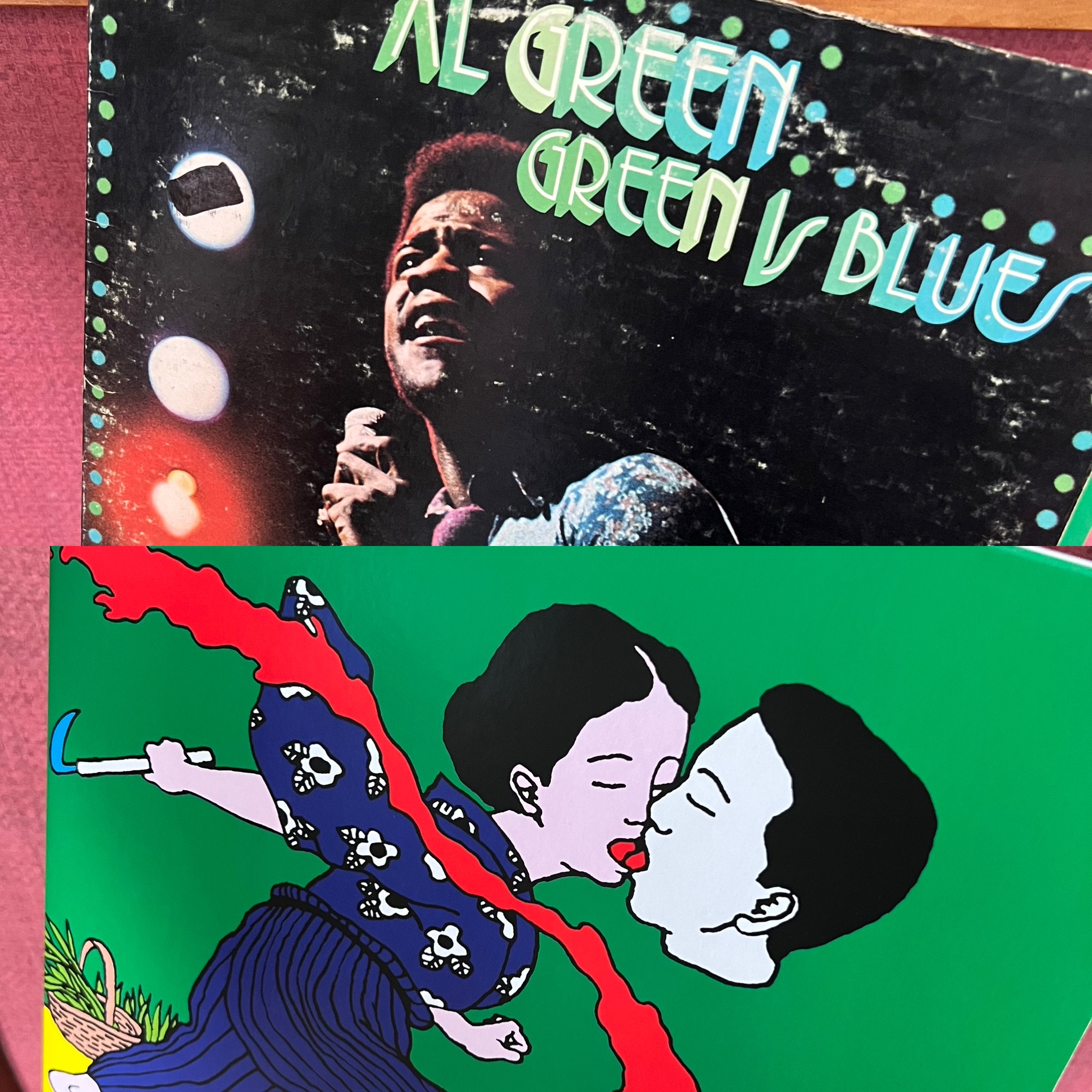
Here’s an odd pairing for you right
next to each other in the alphabet,
the iconic soul singer Al Green and
the contemporary prog rock mad
scientist guitar player singer Geordie
Greep. Like the pairing of Glaspy and
Glavor, I put them together here just
so I can type their names side by side:
Glaspy and Glavor, Green and Greep.
Outside of the sound of their names,
these two artists, perhaps two generations
removed, have very little in common,
except for maybe, in small moments or
in a song here and there, Geordi Greep
might sound a little bit like a soul
singer, or a lounge lizard–perhaps more
like Frank Sinatra than Al Green.
I do not know how I acquired Green’s
1972 album Green is Blues. The cover
is beat to hell and the record looked dicey
but after a cleaning it played nicely without
a single skip or scratch and just few enough
pops not to impede the listening. I’m on
a soul train now, and his voice is super
familiar from all those 70’s hits but none
of those songs are on this record. No matter.
It’s still a vibe, as the kids say. Al Green
was like a chill James Brown. He could
get funky but he rarely ever yelled. His was
a silky, slinky kind of voice, pitch perfect,
spot on, rhythmically and stylistically
agile. And on this record, yeah, there are
some blues tunes, but it’s mostly along
those soulful lines. He’s got writing
credits on only a couple of these songs,
all the rest are either songs that were
written for him, or covers like “My Girl,”
“The Letter,” and oddly, “Get Back” by the
Beatles. A groovy record to ease me into
the sometimes difficult listening of Mr.
Geordie Greep.
His first solo album post Black Midi,
The New Sound, is a record that sounds
more friendly in some ways than the
math noise prog rock of his previous
band, and yet, Greep’s tendency toward
chaos and rapid fire spoken screeds
and apoplectic rap shouting is evident
on the very first song of this album,
called oddly, Al Green-like, “Blues.”
The ending of this thing is just a
cacophony of a band and a singer
completely out of control, or at least
appearing that way–with a kind of
surgical precision. But then,
on track two, “Terra,” Greep is crooning like
an old jazz cat over the top of a tasteful
latin samba. The hit from the record
(when I saw him live it appeared to be
the only song the audience knew),
is the funky, shake-your-ass-able
“Holy, Holy,” a creepy Greep lyric if there
ever was one, from the point of view
of some sexist, super narcissistic
character we hope is a figment of
Geordie’s imagination and not at all
autobiographical. That’s the difficulty
with Greep’s lyrics. They are often
written in the point of view of reprehensible
and morally bankrupt individuals.
Listeners have to be a little bit discerning
in order not to come to premature
conclusions about this lyricist. Despite
the disturbing content, this “Holy, Holy”
song is glorious, packed with over the
top female backing vocals, terrific horn
blasts, and fantastic ensemble musicianship.
Many of the songs on this album by this
British guitar player are decidedly Latin:
bossa nova, samba, salsa, cumbia, all infused
with Greep’s crazy big band leader madness
and lyrical mischief. In some places the
record is noisy, nearly unlistenable,
taxing the listener’s patience to the nth
degree, but those moments transition
often into complicated and progressive
turnarounds and we find ourselves in
a pretty standard 4/4 funk rock or a kind
of Bacharachian easy-listening waltz.
With Greep’s solo stuff, as it was with Black
Midi, we can never be sure where he’s
going to take us next, only that wherever
it is, it will be a wild ride full of scary surprises
and rewards. Of the entire Geordie Greep
oeuvre, including the three Black Midi albums,
this record, The New Sound, is my favorite.
Start here, if you dare. Then go backwards,
if you dare.
Notes on the vinyl editions:
- Green is Blues, London Records, 1972, black vinyl
- The New Sound, Rough Trade, 2024, double black vinyl
In case you don’t already know: I’m listening to almost everything in my vinyl collection, A to Z, and writing at least one, sometimes two or three long skinny poem-like-things in response for each artist, and on a few occasions, writing a long skinny poem-like-thing in response to more than one artist. As a poet and a student of poetry, I understand that these things look like poems, but they don’t really sound much like poetry, hence, I call them “poem-like-things.” I’ll admit that they’re just long, skinny essays that veer every now and then into the poetic or lyric.
 michael jarmer