Are we not men?
We are Devo.
A rare instance during my budding
musical identity, discovering, or hearing
for the first time, a band’s debut album.
Most of my all-time favorite bands
I heard for the first time on their third
or forth record (XTC, Boomtown Rats,
Elvis Costello, Talking Heads, Japan).
After all, I was just a kid. I had no
subscriptions to rock magazines,
MTV wasn’t yet a thing, radio rarely
played anything beyond the top 40,
so my only awareness of the full
possibility of rock music in the late
70’s was the neighborhood record
store–and that’s when I discovered
most of the music that would alter
my life and my musical identity forever.
But in the case of Devo, I saw them
on Saturday Night Live covering
The Stones’ “Satisfaction (I Can’t Get No).”
Mind 100% blown.
It was the weirdest musical performance
I had ever seen in my life.
So my first Devo album was the debut,
Q: Are We Not Men? A: We Are Devo.
That vinyl specimen was lost in the great
vinyl purge of 1988. Since, I’ve recovered
it on CD, along with Freedom of Choice,
and their most recent album (I hope
not their last), Something For Everybody
from 2010, a great record, BTW.
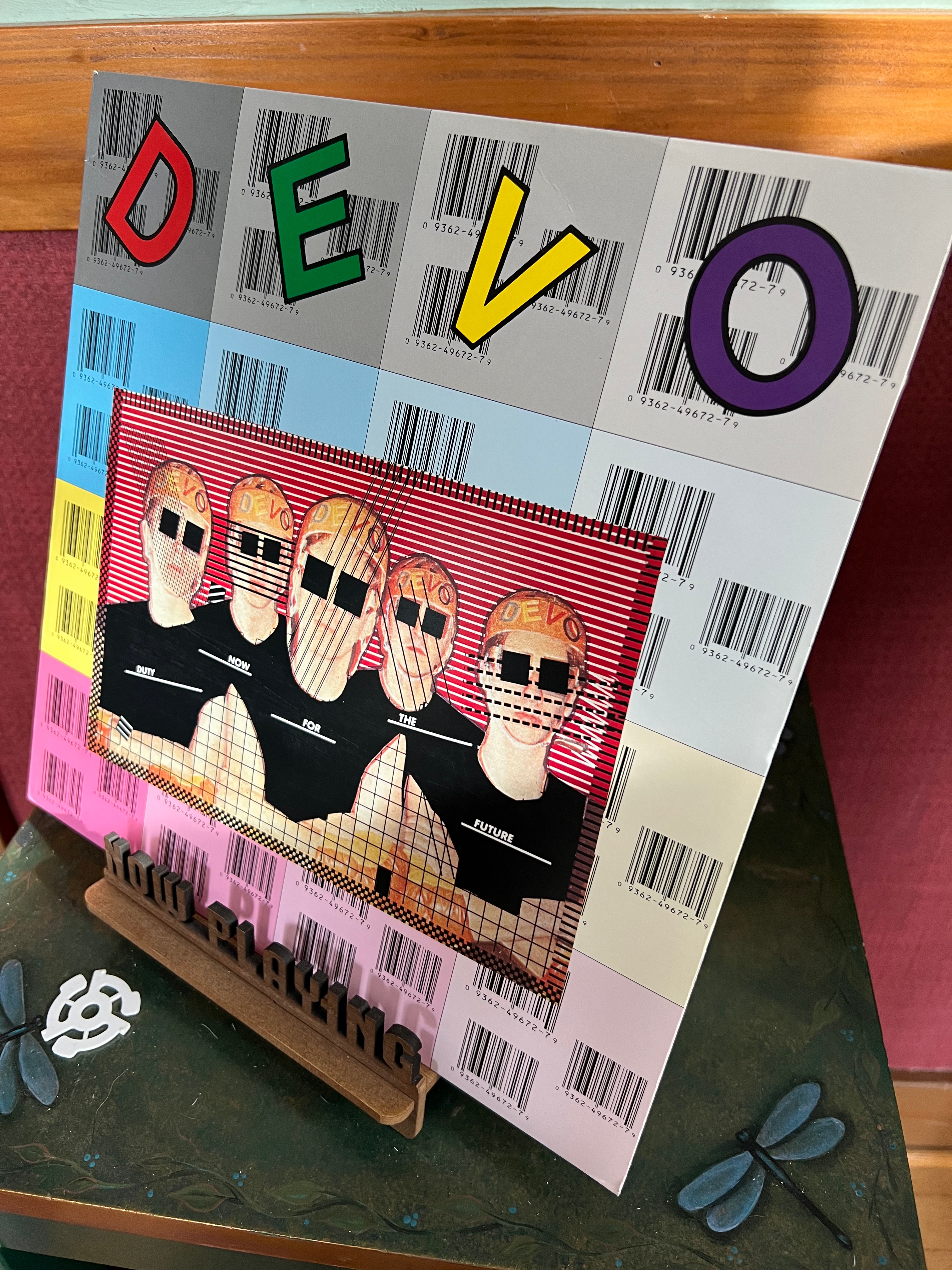
On vinyl, I recently captured the sophomore
record, Duty Now For The Future,
an album that, for some reason, during
my Freshman year in high school, I skipped.
I missed it, likely, because it was not
especially successful, rather obscure in its
own time, and also because I was still
in my hard rock phase, AC/DC and Cheap
Trick, and the nerdy prog of Rush, and still
felt a little awkward with my new wave choices.
And, now, as I pull this Devo from the stacks,
I’m not sure how many times I’ve listened
to it, because looking at the track list,
I couldn’t hum or recite a single tune here.
It begins with the “Devo Corporate Anthem,”
a keyboard and tom-tom instrumental thing that
sounds exactly like its title implies,
sterile, corporate, patriotic, and stiff, funny,
but then we’re rocking with “Clockout.”
Yeah, I don’t recognize any of these songs,
but it’s a fiery record, more progressive
than the debut, just as manic, but way
more proficient and interesting musically,
if not all that memorable melodically.
But I can hear on this album,
especially in the growing underpinning
of synthesizer bass and other keyboard
oriented noise making, the ingredients
that would produce their first hit songs from the
third and brilliant Freedom of Choice.
Following the red energy domes
(upside down flower pots) of the “Whip It”
era, they donned fake plastic ken-doll-esque
hair pieces and released New Traditionalists.
“We’re Through Being Cool” and “Jerking
Back And Forth,” open the album in the most
kick-ass Devo fashion. They had learned,
by Freedom of Choice, how to really write songs
with both lyric and melodic hooks. Mark
Mothersbaugh was singing instead of yelping
and he was sharing lead vocal responsibilities
with Gerald Casale. This is a fun album, albeit
sonically dated, time-stamped 1981,
as most of the off-kilter guitar work is replaced
with synthesizers and the drums sound more
electronic than acoustic. Oddly, the big hit
song from this album, “Beautiful World,”
is second to the last on side two. I wonder
if they knew when they sequenced the album
that it would be a single. Perhaps they thought,
this one’s too dark; let’s bury it on side two.
I kind of doubt that. Devo was always friendly
with the darkness, the underbelly of modern
society, and nothing symbolizes for me that
satirical and sardonic Devo spin more than
the image from the “Satisfaction” video
of the baby putting a fork inside of a toaster.
They knew what they were doing, all along.
Notes on the vinyl editions: Duty Now For The Future, Warner Brothers, 2010, reissue on black vinyl of the 1979 album. New Traditionalists, Warner Brothers, 1981, new pressing on clear vinyl.
In case you don’t already know: I’m listening to almost everything in my vinyl collection, A to Z, and writing a long skinny poem-like-thing in response for each artist. As a poet and a student of poetry, I understand that these things look like poems, but they don’t really sound much like poetry, hence, I call them “poem-like-things.” I’ll admit that they’re just long, skinny essays that veer every now and then into the poetic or lyric.
 michael jarmer