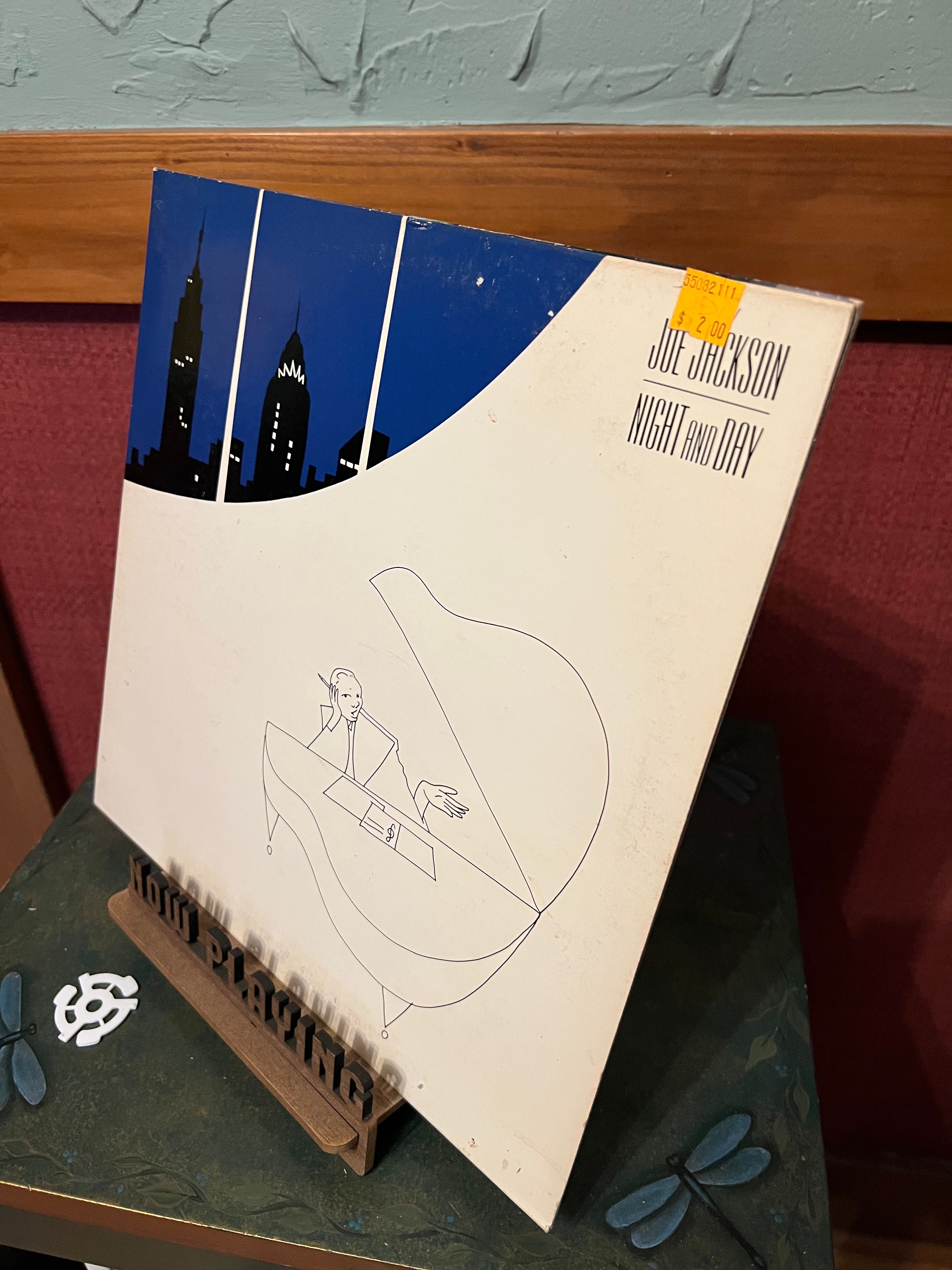
At first, Joe Jackson struck me
as the “other” Elvis Costello,
and at the time, in my teens,
I could not imagine needing
another one. I was wrong about
that, of course, and I knew it
as soon as Jackson released
the big band album, Jumpin’
Jive. He actually beat Costello
to the punch with the genre
hopping. But this, Night and Day,
was the first Joe Jackson album
I bought, and here it is again,
decades after the great vinyl purge,
a recovered used edition I purchased
some years back when I concluded
that here was an album I should
not be without. More like an
Elton John record than an Elvis
Costello one, this loungy, jazzy, lyrically
pithy, sometimes sentimental
thing is a great collection of songs.
I think I’m listening to it
backwards, as I assumed the
day side would come before
the night side, even though
the instructions for play are
right there in the title: Night and Day.
I feel kind of like a dummy, but
“Always Something Breaking Us
In Two” is a classic, would make
an awesome first song, despite that
borrowed opening melody (where
does it come from?), and the lyric in
the latin jazz of “everything gives you cancer”
seems prescient, as does Joe singing
“now and then we wonder who the
real men are.” This is a terrific album
but the pops and cracks are driving
me a little batty. I may have to
trade in this $2 used version for a new
$39 pressing. Nah. If I need a clean listen,
I can do a hi-res stream somewhere.
Side one, the night side,
is way weirder than I remember. The
first three tunes feel like they could have
been XTC songs or Gang of Four tunes.
This jazzy, loungy collection holds on
to Jackson’s punk new wave roots, albeit
music-school-trained new wave and punk
roots. And then, if I was listening in the
correct order, I’d be hearing”Target,”
the first straight up faithful afro-cuban latin
jam with no trace of traditional drum set
on the album. Not your mama’s new wave punk.
But somehow, “Steppin’ Out” feels like
the perfect song to end the album.
I think next time I listen to this record,
I’ll listen to it the wrong way around again.
Over the years, I’ve dipped in and out
of Joe Jackson’s oeuvre. I’ve got four or five
titles in the CD collection, ending with the
early 90’s, and then nothing after until
this 2019 album called Fool. This thing
rocks surprisingly hard. Energy through
the roof, this is clearly a “band” album,
a piano rock record where even the mid-tempo
stuff kicks a little ass. And the slow stuff
is meditative, smart, profound.
Lyrically and melodically, this album
is full of sophisticated stuff and classic
Joe Jackson wit and charm and humor,
and he’s still hearkening back in a song
or two to that afro-cuban thing. I find
myself going back to the Elvis Costello
comparison. Elvis has been more prolific,
but both of these artists have similar
proclivities: a prodigious vocal talent
despite an unusual, nasally voice,
a wide array of musical interests and
influences, a pension for going outside
of their perceived “lanes,” a super-literate
lyrical style, and a consistency of quality
through a decades-long career. It’s a
wonderfully hopeful thing, I think,
to find artists that I loved as a kid who
are still vital, still relevant, still making
great music all these years later.
In for the long haul, as they say.
I’m right there with them.
Notes on the vinyl editions:
- Night and Day, A&M Records, 1982, used black vinyl in mediocre condition.
- Fool, earMUSIC Records, 2019, heavyweight black vinyl, includes a bonus 7 inch single with two covers, the Steely Dan tune “Night By Night” and Henry Mancini’s “Peter Gunn.” Note on the bonus single: I didn’t know “Peter Gunn” had lyrics! All my life, I’ve only heard instrumental versions.
In case you don’t already know: I’m listening to almost everything in my vinyl collection, A to Z, and writing at least one, sometimes two or three long skinny poem-like-things in response for each artist, and on a few occasions, writing a long skinny poem-like-thing in response to more than one artist. As a poet and a student of poetry, I understand that these things look like poems, but they don’t really sound much like poetry, hence, I call them “poem-like-things.” I’ll admit that they’re just long, skinny essays that veer every now and then into the poetic or lyric.
 michael jarmer