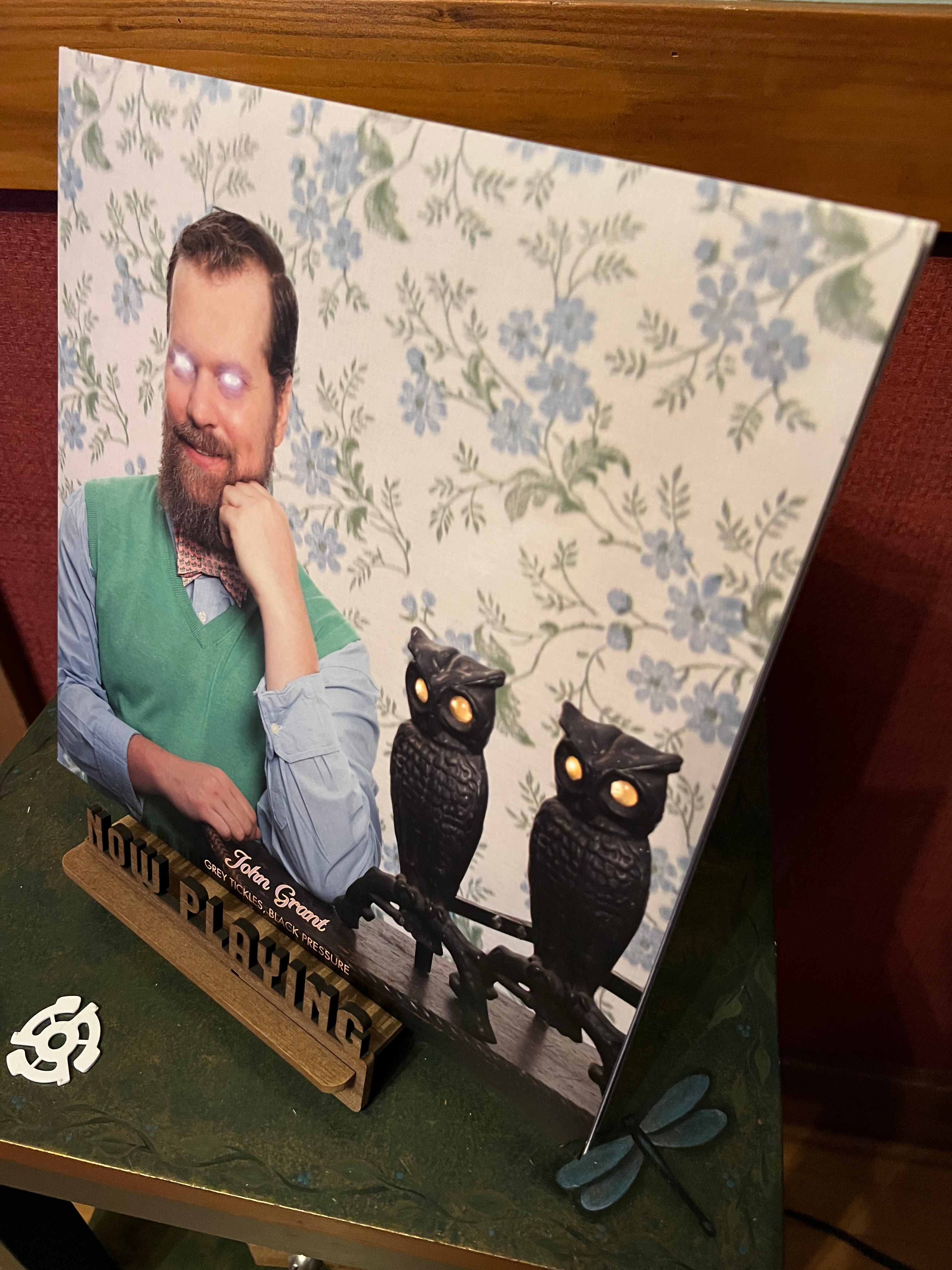
I stumbled upon a live
studio recording of Elbow
performing a song called
“Kindling” from the Little
Fictions album with a guest
vocal performance by a guy
named John Grant. Who’s
this person, I wondered. And
I concluded, if he’s a friend
of Elbow’s, he’s a friend of
mine, and then I watched that
video. Whoever this John
Grant person was, he was
clearly a great singer with
a stunning baritone and
terrific range. Almost
immediately, I think, I started
listening to John Grant.
I don’t know how the two
became acquainted, Elbow
being a British band and
John Grant an American living
in Iceland, but he, and Elbow’s Guy
Garvey, according to the expert
opinion of Michael Jarmer,
are two of the best singers alive
in rock music right now.
My first John Grant album was
Grey Tickles and Black Pressures.
which, after a strange
audio collage of voices in at
least a couple of languages
reciting a variation of 1 Corinthians,
13:13, you know the one, the
famous love verses we’ve all
heard at every wedding we’ve
ever been to in our lifetimes,
opens with the title track and
a chorus that would be
henceforward forever branded
in my brain: “I’ve got grey tickles
and black pressures. I’d rather
lose my arm inside of a corn
thresher, just like Uncle Paul,
just like Uncle Paul.” It’s hard
to say exactly what grey tickles
and black pressures are, but
the lyrics are a kind of list of
grievances, interupted by the
refrain that introduces the
chorus: “but there are children
who have cancer, so all bets are
off, cuz I can’t compete with that.”
His lyrics are often dark, on this record
more often than not they are
funny, but his subject matter
frequently revolves around mental
health issues, familial conflict
or estrangement, sexual identity,
and social commentary. Musically,
this record runs the gamut from
full on pop band, heavy guitar,
drum machine funk, synthesizer
80’s new wave, to ornate string
orchestration. It is mostly upbeat
and wacky with tons of great singing.
The first track on the album
Love Is Magic is so weird it almost
defies description. A Danny Elfman-like
rap about a bunch of really scary shit
over the top of an intense drum machine
pounding electronica soundscape.
But on the title track, our velvet voiced
John Grant is back, encouraging you,
even though “you forgot your medication
and Sade’s playing on the radio,”
to go boldly through the door of love
when it opens up for you. There’s
a lot of heavy synthesizer on this album.
Despite Grant’s accomplished piano playing,
he tends to gravitate toward the synth
and crazy arpeggiated tracks, oddball
space noises, drum machines, and expansive
arrangements. There are only two songs
on this record that clock in under five minutes.
It’s a crazy, funny record where the serious
moments are far and few between. I miss
that seriousness on this record. Although
I love a musician with a sense of humor, and
I appreciate Grant’s wit, he’s most effective,
I think, and resonant, when he’s singing
directly and seriously about the struggles
of 21st century life. I think maybe three of
the ten tracks on this album do that brilliantly
while the rest of the tracks seem to be
oriented toward the funny bone.
Let me just say that a pet peeve of mine
is record label graphic design from which
it is impossible to determine which side
is which. But also, this 2021 record Boy
From Michigan, is a great album. Lyrically
autobiographical, many of these songs
tell stories about growing up and coming
of age as a young gay boy in Michigan in
the 80’s. This record is more melancholy,
almost every song is some manner of slow,
and while there’s still a heavy lean toward
synthesizers, Grant’s singing and story-telling
lyrics take center stage, full of longing and
dread, packed full of specific Michigander details,
the county fair, the neighborhood five and dime,
the tastee-freez, and as a young adult, what
I can only imagine would be a secret but
sacred place: “I see you in the pink art deco
glow of the cruise room. I see you not knowing
all the things we didn’t know.” Specific
concrete details meeting up with profound
and understated revelation. There are
really only two remotely funny tracks
on this entire record, the
rocking and goofy new wave inspired
silliness of “if you want to get with me
you better have a rhetorical figure,” and
the extended double entendre of “your
portfolio is much bigger than I thought.”
John Grant, a polyglot BTW, opens the
most recent album The Art of the Lie with a
four on the floor funk tune, “All That
School For Nothing.” The polyglot factor
has really nothing to do with the song,
a social commentary obliquely criticizing
the hypocrisies of religion and patriotism,
I only mention it here to make sure
I don’t forget. By all accounts, Grant is
fluent or nearly fluent in five languages.
At the show last year, he talked about
the Icelandic language on stage with
an acoustic piano and some synthesizers,
no band, and he taught us some phrases.
This 2024 album, the last one I listen
to over a couple of days, is my favorite.
Every tune is strong. The upbeat pieces
will make you want to dance; all of them,
even the quiet ones, will make you want
to sing along; in some cases, in
the autobiographical tunes about his
parents in particular, singing along
might be difficult without choking up.
To his father, he sings these heart
breaking lines: “And sometimes I just
want to run into your arms and let you
hold me, once again. I feel ashamed
because I couldn’t be the man you always
hoped that I would become.” I mean, it’s
difficult for me to even type those words.
A similar effect is achieved in the chorus
of “Daddy,” an almost seven minute long
meditation on the sometimes inscrutable
natures of our parents, especially fathers,
especially of that generation. Grant is
only four years younger than I am, so his
dad, was probably a lot like mine,
a WWII generation stoic,
uncommunicative, distant, emotionally
unavailable. While there are a few
funny moments on this album, most of
it is dead serious and emotionally
powerful, and sometimes scary, as in
the haunting song that begins the fourth
side of the album, “The Child Catcher.”
Between last night and this morning
I have immersed myself in John Grant’s
music, four consecutive albums in a row,
and it is a deep experience, one that I
would gladly repeat. His voice is a crucial
one, I think, for our time, and he sees
things so clearly and sings about them
so vividly and provocatively. He may be
looking back at us from some distance,
but that Icelandic vantage point, I bet,
has given him a perspective that allows
him to hold up for us a mirror–if we can
bare to look.
Notes on the vinyl editions:
- Grey Tickles and Black Pressures, Bella Union Records, 2015, double album, disc one on peach and disc two on pink vinyl.
- Love is Magic, Bella Union Records, 2018, double album on clear vinyl.
- Boy from Michigan, Bella Union Records, 2021, double black vinyl.
- The Art of the Lie, Bella Union Records, 2024, double pink vinyl.
In case you don’t already know: I’m listening to almost everything in my vinyl collection, A to Z, and writing at least one, sometimes two or three long skinny poem-like-things in response for each artist, and on a few occasions, writing a long skinny poem-like-thing in response to more than one artist. As a poet and a student of poetry, I understand that these things look like poems, but they don’t really sound much like poetry, hence, I call them “poem-like-things.” I’ll admit that they’re just long, skinny essays that veer every now and then into the poetic or lyric.
 michael jarmer