It took me years after hearing
his music for the first time and
becoming a fan to figure out
that Peter Gabriel was the first
lead singer of Genesis! In this
regard, I was born yesterday,
or living under a rock. It was
1986, and I think So was my first,
and then I went backwards almost
all the way, and from that point
on, I religiously got every record
he released.
Almost a completist, I have every
one of Peter Gabriel’s solo studio
records on CD, except for the first
one and the more recent orchestral
recording of songs from his entire
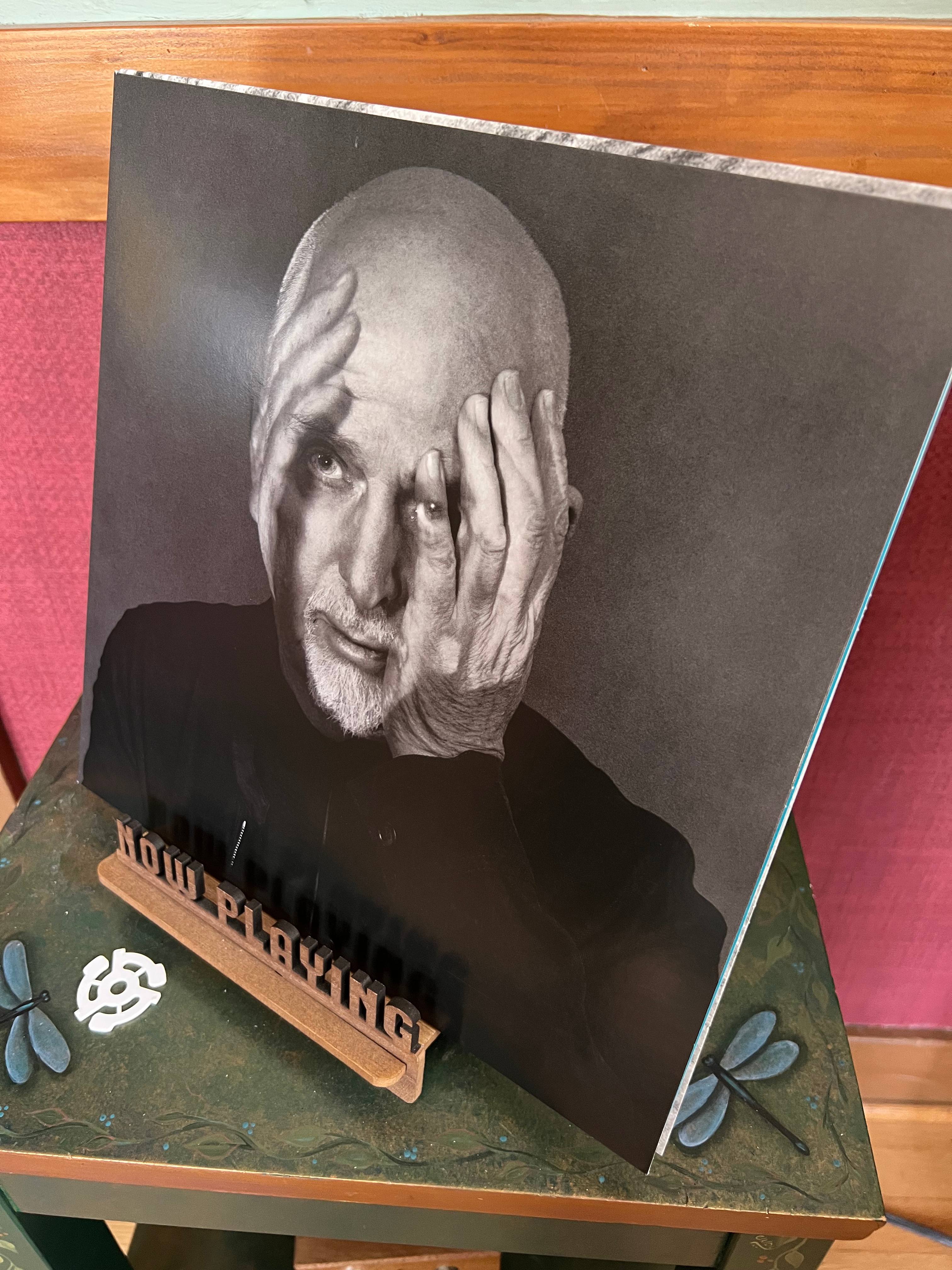
career. This most recent album,
IO, is the only album of his I have
on vinyl. It comes 22 years after
his last album of new songs, Up,
from 2002.
After his fourth studio album,
the fourth album in a row without
a title other than the eponymous
Peter Gabriel, records otherwise
identified by the cover art, The Car,
Scratch, Melt, and then Security,
he then became obsessed with
titles with only two letters: So,
Us, Up, IO, and the forthcoming,
OI, respectively. I find this amusing,
and Gabriel probably does as well.
But there’s a simplicity to it, a cool
expression of continuity.
Peter Gabriel’s music constitutes
a kind of central soundtrack to my
entire adult life. My first Gabriel I bought
the year I got married, and this year,
40 years later, as soon as OI hits the
shelves, I will nab myself a copy.
Listening today to IO, it feels so
incredibly familiar and comfortable,
his voice as strong as it ever has been,
his arrangements super engaging,
his lyrics smart, sometimes cryptic,
sometimes crystal clear, bordering
on the sentimental but never quite
arriving there, every emotion feeling
authentic and relatable. Even though
I chose the Dark Side Mix of this
album, this is not a dark record.
Musically, sometimes it feels foreboding,
and the opening tune describes
a potentially dystopian view of 21st
century technology manifesting
in a surveillance state, but at 74 years
old when this album is released, Gabriel
sounds optimistic, hopeful, grateful,
cautious, yes, but full of mostly joy.
I love that he can be on one song
pretty weird and scary and on the
very next song make you want to
cry about the bittersweet reality of
the passing of time, mortality and
all of that, and then later he can
remind you about the ecstatic
and wonderfully congruous connection
between all things: “Stuff going out,
stuff going in. I”m just a part of
everything.” And then at some point
in every Peter Gabriel album, you’re
just gonna want to shake your booty.
“Road to Joy” will do that to you.
This is a great album. Not a single
snoozer.
What mean you, Michael Jarmer,
by “The Dark Side Mix?” You might
well ask. I’m not sure how I feel
about this, but Peter Gabriel
released two versions of this album,
a dark side and a bright side mix,
two completely independent mixes
of the album, one by Tchad Blake,
who has mixed Fiona Apple, Tom
Waits, and Soul Coughing, and
another by Mark “Spike” Stent, who
has worked with the likes of
Beyoncé, Harry Styles, and Coldplay.
Just from that list of artists, it
might be clear why Blake would
be the dark guy and Stent would be
bright. And while I did not buy
both versions, because a part of
me felt like offering up two competing
versions of the same album was
a bit of a dirty merchandise trick,
I have streamed the Bright Side mix
and noticed some significant differences.
Buying both records would be
overkill and silly and expensive,
so I recommend going with your gut
(are you in the dark or in the light?),
or listening to both on a streaming
service and choosing your favorite.
Personally, I prefer the dark.
Tchad Blake has always been a master
at great sounding drums, and Tony
Levin’s bass work animates the songs
with a cool, dark intensity with Blake
at the helm. No matter, though;
I don’t think either mix makes the
songs any better. They stand on their
own exquisitely, bright or dark.
Notes on the vinyl edition: IO, Real World Records, 2023, 180 g. double black vinyl.
In case you don’t already know: I’m listening to almost everything in my vinyl collection, A to Z, and writing at least one, sometimes two or three long skinny poem-like-things in response for each artist, and on a few occasions, writing a long skinny poem-like-thing in response to more than one artist. As a poet and a student of poetry, I understand that these things look like poems, but they don’t really sound much like poetry, hence, I call them “poem-like-things.” I’ll admit that they’re just long, skinny essays that veer every now and then into the poetic or lyric.
 michael jarmer