I
Shock rocker Alice Cooper
each tour would devise some
way to execute himself at
the end of the show. One
tour, he hung himself, in another
he chopped his head off
with a guillotine, and the time
I saw him on the From
The Inside tour, he put himself
in an electric chair. A rock
star with 9 lives, by the time
I fell in love with his creepiness,
he had relapsed into an alcoholism
that almost killed him again.
It wasn’t until 1983 that he
became sober for good, and is
still kicking and playing his
horrifying rock and roll,
interestingly enough, over the
last decades, turning to a kind
of heavy metal as opposed to
the kind of genre grab bag
hard rock glam thing show tune
prog rock new wave synthesizer stuff
he did all through the 70’s
and into the early 80’s. I much preferred
his music when he was on the
verge of dying. Not that I think
for a moment that substance abuse
is good for artists, only I acknowledge
that, sometimes, it can net interesting
results. As a kid, I found it
absolutely fascinating that I never
knew where he would go next,
and I loved the theatrical nature
of it all, and the morbid stuff was
fun, and even at its creepiest, was
tongue-in-cheek, uproariously funny.
He could pair the horror-film images
of a necrophiliac to a nightmare trip
to the dentist’s office, and then he
could turn around and deliver a
heart-wrenching ballad. As far as I know
(and admittedly I don’t know much),
his recent output has none of that
exploratory experimentation.
II
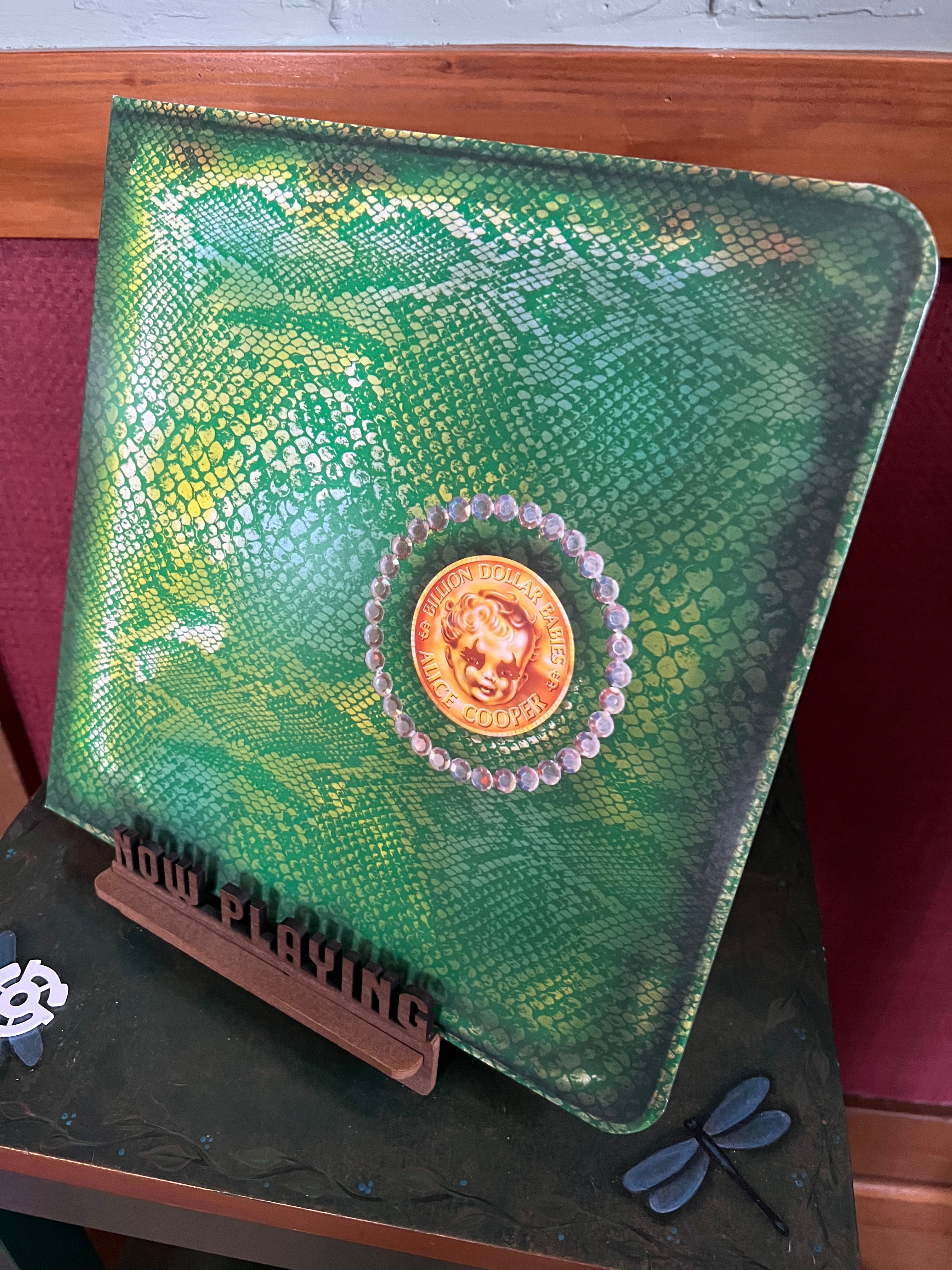
Billion Dollar Babies, while it was
not my first Cooper album, is as far back
as I go with Alice’s repertoire. 1973,
his sixth studio album. It is
a brilliant record, fun, spooky, full
of stellar musicianship, some epic
hit songs, and it sounds huge, and
may contain the most disturbing of
all of his songs, the album closer
“I Love The Dead.” My vinyl collection
skips Welcome to My Nightmare, Alice
Cooper Goes To Hell, Lace and Whiskey,
and From the Inside (all great albums),
and goes straight to 1980’s Flush
the Fashion, where Alice makes
a foray into the new wave
with the brilliant “Clones” single.
There’s not a clunker on this record,
not a single, boring moment. Maybe
Cooper’s funniest album, which is
one of the things, I think, at least for me,
that made him so great. He had,
during those first two decades,
a satirical sense way beyond any
of his peers, save maybe Zappa.
I think I felt a similar affinity with
his next studio album, Special Forces,
which I have on CD, but which I won’t
listen to now, as this is exclusively
a vinyl listening challenge. It happens
that, as I go through my records,
I often feel a tug toward the basement
CD collection for those other beloved titles.
III
For some reason, I skipped the 1982
Zipper Catches Skin. For decades, it was
simply missing from my experience,
until there was a rash of reissues from
Cooper’s catalog, and I thought, now
is the time to fill in that gap. I must
not have cared for it, because as I prepare
to spin the album, I have no recollection
of anything that might be on it. And
when I spin it, I recognize nothing.
I’ll give Alice this: it doesn’t sound
like an 80’s record, but I think that’s true
of a lot of albums early in the decade;
that production aesthetic hadn’t yet settled
in on everyone like some kind of virus.
“I Am The Future,” apparently the first single
from the record, was on the soundtrack
to a crime-thriller called Class of ’84,
a film I had never heard of until today.
There are some fun musical surprises
here and there, some signature Alice moves,
expert musicianship throughout, and some
clever hooks, and a super fun
appearance from Patty Donahue from
The Waitresses on a song that attempts
to answer her “I Know What Boys Like”
with this silly thing called “I Like Girls.”
“I Better Be Good” seems to anticipate
the Violent Femmes’ “Blister in the Sun,”
which comes out the next year. I wonder
if they had heard this tune–not that there’s
anything remarkably original about it.
It stands out for me as a favorite, though,
from this, possibly, my second listen ever,
for its wonderfully snappy execution, its
hook line, and of course, for Patty, rest her soul.
I’m curious about how I would have felt
about this record if I would have encountered
it where it fell, historically. Would I have
loved it? Would it have become a favorite?
I tend to think that it might have. But now,
while it’s fresh and seemingly brand new,
and while it was entertaining and hardly
disappointing to listen to, I don’t know
when I will return to it. I have a hunch,
that the next time I’m in the mood for Alice,
I’ll be reaching for one of the classics.
IV
Rounding out my vinyl Cooper collection,
is the record immediately after Zipper,
a thing called Da Da, a record I did buy
when it came out. Even though I skipped
the last one, something compelled me
toward this new 1983 Cooper, a return
to the concept album, a practice Alice
had abandoned for a number of years.
Lost in the great vinyl purge of 1988,
I recaptured this album in recent years,
probably the same year I acquired Zipper.
I bought Zipper Catches Skin because I had
never heard it; I bought Da Da because
I remembered liking it, but I remembered,
too, that I thought it was a difficult album.
It’s a scary record, opening with a scary
instrumental, the only voice to which
is a child’s exclamation of “da da,”
and a dramatic dialogue between
a patient and his therapist that introduces
the album’s main conceptual
thrust, the perhaps homicidal relationship
between a father and son, a disabled
sibling locked in the attic, and a missing
mother. Possible, too, is that all of these
characters are various personalities of
one very sick individual.
Not all of the songs are clearly
tied to this central motif, and some
of the songs recall Cooper’s signature
sense of humor: a shopping mall Santa
in “No Man’s Land,” and the wildly
satirical “I Love America” both offer
relief from the morbid subject matter.
Sonically, this record is a departure
for Cooper. Composed largely using
the Fairlight CMI, with Bob Ezrin again at
the producer’s helm, it’s a dark sounding
record, it uses the Fairlight drum
machines on most tracks, and it’s
likely the most keyboard heavy
album Cooper had ever made.
I think I’d love this album if it
sounded better. Even so, the song
writing here rivals his best, and the
theatrics of it, and the creepiness,
rival the biggest and scariest
moments from the other most
famous Ezrin-produced Alice,
Welcome to My Nightmare.
The closing song, “Pass the Gun
Around,” is nothing short of epic.
I didn’t know I’d have so much
to say about Cooper, but I realize
how huge he was for me,
bringing a kind of conceptual
sophistication and theatrical panache
to rock and roll that no one had matched,
before or after, and at the same time
the quality of his output was consistently
high and sometimes downright revelatory.
Notes on the vinyl editions: Billion Dollar Babies, Warner Brothers, 1973, recent reissue on green w/black swirl vinyl. Flush the Fashion, Warner Brothers, 1980, used copy, possibly a first pressing, black vinyl. Zipper Catches Skin, Warner Brothers, 1982, recent reissue, clear vinyl with black accents or swirls. Da Da, Warner Brothers, 1983, recent reissue, orange vinyl with a grey/green swirl.
FYI: I’m listening to almost everything in my vinyl collection, A to Z, and writing a long skinny poem-like-thing in response for each artist. These things look like a duck, but they don’t quack like a duck. Hence: “poem-like-thing.”
 michael jarmer