I
“Ground Control to Major Tom,”
are likely the first words any of us
ever heard from David Bowie.
Maybe I was five, and for years
I would hear that distinctive voice
on the radio and knew the hits,
but my older siblings, the arbiters
of new music into the household
never brought home a Bowie album.
I didn’t start buying his records
until I was a teenager, 1980 at
the earliest. From that moment
forward I was utterly devoted.
So after his death, when
these expansive box sets started
to emerge, I thought here
was an opportunity to educate
myself about all the Bowie
I missed growing up, a full decade
of music, around fourteen studio
albums I had never heard.
Every year almost, since 2016,
a new box full of treasures.
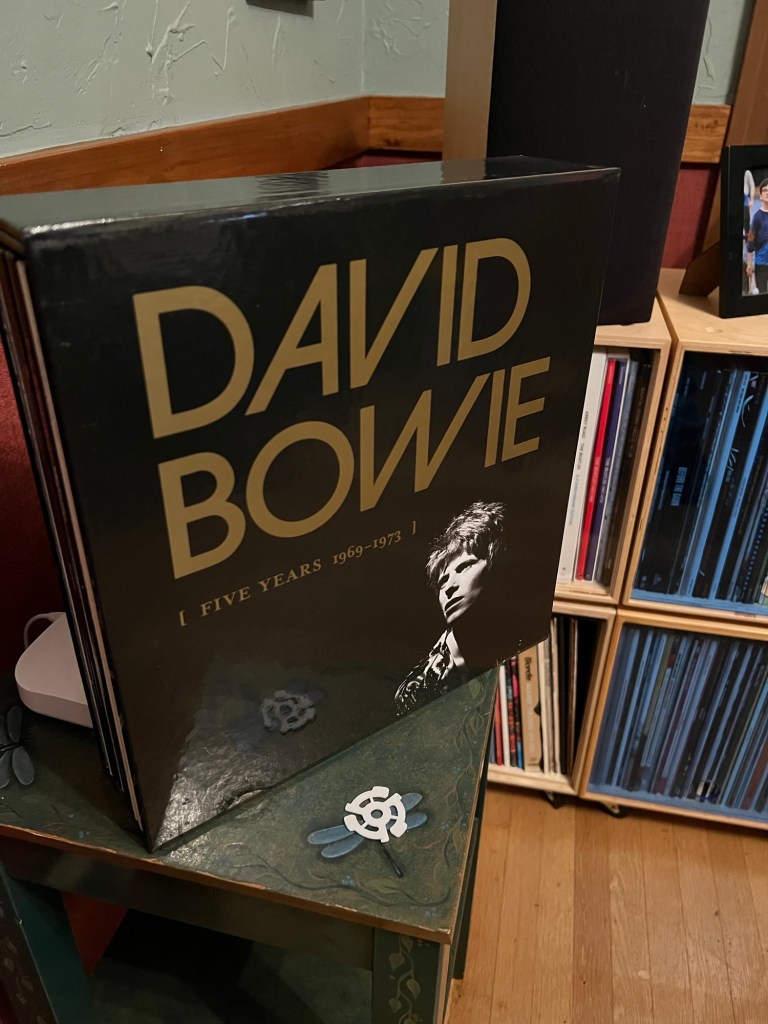
This first one, Five Years, 1969-1973,
the opening chapters and early
transformations of a rock and roll genius.
Outside of “Space Oddity,” the first
album is really not very good, but
provides hints, little glimmers of what’s
to come, a glimpse of his staggering
ambition as an artist.
II
The Man Who Sold The World features
David Bowie on the cover in a dress
sprawled out luxuriously in a chaise lounge,
which strikes me now as a radical
move. As a youngster, I must have seen that
cover in record shops or on posters
but I don’t remember if it even registered
for me as something unusual or daring.
Maybe I thought it was a photo of a
woman, but certainly, I could read, and
there’s David’s name as plain as day
on the cover. I only learned this in
the liner notes, but in the U.S. the
record was initially released with a
dumb, uncontroversial cover, one that
I have no memory of seeing. America,
still hanging tight to its puritanical roots.
This record sounds better than the first,
is more focused, rocks a lot harder,
at least until the waltz ballad that
concludes the first side, “After All.”
Side two gets pretty weird, almost
uncomfortably so–what the hell is
he doing with his voice–establishing
maybe the one constant of his career,
comfortability with the strange and
with change, with experimentation.
I don’t think there was a single song
on this record that became anything
like a hit, save for the title tune,
which I recognize, not because I
remember hearing it over and over
on the radio, but because I’ve heard it
everywhere else since then,
that undeniable chorus hook,
a perfect marriage of great guitar
lines and that unforgettable vocal melody.
This record is better than the first,
but neither of these albums found their
way into anything like regular rotation.
Listening to them again is kind of like
listening for the first time.
III
And then comes Hunky Dory.
Bowie’s first undeniably great album.
I’d argue that “Changes” is one
of the greatest pop songs ever
written. And for me, it’s not so
much the hook in the chorus,
but that beautiful vocal melody
in the verse forms, and those lyrics.
For my money, there’s not a bad
song on the album. I like even the
strangest ones, the silliness of
“Kooks” or the show tune vibe
of “Fill Your Heart.” Next up,
possibly the most famous of Bowie’s
70’s output, The Rise and Fall of Ziggy
Stardust and the Spiders from Mars.
How strangely manic and high his
voice is on these songs, coming
back down to Earth for the verses
of “Starman.” These are great,
memorable tunes, but if this is
a kind of concept album, as I think
it’s often billed, I couldn’t tell
you what the concept was–
outside of the creation of this
persona–discernible in only
a few of the tunes. Could someone
tell me what happens in “Five Years”?
IV
I often wonder what might have
prevented any of these early albums from
becoming like a beloved favorite.
Is it possible, no matter how much
you like a record, to really LOVE
an album you arrive at decades
after the fact in the same way
you love a record you bought
brand new the same number
of decades ago? I doubt it, somehow.
It might take discipline to make
it possible, for example, by listening
over and over again, neglecting
anything new for awhile, learning
everything you can about how
others have appreciated and loved
it over the years. Then maybe.
So for me, I think these early Bowie
records become a kind of joyful
curiosity, a piece of music history,
a missing part of my education.
This Pinups album, an album of
cover tunes, surprisingly, while its
mostly a dumb rock record, is an
homage to Bowie’s rock heroes,
which, in itself, is fascinating, and
finds him singing in new ways,
ways that will become a crucial
part of his signature style moving
forward, and Aladdin Sane, with the
iconic lightning bolt face cover, after
the wild experimentation of the
first four Bowie albums, is yet
another mostly straight up rock record
with a few radical departures,
like the crazy title track with
all that wild and discordant
piano stuff happening, or the
theatrical “Time” in all of its hugeness.
Huge was David Bowie’s effect
on the planet. I saw a meme recently
that posed the theory, sincerely
I think, that there may have been a
correlation, if not a direct cause,
between Bowie’s death in 2016 and
the world kind of going to Hell
in a handbasket.
Notes on the vinyl editions: I decided early on that if I listen to every record in each of the Bowie boxes in my collection, I will not likely ever make it to the letter C, let alone the end of the B’s. With none of those early albums already in my collection on vinyl or CD, I became a kind of obsessive collector. I have every box set the Bowie estate released of the entire catalog except for the most recent and last one, at $459, the obscenely pricey I Can’t Give Everything Away. So I have made myself a deal that I will listen to every studio album and will skip live albums and b-side bonus track compilations and redundancies (i.e. alternative mixes of the same album), which in the case of Five Years, 1969-1973, ads up to about 7 discs worth of material out of 13. And while it also seems slightly impossible, like I have done with all the other artists up to this point, to write a single response after listening to all of Bowie’s records, I think I will write one poem-like-thing for each box. We’ll see how that goes. It’s so much Bowie. Hours and hours of Bowie. I may need a palate cleanser here and there. Move back and forth through the remaining B’s? Maybe.
This box set, Five Years, 1969-1973, Parlaphone Records, 2015, 180 gram black vinyl. I listened to the following studio albums: David Bowie, The Man Who Sold The World, Hunky Dory, The Rise and Fall of Ziggy Stardust and the Spiders From Mars (the 2003 remix), Pinups, and Aladdin Sane.
 michael jarmer