2012
She’s released five albums
in 24 years. I have them all
in my collection, but only
the last two on vinyl, the two
most challenging, difficult
Fiona albums in her catalog.
Last night, in an hour or two
of sleeplessness, I knew she
was coming up in the alphabet,
and I thought of that, as one
does during an episode of
insomnia. Then I tried
to remember the title of the
first of the last two records,
the record from 2012.
I couldn’t do it. I remembered
all the other titles, if only
the first few words of the
impossibly long “When the Pawn. . .”
but I was absolutely stuck
on this one. This morning,
after breakfast and coffee,
I pulled the record out and
put it on the turntable,
this crazy monstrosity of a
self portrait on the cover,
and I read the title, as if for
the first time: “The Idler Wheel
Is Wiser Than the Driver of
the Screw and Whipping Cords
Will Serve You More Than Ropes
Will Ever Do.” I understand
why I had difficulty with it.
I didn’t know what an idler
wheel was, so, as one does,
I googled that. It’s a wheel
which serves only to transmit
rotation from one shaft to another
in applications where it is
undesirable to connect them
directly. For example, connecting
a motor to the platter of a
phonograph. Damn, this is a
weird record, but beautiful,
a record that I remember
feeling deserved to be listened
to more often than I did.
Why didn’t I love it?
Its minimalist production?
Its lack of conventional
drum set work? It didn’t rock?
None of these things
seem sufficient enough,
and yet, they played a role
in my cool reception, I’m
sure. I conclude that it’s worth
keeping even for the occasional
close listen, for its complexity,
its intellectual ferocity, for
Fiona’s voice and her words.
I still don’t understand
how an idler wheel is wiser
than the driver of the screw,
or why one would rather
be whipped than roped,
and I ponder that further
as the record comes to a close
with Fiona singing a round
with herself of the disturbing
but irresistibly catchy line,
“I’m a hot knife
and he’s a pad of butter.”
2020
It takes her eight years to
release a new record, at the height
of the pandemic, no less.
Almost universally praised,
and for good reason, this record,
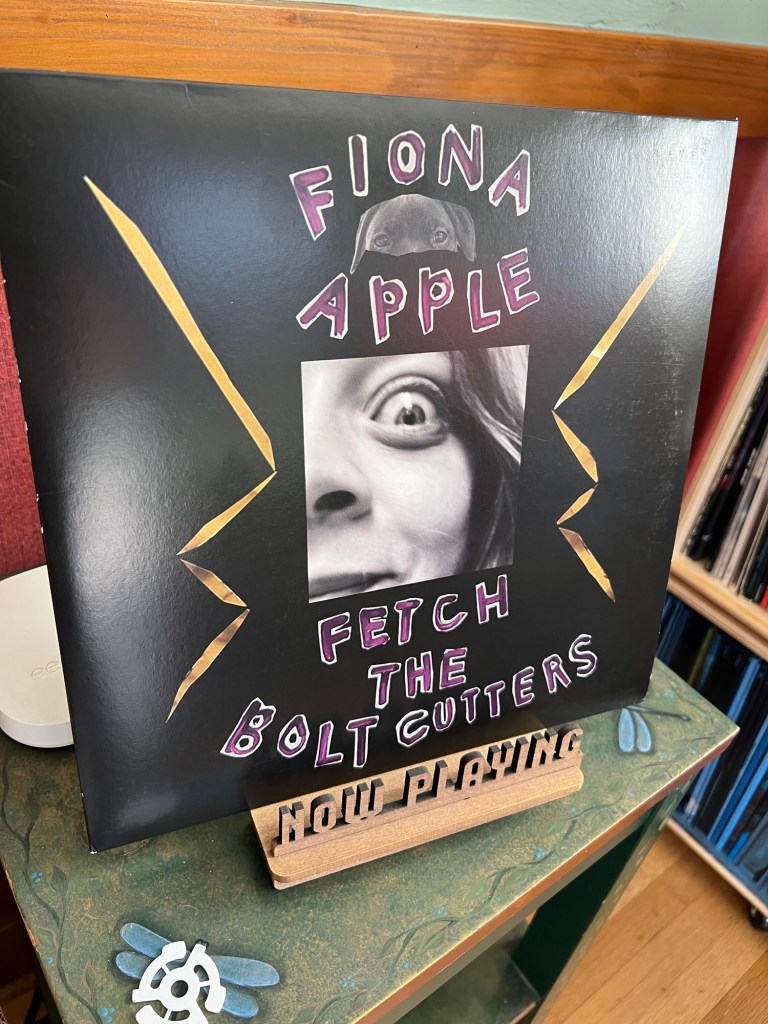
Fetch the Bolt Cutters is brilliant
from start to finish.
Like Idler Wheel, it’s challenging,
daring, experimental. Check out
how long she holds that note,
or the maniacal yodeling at the end
of “I Want You To Love Me,”
barely hanging on, she doesn’t care
about the precision of the singing,
but about the precision of the feeling.
“Shemeika said I had potential” is
a hook so sharp and memorable,
years after my first listen I still find myself
repeating it randomly, driving,
showering, eating breakfast, lying
awake in the middle of the night.
It may be my favorite Fiona song ever.
And the drum set work from
Amy Aileen Wood is out of this world
groovy, groovy, groovy.
“Kick me under the table all you want,
I won’t shut up.” I don’t know who
Cookie is, but I think the thing
about Fiona that I love the most
is that rapid-fire delivery of her
intricately crafted, super smart,
fiery lyric, what the kids these days
call “spitting bars.” She may be an
eccentric, and has a kind of mixed
record of strange behavior during
live performances, but Fiona Apple
is a singular figure, one-of-a-kind,
a true artist, an iconoclast, a
musical genius of the first order,
and I love her.
Notes on the vinyl editions: The Idler Wheel, Epic Records, 2012, heavyweight black vinyl. Fetch the Bolt Cutters, Epic Records, 2020, heavyweight white vinyl. Both first pressings. Pristine playback with both records. Good on ya, Epic.
Postscript in Bullets:
- This is the 9th poem in a series of poems written while attempting to listen to every record in the collection, A to Z. I’m writing one poem for each artist in the collection, no matter how many records of said artist I have listened to. I use the word “poem” loosely. Perhaps the only poetic convention here is that these pieces are composed in lines as opposed to paragraphs.
- This is another project that will take a long-ass time to complete, if it is ever completed. I wouldn’t hold your breath.
- All the poems in this series will have dumb titles to make these pieces easy to distinguish from other kinds of poems: the letter of the alphabet and the name of the artist.
- The poems may or may not be a direct response to the listening, might be tangential, discursive, journal-like, biographical. I’m finding I am less satisfied with the output when I end up writing purely descriptive pieces about the music. I prefer the associative approach, even though it is less obvious that I have actually listened and not just remembered. But that’s not really the point, I think, is it? The listening is just for me. The writing, however, hopes to find an audience. So I want to try to do what’s best on the page, what’s most engaging or artful. I will try to do better. However, it is the nature of blogging, and/or publishing our shitty rough drafts as soon as they are completed, that the work is not quite as perfect as it could be. Hasn’t stopped me.
 michael jarmer