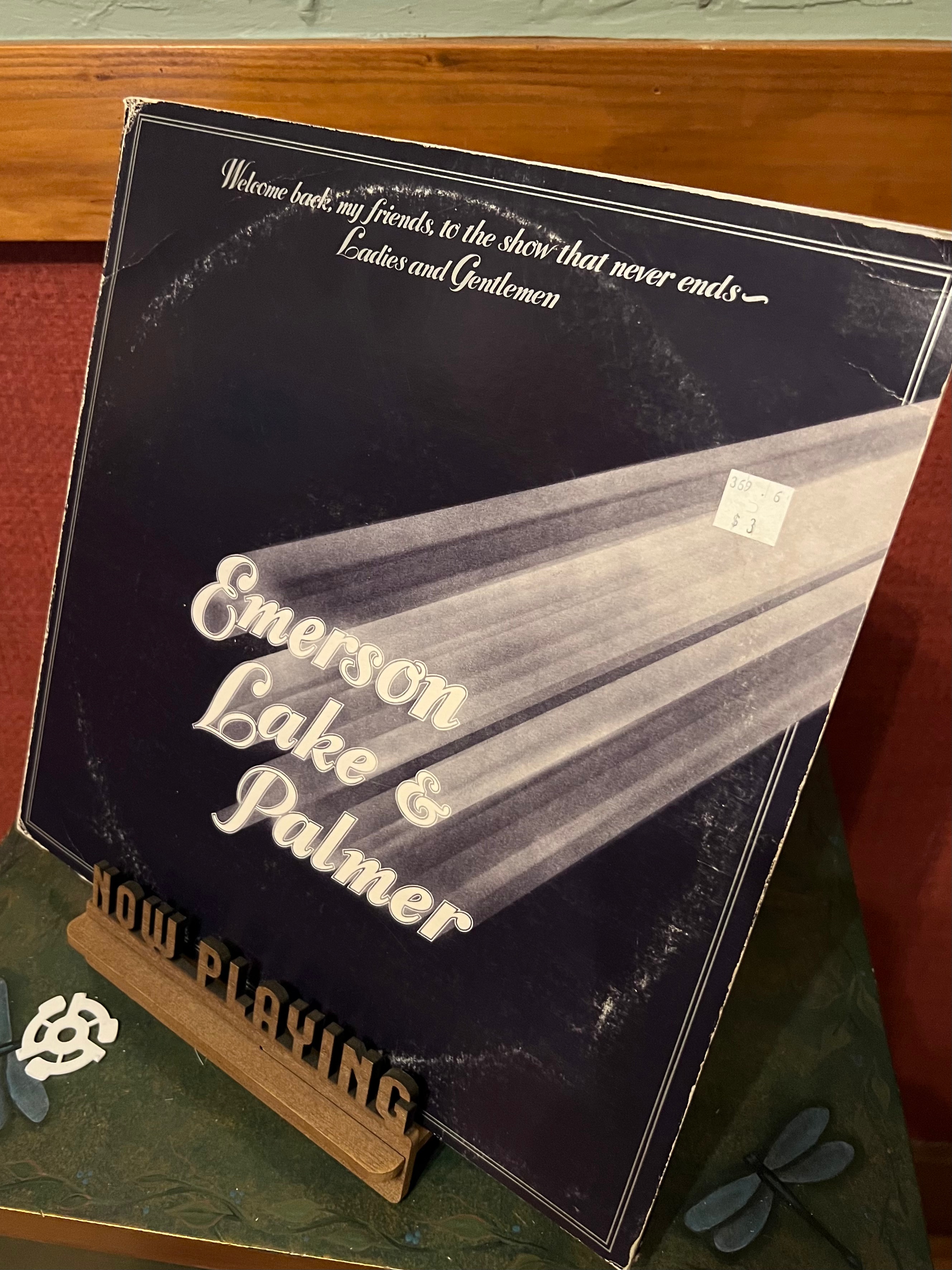
My first introduction
to progressive rock was
likely Yes. But I didn’t know
it was prog rock because they
had hit songs and the complexity
went over my head, or I didn’t hear
it as complexity because I was not
yet a musician. As a pre-teen,
I started listening to Rush, but came
to them via their very first album,
pre-Peart, pre-prog, almost like a
Led Zeppelin cover band. And then
that second album with the new
drummer changed everything, but
I still didn’t really have a word for what
I was hearing.
The term “progressive rock” I probably
learned from the only private drum
instructor I ever studied with, a guy
named Sam Henry, a local celebrity
who played drums for punk bands,
The Wipers, The Rats, Napalm Beach.
He was a drummer technically way
over-skilled for punk rock, but he loved
the music, clearly, and was an intensely
powerful rock drummer. A key component
of his teaching style was to ask students
to listen to music with great drumming
and to play along to the records. As I was
learning to become a rock drummer,
I spent a lot of time drumming to my
favorites, and some time drumming to
music that Sam thought might be good
for me. The first time I ever heard
Emerson, Lake, and Palmer was in the
context of a drum lesson with Sam.
For whatever reason, I don’t think I liked
them. I never bought one of their albums
until, within the last decade, I came across
this three-album live set called Welcome
Back My Friends To The Show That Never
Ends–Ladies and Gentlemen, Emerson Lake
And Palmer. In part to pay respect for Sam Henry,
but also because I was curious and the
record was a steal at $3, I took it home.
I think I have listened to it maybe once,
but I can, from my earlier experience as
a youngster, accurately sing the title of
this album. Welcome back my friends to
the show that never ends. We’re so glad
you could attend. Come inside. Come inside.
Spinning side one. I mean, Kieth Emerson
must have been a kind of early genius
of rock and roll keyboards and synthesizers,
and I appreciate the historic nature of that,
but I just feel like I’m in some kind of
psychedelic skating rink in Great Britain.
A lot of crazy noise-making, rhythmically
complex ensemble movements, some
nice singing of absolutely ridiculous lyrics,
odd time signatures, crazy drumming,
but this is a shitty live recording from
1974 and I don’t find it very musical at all.
Outside of the skill-set prowess of these
three players, and Greg Lake’s seamless
switching from bass to guitar, I find nearly
nothing else redeeming about it, other than
it made me think about my teacher Sam Henry.
The question is: can I hang in there for six sides?
I don’t know that I can. I’m wearing headphones
to shield my partner from this nonsense,
but when I stand up to get a beer
and, so as not to miss anything altogether,
bump the amp volume through the speakers
just slightly, I find the music is much improved
at low volume from the stereo speakers.
Now the question becomes, can I stomach
six sides of this at low volume? I force
myself to keep the headphones on, lest
I allow the record to just kind of drift
away in the background like some kind of
progressive white noise, and I marvel at
the fact that every time Emerson takes a solo,
which is on every song, his lead line
inexplicably and randomly moves back
and forth between the right and left of the
stereo field, which might be cool, I guesss,
if you were high, and lived in 1974. That
doesn’t occur when he takes a piano solo.
There must have been a belief that a synth
solo must take unfair advantage of the stereo field
in order to be interesting. I’m listening to
the third side before I hear songs I recognize.
“Still. . . You Turn Me On,” followed by “Lucky
Man.” These must have been the tunes that
made it to the radio, likely the band’s bread
and butter in its formative years. They’re very
nice tunes, both, and I might even say that
I enjoyed them, enough even, half way through
this live album experience, to turn the record
over to side four, half of which is just Keith
Emerson improvising like a madman on the piano.
The guy most certainly had chops–and a sense
of humor. I’m forcing down sides five and six.
Skating rink meets science fiction dystopia–I don’t
know what else to make of these concluding
tracks, “Karn Evil 9” in three impressions, whatever
that means, over the two concluding sides
of the album. But this is where that melody comes
from and the title: Welcome back my friends to the
show that never ends. . . which, after a little internet
digging, is not so much the rock and roll
welcome it appears to be, but an ugly greeting
from some futuristic technological warlord.
The good news, though, at the end of
“Karn Evil 9,” impression one, part two, is that
we’re treated to a Carl Palmer drum solo, perhaps
for me, the most enjoyable part of this album.
Would listening to a studio album from ELP,
with it’s heightened fidelity and production
values, be a better experience? Would I like
them more than I do after listening to this?
It might be a worthy experiment,
but an experience that for now
I’m happy not to be searching for.
Notes on the vinyl edition: Welcome Back My Friends To A Show That Never Ends–Ladies and Gentlemen, Emerson Lake and Palmer, Manticore Records, 1974. Three-record set on black vinyl, used but in great condition. The only skip happened during “Lucky Man,” likely the only track the original owner listened to! Might be cleared with a thorough cleaning. This record was sequenced for the stacking turntables that were prevalent at the time, so that you could listen to sides one, two, and three without getting up. You’d then have to turn all three LPs over and re-stack them so that you could listen to sides four, five, and six, again, without getting up. These stackers were automated for convenient continuous listening. A convenience then, now a total pain in the ass, as LP stacking turntables have fallen out of favor–for obvious reasons.
In case you don’t already know: I’m listening to almost everything in my vinyl collection, A to Z, and writing at least one, sometimes two or three long skinny poem-like-things in response for each artist, and on a few occasions, writing a long skinny poem-like-thing in response to more than one artist. As a poet and a student of poetry, I understand that these things look like poems, but they don’t really sound much like poetry, hence, I call them “poem-like-things.” I’ll admit that they’re just long, skinny essays that veer every now and then into the poetic or lyric.
 michael jarmer